How to Teach Math to Your Preschooler
Affiliate Disclosure: “This post contains affiliate links, which means I receive a small commission, at no extra cost to you, if you make a purchase using those links.”
Over the years, I’ve learned that many parents feel intimidated to teach math to their preschoolers. Some even go further, thinking they can’t do it, but teaching math isn’t complicated. Many parents do it without realizing they are teaching their children math concepts every day.
Teaching math to your preschooler is not about taking a paper and a pencil and doing mathematical operations. They are not ready for that. Math has to be taught in a fun way, using hands-on activities, and I would like to help you figure out how.
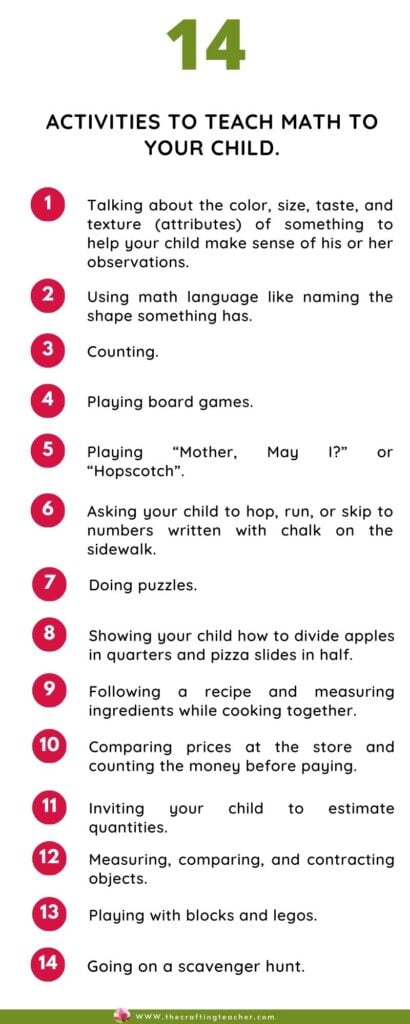
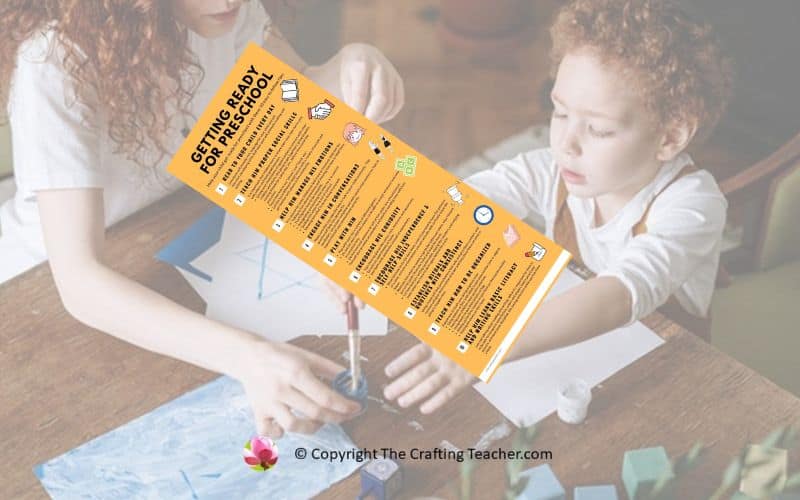
I’ve included a free infographic to help you remember the activities you can do with your child to help him or her learn math, which you can download at the end of this post.
Activities To Teach Math to Your Preschooler
Teaching math is not only about numbers and operations. Math also involves observing the world around them, solving problems, understanding one-to-one correspondence, learning shapes, classifying and ordering, comparing objects, recognizing and making patterns, measuring, understanding cause-and-effect situations, and following the sequence of events, among other things.
Kids learn best when they are having fun, when things are meaningful to them, and when they don’t feel stressed, forced, or frustrated. So, to teach math to preschoolers, integrate it into your daily life as naturally as possible. Below are some ideas that can help.
Help Your Child Make Sense of Observations
Your child constantly uses his or her senses to gather information about the world around him or her. Talk to your child about the color, size, taste, and texture of things (attributes) in a way your child can understand, for example:
- “These apples are red.”
- “Your brother is taller than you”.
- “These cookies are sweet, and these crackers are salty.”
- “Your new blanket is very soft.”
- “Touch this kitty. Its fur is so soft!”
That way, your child will learn vocabulary and understand what he or she is observing, as well as the similarities and differences between things.
Use Math Language
Make a habit of using math language in your daily life; it can be super simple and easy. When you use the name of any attribute, you’re using math language. In other words, use attributes when talking about something or someone, such as heavy, bigger, tall, short, square, round, light, etc.
Call attention to shapes in the environment, for example:
- “The door is rectangular”.
- “The moon is round like a circle.”
- “The window is square.”
Once your child recognizes 2D or simple shapes, you can start with 3D shapes, for example:
- “This can of vegetables is a cylinder.”
- “Your ball is a sphere.”
- “These letter blocks are cubes.”
Count With Your Child
Before a child can identify a written number, they need to learn the order of numbers by counting, starting with small amounts until they reach ten. Once a child masters the sum of ten, you can add more.
Remember that children learn by observation and repetition; therefore, use anything and everything you have in your house, the store, or on the street to count in front of your child, then help your child count, and finally let him or her do it alone. For example, you can count how many:
- Steps to go to the second floor.
- Crackers or cookies you are serving him or her for a snack.
- Jumping jacks or push-ups you or your child can do.
- Balls you can get into the basketball hoop.
- White cars you see on the way to the store.
- Eggs, cans, or any other items you have left in the pantry.
- Buttons his or her shirt has.
- Blocks he or she used to build a tower.
Once your child masters counting, you can start showing him or her how to add and subtract.
It is also a good idea to show your child what numbers look like, so he or she can start associating the name of the number with its shape when it’s written. One way to do this is to show your child the numbers you see in the environment.
Start with something simple, like a single number on a toy. When your child recognizes numbers from 0 to 9, you can start showing him or her two-digit numbers, such as house numbers or mile markers, before you move on to more complex numbers.
Play Math and Board Games Together
I remember growing up in my country and spending hours playing board games as a family. I did the same with my children, and now that they are grown, they still remember those quality times we spent together; they still love board games and plan to use them with their children.
Math and Board games are incredible teaching experiences where children learn and develop essential skills, such as logical reasoning, critical thinking, spatial awareness, number concepts, and social-emotional skills like taking turns and respecting others’ choices.
There are many board games, but today I would like to share a few examples you can use with your preschoolers. These are:
- Colorama. This matching game has different levels, reinforces pattern and shape recognition, and helps your child form connections at an early age. Players use dice to get a color and shape and must locate the correct spot on the board.
- Feed the Woozle. This silly but fun game has three levels for 2- to 5-year-old children. It teaches dexterity, fine motor skills, body awareness, and counting while they have fun and cooperate. They will also learn to take turns and build valuable social skills.
- Where’s Bear? This sweet game can be played by children 2 years old and up, and it combines two favorite activities- stacking blocks and finding hidden objects-into a match! Parents and kids take turns hiding and finding Bear under the sturdy nesting boxes. It helps children understand object permanence, build problem-solving skills, and learn spatial concepts like up, down, top, bottom, sorting, classifying, and matching. It also includes social skill development, numerous cognitive benefits, and can improve emotional well-being.
- Uno. Although this game is marketed for children aged seven and up, you can easily modify it for younger kids. I have used it with my children since they were very young, and they loved it (they still do!).
- Hoot, Owl, Hoot! In this color-coordinated matching game, players work together to help the owls fly back to their nest before the sun comes up. Kids will learn simple strategy, follow directions, take turns, build emotional development, practice shared decision-making, build positive self-esteem, develop creative problem-solving, and build a sense of community in a non-stressful play environment. The game has two levels of play, so it grows with your child and lets older kids play with younger ones.
- Shopping List Memory Game. In this game, children race around the shop against their friends to see who can collect all the groceries on the list first. It encourages observation, matching, memory, and personal and social skills.
- Rat-A-Tat-Cat is an excellent game for conversations about numbers. The idea is to have the lowest score when someone calls “Rat-a-tat-cat!” It helps children develop timing, basic mathematical concepts, strategy, memory, and addition.
- Monkey Around. This game contains 40 cards that prompt players to move together – from hugs to high fives to simple gross motor skills like balancing, hopping, and marching. It encourages children to learn gross motor skills, hand-eye coordination, imitation, vocabulary, and social-emotional skills through play.
- Zingo. This game is adaptable to players of all ages. It helps children develop literacy skills, such as vocabulary development and print awareness, and math skills, such as matching, through fun, fast-paced play.
- Dominoes is an age-old classic. It is designed for 2-5 players and encourages fine motor skills, hand-eye coordination, and number sense.
- Math For Love Tiny Polka Dot. This is an excellent combo of 16 easy-to-learn games with vibrant, colorful designs, and it will help your children fall in love with numbers while teaching them counting, arithmetic, and logic.
- Banana Blast. Players pull bananas from the treetop in this exciting game until the monkey jumps! It keeps kids engaged because every player gets a chance to catch the monkey, helping them practice reflexes and hand-to-eye coordination.
- Candyland. This classic board game for kids ages 3 and up lets them play alone as they race to the castle while encountering all kinds of “delicious” surprises. A great game for kids who haven’t learned to read yet.
- Pete the Cat: The Missing Cupcakes Game. This board game for children ages three and up promotes memory, creativity, participation, and cooperation. Players work together to find the missing cupcakes while singing, acting, and identifying objects in an interactive and dynamic experience.
- Frankie’s Food Truck Fiasco. This basic shapes matching game helps children build early math skills by identifying geometric shapes and developing fine motor skills as they use the squeezer to move the game pieces.
- Color Matching Pegboard is a creative playtime game that starts by matching and snapping the mushroom nails to the illustrated pattern cards to complete the picture. Then, you move on to creating unique designs using only the pegboard. This game develops your children’s fine motor skills, hand dexterity, color recognition, artistic senses, imagination, early patterning, and sequencing ability.
- Let’s Feed the Very Hungry Caterpillar is a fun game of counting, collecting, and puzzle-building that encourages decision-making and supports fine motor skill development.
Not all math games use cards, dice, boards, or spinners. You can also make up math games without even spending a dime, teaching your child the attributes, spatial words, and concepts. For example:
- Playing “Mother, May I?” or Hopscotch.
- Use chalk to write numbers on a driveway and challenge your child to run, hop, or skip to the correct number.
- Doing puzzles.
- Showing your child how to divide the apples into quarters and pizza slices into halves.
- Cooking with your child, showing him or her how to follow a recipe and measure the ingredients.
- When you go to the store, show your child how to compare prices before buying an item.
- Show your child how you count money when you pay for something.
- Do activities to help your child develop estimation skills and mathematical thinking in a fun and easy way, asking questions such as: How much lemonade do you think we need to make to fill this pitcher? How many pieces can we cut on this pie? How many M&Ms do you think a bag has?
- Measuring your child’s height by making a mark on the wall occasionally.
- Comparing and contrasting objects: “This blue tone is darker than this one”; “This table is lower than this one”; “This pineapple is smaller than this one”; “These two plates are the same size.”
- Playing blocks and Legos with your child and showing him or her how to build something.
- Going on a scavenger hunt. That’s math too!
Read Books with Math Concepts to Your Child
If you know me already, you might remember I’m big on using books to teach preschoolers pretty much everything. Books help children develop emotional literacy and offer incredible opportunities to learn concepts across all domains.
To help your child develop or improve their mathematical skills, you can use books that focus on concepts such as numbers, shapes, counting, spatial relationships, measuring, etc.
Below are some of my favorites. You can find them at your local library, used bookstore, and on Amazon. I’ve included my affiliate link in the title for a faster checkout if you want to purchase some.
- One Fish Two Fish Red Fish Blue Fish by Dr. Seuss. This brilliant book teaches mathematical concepts, from counting to opposites, using Dr. Seuss’s signature silly rhymes and colorful characters.
- Quack and Count by Keith Baker. With playful, rhyming text and bold collage illustrations, this story captures the excitement of a day’s adventures and gently introduces counting.
- The Counting Veggies by Dr. Paul Lee. With adorable characters and captivating illustrations, this story captures your child’s imagination as they discover numbers from one to ten in a delightful, interactive way.
- Bunny Money by Rosemary Wells. This adorable story is a fun, lively introduction to early math, featuring two bunnies trying to manage their money to buy a birthday present for their grandma.
- Ten Tiny Babies by Karen Katz uses rhyme, bright colors, and irresistibly adorable babies to help children learn how to count.
- Ellie’s Magical Math Adventure by Jon Paul is more than just a story; it’s a gateway to discovering the fun in learning. It teaches children that math isn’t just numbers on a page; it’s a part of the world and everyday life.
- Not Just Another Counting Book by Kay Mon Ray invites children to join two animal friends for an exhilarating day filled with counting, problem-solving, new friends, and madcap adventure.
- Dino Counting by Little Hippo Books. This interactive adventure features colorful illustrations and rhyming sentences. It introduces young children to dinosaurs and counting while helping them develop fine motor skills by moving the beads on the attached abacus.
- The Right Number of Elephants by Jeff Sheppard is a joyous twist on the counting-book concept, using well-executed illustrations and a contagious sense of movement.
- Chicka Chicka 1 2 3 by Bill Martin Jr. One hundred and one numbers climb the apple tree in this bright, rollicking, joyous book for young children, teaching them to count by ones and then by tens; more and more numbers clamber onto the tree’s branches.
- Big Book of Shapes by Wiley Blevins introduces simple shapes using the imaginations of two kids, where these shapes found in a box take on exciting new meanings.
- Actual Size by Steve Jenkins. This visually stunning picture book illustrates animals, both large and small, at actual size.
- Ten Sparkly Snowflakes by Tiger Tales invites young children to join the woodland animals as they get ready to play snowy games in this peek-through counting book, delighting them as the number of snowflakes decreases from 10 to 1 with each turn of the page.
- Five Little Apples by Yusuke Yonezu features math concepts, friendly, smiling animals, and a bold, bright, kid-friendly design. It is a perfect book to teach little ones to count backward and begin subtracting.
Pin It For Later
If you are in a rush and don’t have time to read the post and download the printable but want to save it, pin it to one of your Pinterest boards for later.
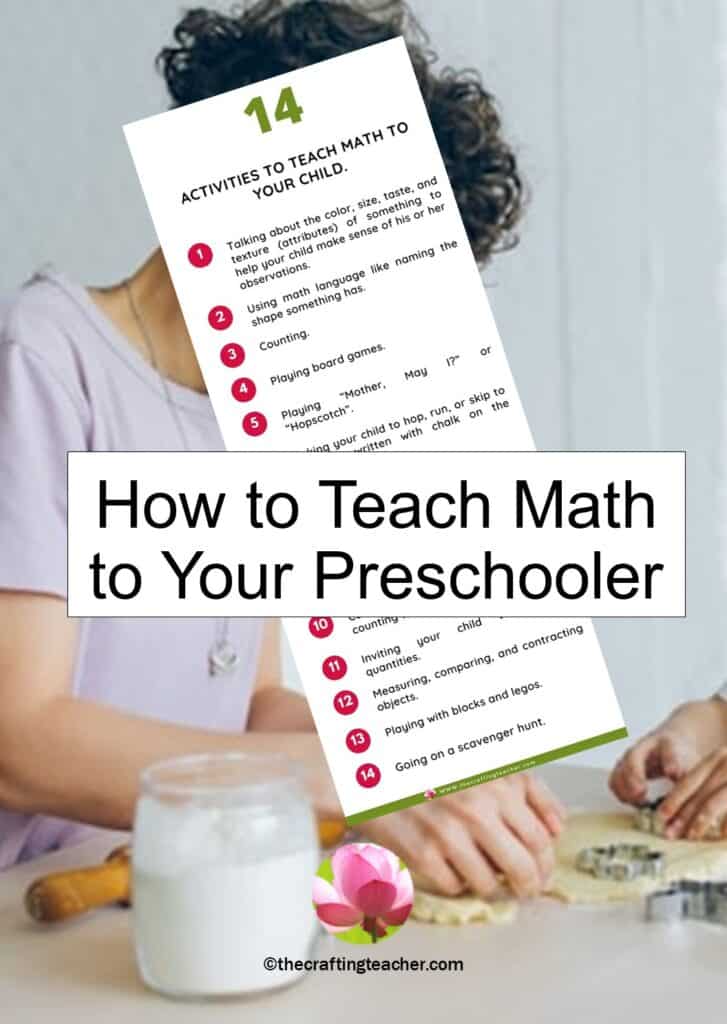
Remember to grab your free infographic. Click the link below and enter your information to download it immediately.
Again, don’t stress over this. We all know that it is impossible for a child to be right all the time when estimating or counting. You don’t necessarily need your child to be correct, but you must complete any activity or question you ask by showing your child the answer. That will help him or her start learning mathematical concepts.
In other words, pay attention every time you use math in your daily routine and show your child how you use it to help him or her develop awareness and math skills. Most importantly, stay positive and be patient. Learning takes time and practice. Give your child the time he or she needs. I promise it will significantly support your child’s development.
Be happy, safe, and creative. I wish you well.
Love,

P.S. If you would like an article on how to make something specific, please let me know, and I will do my best to write it for you. My goal is to help you however I can.
Other Posts You Might Like: