Affiliate Disclosure: “This post contains affiliate links, which means I receive a small commission, at no extra cost to you, if you make a purchase using those links.”
10 Best Tips to Get Your Child Ready for Preschool
When children start going to a childcare center during their toddler years, they learn essential skills that prepare them for preschool, such as potty training, socializing, and picking up their toys. However, not all children go to school, and not all parents have the time or know-how to help their children develop those essential skills before they are four.
Going to preschool marks a critical phase in your child’s development. In preschool, he will develop new skills, make new friends, and become more independent, which will help prepare him for a successful future in school. However, this transition is not always easy for the child (or his parents).
Sometimes, going to school or the “big classroom” can be scary, exciting, and even sad for both you and your child. However, a few simple things, like reading and playing games together, can help prepare your child for preschool and greatly affect how he reacts and behaves when he starts.
Don’t worry. It’s not complicated, and you probably do it already without even knowing.
How Can You Help Your Child?
Here are ten tips that will help you accomplish this goal:
1. Read to Your Child Every Day
I cannot stress how important this is! Have books in your living room, kitchen, his room, and purse everywhere! Let your child flip through the pages and pretend to read. Read books to him constantly, even the same ones. Ask him questions about the story so he can recall the events and reenact them; let him take books to the beach, the park, his grandparents’ house, or the library if you don’t have enough books at home. Good literature will provide rich language for your child and help him start developing skills that will later promote reading and writing.
Some of my favorite books for preschool are:
- The Kissing Hand by Audrey Penn. This heartwarming book has become a children’s classic that has touched the lives of millions of children and their parents, especially during separation, whether starting school, entering daycare, or going to camp. Kindergarten teachers widely use it on the first day of school.
- Llama Llama Misses Mama by Anna Dewdney. This sweet book talks about Llama Llama’s first day of preschool, and Llama Llama’s mama makes sure he’s ready. They meet the teachers, see the other children, and look at all the books and games, but then it’s time for Mama to leave. Llama Llama isn’t so excited anymore because he’s not sure Mama is coming back for him.
- Maisy Goes to Preschool by Lucy Cousins. In a bright, full-size storybook full of familiar scenes, this child-friendly look at a day in the life of a preschooler is one that both newcomers and seasoned pros will be happy to share.
- What to Expect at Preschool by Heidi Murkoff. With the help of Angus, the lovable Answer Dog, best-selling author Heidi Murkoff extends a hand to children and parents as they tackle life’s first experiences together.
- This Is How We Make Friends: For kids going to preschool by DK. This children’s book about making friends teaches important emotional skills like kindness and empathy so kids can make a best friend on their first day of school!
- Curious George First Day of School by H. A. Rey. This cute story talks about the first day of school when George is invited to Mr. Apple’s class to be a special helper. George is just the right monkey for the job until he starts to cause his usual mischief.
2. Teach Your Child Proper Social Skills
Children must learn to share their toys, take turns, play with others, and have good manners. This will go a long way toward a successful start to their journey.
A good way to do that is by:
- Before he enters preschool, give your child plenty of opportunities to interact with other children and adults, like going to get-togethers, going to parks, inviting friends for a play day, etc.
- Teach him to say“please” and “thank you.”
- Give him different experiences with various people and help him get familiar with places in his community.
4. Help Your Child Manage Her Emotions
It is natural for some children to feel scared or insecure when they start classes in a new school or classroom. They don’t know what to expect or what will happen, but it helps when they know how to manage those emotions before they start preschool. You can help your child learn this skill by:
- Talk to your child about emotions or feelings he might be experiencing to show him how to label these emotions; for example, “You are crying. I understand you are sad because I didn’t let you eat ice cream. You will eat it after dinner.”
- Teaching him how to recognize how others might be feeling and be empathic to them, for example: “Look, your friend is sad because her new toy broke. Why don’t you play with her for a while? You will make her feel so happy if you do that”.
- Recognizing and praising him when he is in control, for example: “You have your listening ears on, and you are behaving well here at the store. I am very proud of you!”
- Guiding him when he is out of control. For example, if he is having a temper tantrum or crying hard. Help him by being very calm yourself, and then you can tell him, “Breathe, sweetie. Everything is going to be okay. You are safe. I am with you,” or something like that.
- Show your child what to do by doing it yourself. Children are like little sponges that absorb everything around them. If you are out of control, constantly crying, screaming, or something like that, that is precisely what you will teach your child. You are teaching him to respond emotionally by staying in control of yourself.
4. Engage Your Child in Conversations.
Make sure you take time to talk to your child regularly. This practice will help him build his vocabulary, use proper, complete, well-constructed sentences, and learn to express himself clearly. Another thing you can do is ask your child open-ended questions to promote his thinking process and reinforce his curiosity; for example, you can ask him questions like:
- What are you building?
- Why do you think the sky is blue?
- How will you make that tower bigger?
- Where do you think that butterfly is going?
Another type of statement you can use is the “I wonder why….” For example:
- I wonder what will happen if you mix those two colors.
- I wonder how to make homemade bubbles.
- I wonder how I can make this piece of bread smaller.
It sounds silly, but it’s also very powerful, and it will help your child tremendously.
5. Play with Your Child
Preschool children cannot sit down to learn something like older kids. They need to feel (and think) they are playing, and it will also promote excellent, positive bonding time with him.
- Play a variety of games with your child. It doesn’t matter what you play (a board game, catching balls, building with Legos or blocks, doing puzzles, playing with dolls, etc.) as long as you do it often and make it fun.
- Do not always let your child win. He needs to understand that he will not always win in order to accept any outcome positively.
- Do not lose your patience or yell at him under any circumstances. Remember, it should be a fun, encouraging activity. You want him to feel reassured, not insecure.
6. Encourage Your Child’s Curiosity
Children are naturally curious about their environment and what is happening around them. Fuel this eagerness to learn and encourage his creativity, because children learn by asking questions, experiencing new things, and having teachable moments whenever they can.
You can help your child tremendously and very easily, just by taking the time to be present in his life and have lots of quality time with him.
Some of the things you can do are:
- Take him to places like parks, zoos, museums, and aquariums. Talk to him about what he sees and answer all his questions. Point to specific items like a beetle in the park. Teach her that a beetle is an insect with six legs and three body parts, for example.
- Do simple science experiments at home. Here are some you can use.
- Use flashcards and books instead of worksheets.
7. Encourage Your Child’s Independence and Self-Help Skills
I understand that you might still see your child as your baby and want to do everything for him, but he mustn’t rely on you for everything. An independent child who knows how to take care of his personal needs will do much better at preschool than one who doesn’t.
Some things that you can do to help him are:
- Show him how to tie his shoes, even if you need to have the patience of a saint and extra time before you can finally leave the house.
- Motivate him to go to the bathroom alone, wipe himself, put on his pants, flush the toilet, and wash his hands.
- Let him help you set up the table, wipe the counters, and sweep (even when you have to do it again behind his back).
If you would like more information on ways to support self-help skills in children of all ages, here is a giant list you might find useful.
8. Establish Rituals and Routines with Consistency
Many children do not respond well to change and sometimes react negatively with temper tantrums, crying, or aggression. Rituals help preschoolers feel safe and comforted, and routines give them a sense of order and help them focus on what will happen next.
Since preschool is a more structured environment with schedules and regular practices or routines used every day, putting rituals and routines in place at home will help your child get used to this practice and make her transition smoother.
- Play a game, and then have a special hug or handshake when you finish.
- Read a book every night and then sing a good night song.
- Prepare the table for your meals, and let him help you clean up afterward.
- Say “I Love You” or kiss your hand and put it on her heart when saying goodbye.
Some routines are:
- Eating at the table.
- Letting her self-serve her food.
- Putting the leftovers in the trash can.
- Washing her hands before and after eating and going to the bathroom.
- Going to bed at the same time every night.
- Brushing her teeth after every meal.
It is also important that you practice this EVERY DAY. Consistency is the key. These rituals and routines need to be done every day to be effective. Remember, your child needs stability to feel secure and loved, and this is a great way to help him feel that.
If you want more information about rituals and routines, you might want to read a wonderful book called “I Love You Rituals” by Dr. Becky A. Bailey.
9. Teach Your Child How to Be Organized
One preschool practice is picking up toys before children change areas, and if a child isn’t used to it, he might have a hard time adjusting to the routine. A good way to teach your child organization is by:
- Using labeled baskets or bins to put away similar toys or objects.
- Having your children clean up after playtime.
- Using hooks to put their jackets or bags.
- Picking up her dirty clothes and putting them in the laundry basket.
- Putting her shoes in the closet.
Make sure you do not make him feel like you’re punishing him. Make it fun. Like a game. You can use a little song to encourage him, like this one.
10. Help Your Child Learn Basic Literacy and Writing Skills
No, I am not talking about reading and writing. It is not age-appropriate, and he will learn it in time. Your child needs to recognize some letters, colors, and shapes; hold a pencil and scissors; and have some discipline, like paying attention while you read him a book.
Some ways you can help your child develop readiness in this area are:
- Introduce him to some letters during your routine. For example, you can say: “Look, this is an /m/. Your name is Matt. It starts with /m/”, or “This is your toy car. Car starts with /c/.”
- You can do the same with the colors, for example: “Here is your red apple for a snack” or “Your yellow duck is in your bathtub”.
- And the same applies to shapes, for example: “Look, the window is a square”, “The door is a rectangle”, or “Your Oreo cookie is a circle“.
- Read him a book every day, ask him questions about the story you just read, and invite him to recall the events in the story. I cannot stress how important this is. Books will not only help your child develop his imagination but also his reading and writing skills.
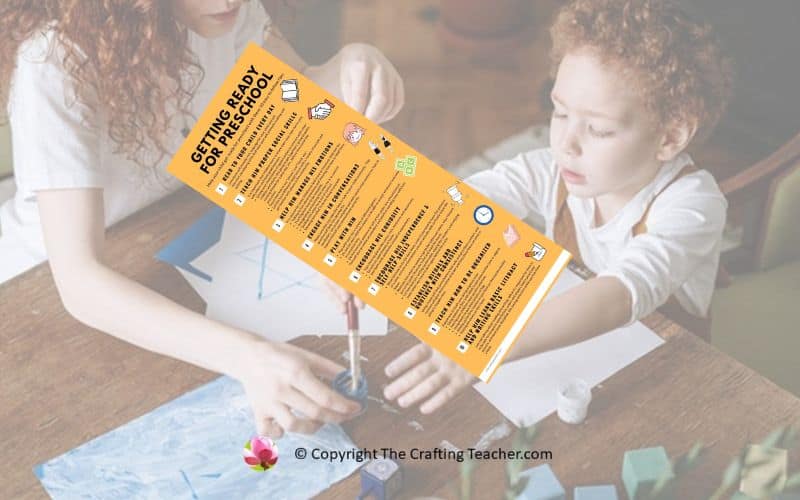
Here is an infographic that will help you remember these suggestions.
The Last Thing You Need to Know
There is no magic wand to help your child develop these skills from one moment to the next. Children need constant repetition. Practice, practice, practice all the time. Be consistent, patient, assertive, loving, and caring all the time.
I know it is hard sometimes when you have a hard day at work, are stressed out, or are mad at your spouse. I get it. I have been in your shoes, and it is not easy. Being a good parent may be one of the hardest jobs you will ever have, and it comes with more responsibilities, but it is so worth it.
Remember that you are your child’s first teacher. What he learns and the skills he develops at home will not only help him prepare better for preschool but, most importantly, give him the foundation to be a great adult in the future.
You are the best example your child will ever have. Live by what you want him to learn and do. Don’t ask him to do something you aren’t showing him in your personal life.
The seeds you plant in your child’s early years of existence will help him grow into a strong, happy, and successful adult, and there is nothing more important than seeing the fruits of your hard work at the end.
One of my favorite quotes is from Frederick Douglass: “It’s easier to build a child than to repair an adult.” Please accept this gift as a reminder of that.
I know you are going to be okay. You are already a very good mom and can be a great one. Please let me know if you need any more ideas or resources. I will gladly help you in any way I can.
Be happy, safe, and creative. I wish you well.
Love,

P.S. Please let me know if any of these resources were useful, or if you came up with something different. I would love to hear from you.
Other Posts You Might Like: