Feathers for Lunch Story-related Science Pack for Preschoolers
Affiliate Disclosure: “This post contains affiliate links, which means I receive a small commission, at no extra cost to you, if you make a purchase using those links.”
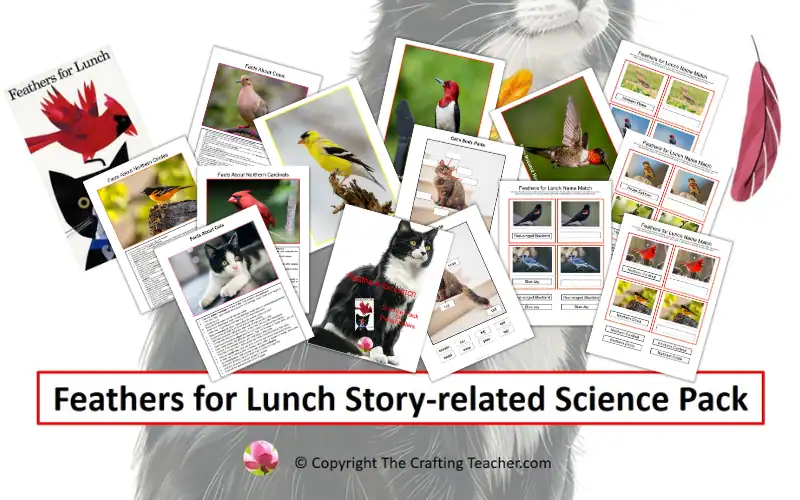
Feathers for Lunch by Lois Ehlert tells the story of a cat that goes out to the backyard, featuring labeled flora like geraniums, apple tree branches, lilac bushes, and Rembrandt tulips, and introduces the children to 12 common North American backyard birds.
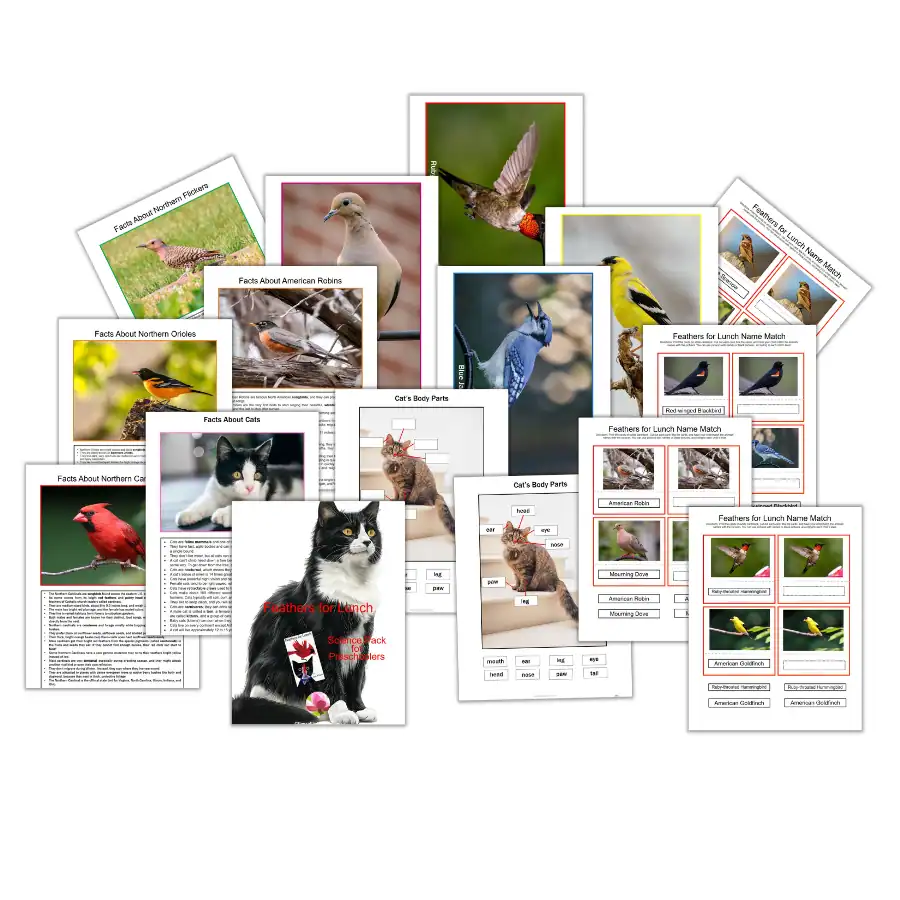
This FREE 34-page Feathers for Lunch Story-related Science Pack will help you teach them backyard physics and animal behaviors, with a focus on observation and discovery. You can download it at the end of this post.
Feathers for Lunch Science Pack
You can use science to teach across all domains because it easily relates to literacy, math, and art. That is why it is important to encourage your children to ask questions, observe various natural phenomena, experiment, and explore.
Using storybooks to teach science to preschoolers is an excellent way to help them discover the world around them and learn why and how things happen, using their own natural curiosity to encourage them and help them develop their scientific thinking through fun, interactive activities.
This pack will help preschoolers develop important skills such as:
- Build a Positive Connection to Science: Helping them use their interest in exploration and experimentation.
- Stimulate their Scientific Thinking: To help them make sense of the world around them, why things happen, and how they work.
- Vocabulary Development: Using scientific words and recognizing characteristics and differences between the different bird species.
- Social Skills: Working cooperatively helps them develop their communication, teamwork, and cooperation.
- Reasoning and problem-solving skills: Understanding what happens and how to solve it helps preschoolers learn to resolve situations and conflicts.
This story can serve as a basis for many science activities. Below are some I like to use.
Knowledge Review
Display the animals’ photos included in the pack.
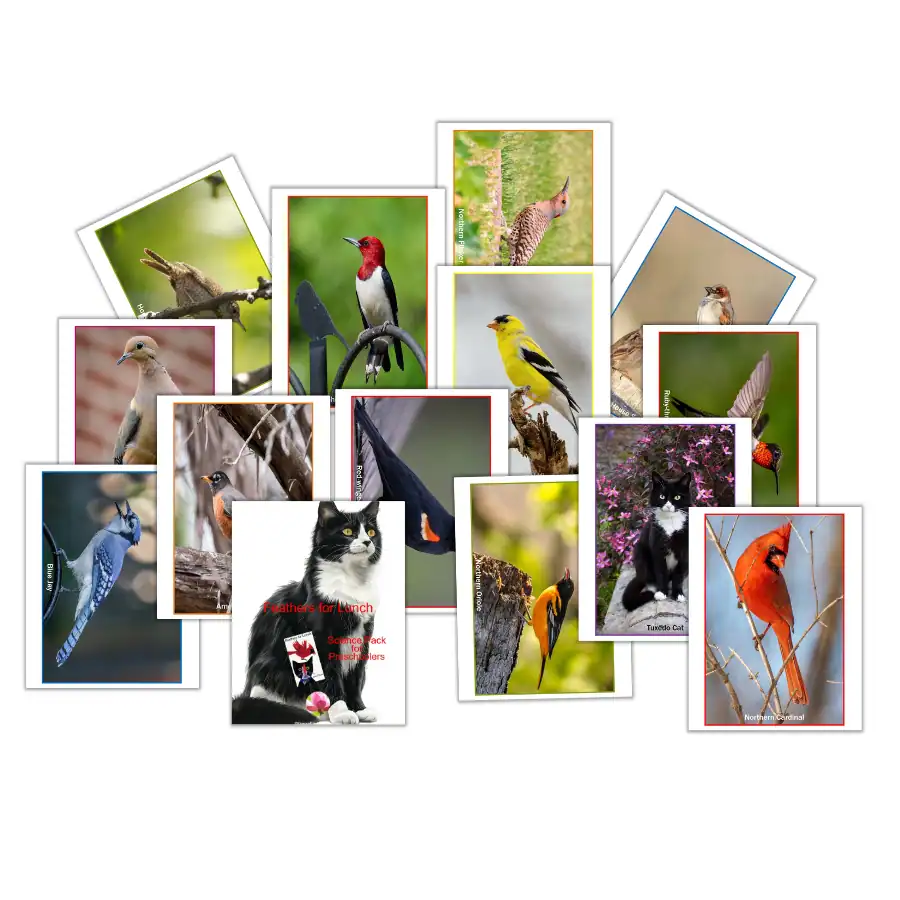
Invite the children to tell what they know about cats and birds by asking questions such as:
- Have you ever heard a bird sing or make any type of sound?
- Can you imitate a sound you heard a bird make?
- Why do you think different birds make different sounds?
- What can birds do that cats cannot?
Accept all comments, promote discussion, write the responses on chart paper, and review them later.
Explain Facts About the Animals in the Story
Introduce each animal at a time, showing the children the picture of the animal you are introducing. This pack includes a card for each animal to help you remember some of the most important facts.
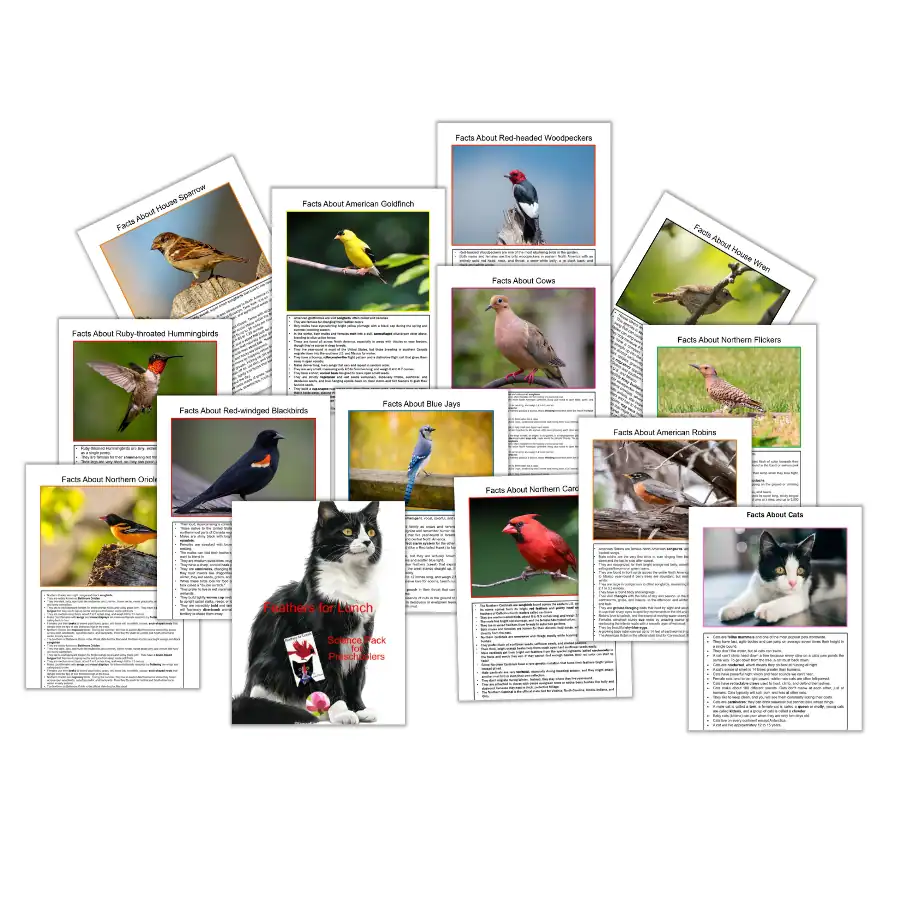
Discuss some of the characteristics, behaviors, species, and other important facts of each of the animals. Help them understand the different ones and distinguish between them.
You can also show them videos to help them see how those animals act and sound.
Cats
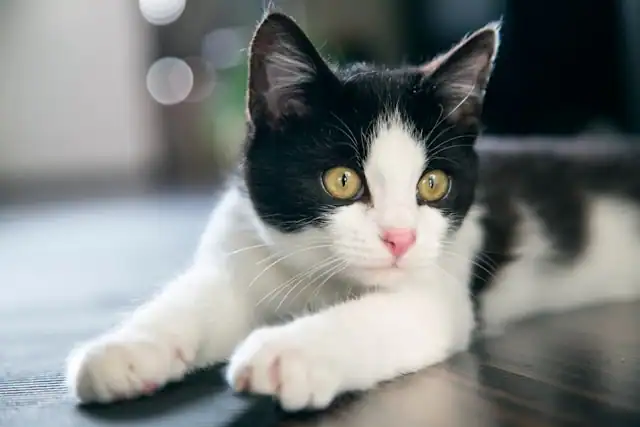
- Cats are feline mammals and one of the most popular pets worldwide.
- They have fast, agile bodies and can jump on average seven times their height in a single bound.
- They don’t like water, but all cats can swim.
- A cat can’t climb head down a tree because every claw on a cat’s paw points the same way. To get down, a cat must back down.
- Cats are nocturnal, which means they hunt best at night.
- A cat’s sense of smell is 14 times greater than humans’.
- Cats have powerful night vision and can hear sounds we can’t.
- Female cats tend to be right-pawed, while male cats are often left-pawed.
- Cats have retractable claws used to hunt, climb, and defend themselves.
- Cats make about 100 different sounds. Cats don’t meow at each other, just at humans. Cats typically spit, purr, and hiss at other cats.
- They like to keep clean, and you will see them constantly licking their coats.
- Cats are carnivores; they can drink seawater but cannot taste sweet things.
- A male cat is called a tom, a female cat is called a queen or molly, young cats are called kittens, and a group of cats is called a clowder.
- Baby cats (kittens) can purr when they are only two days old.
- Cats live on every continent except Antarctica.
- A cat lives about 12 to 15 years.
Northern Cardinals
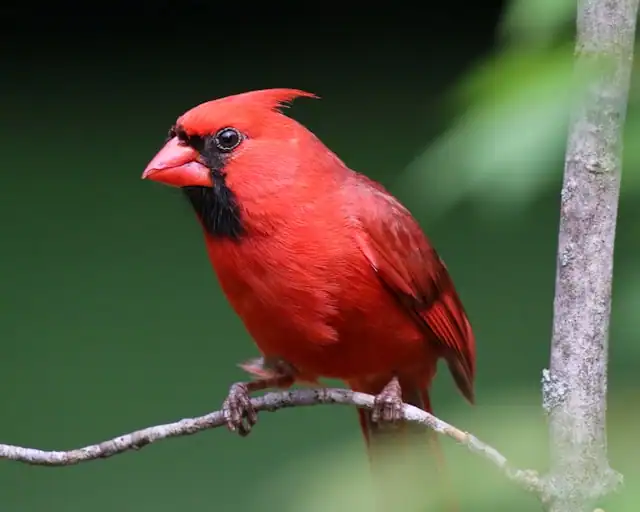
- Northern Cardinals are songbirds found across the eastern U.S. and Mexico.
- Their name comes from their bright red feathers and pointy head crests that resemble the feathers of Catholic church leaders called cardinals.
- They are medium-sized birds, about 8 to 9.3 inches long, and weigh 1.2 to 2.3 ounces.
- The male has bright red plumage, and the female has muted colors.
- They live in varied habitats from forests to suburban gardens.
- Both males and females are known for their distinct, loud songs, with females often singing directly from the nest.
- Northern cardinals are omnivores and mostly forage by hopping on the ground or in low bushes.
- They prefer black oil sunflower seeds, safflower seeds, and shelled peanuts.
- Their thick, bright orange beaks help them crack open hard sunflower seeds easily.
- Male cardinals get their bright red feathers from the special pigments (called carotenoids) in the fruits and seeds they eat. If they cannot find enough berries, their red color can start to fade!
- Some Northern Cardinals have a rare genetic mutation that turns their feathers bright yellow instead of red.
- Male cardinals are very territorial, especially during breeding season, and they might attack another rival bird or even their own reflection.
- They don’t migrate during Winter. Instead, they stay where they live year-round.
- They are attracted to places with dense evergreen trees or native berry bushes like holly and dogwood, because they nest in thick, protective foliage.
- The Northern Cardinal is the official state bird for Virginia, North Carolina, Illinois, Indiana, and Ohio.
Northern Orioles
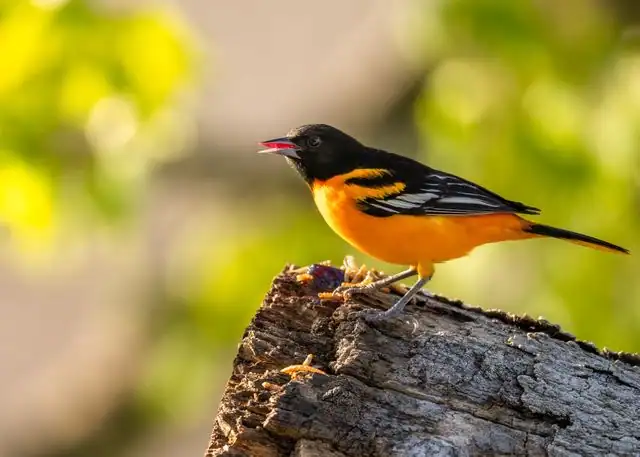
- Northern Orioles are bright orange-and-black songbirds.
- They are widely known as Baltimore Orioles.
- They love dark, juicy, ripe fruits like mulberries and cherries, flower nectar, sweet grape jelly, and insects like hairy and spiny caterpillars.
- They like to visit backyard feeders for bright orange slices and sticky grape jelly. They have a brush-tipped tongue that they use to lap up nectar and juice from deep inside soft fruits.
- They are medium-sized birds, about 7 to 8 inches long, and weigh 0.8 to 1.5 ounces.
- Males court females with songs and visual displays. An interested female responds by fluttering her wings and calling back.
- Females use their beaks to weave plant fibers, grass, and twine into incredible, unique, sock-shaped nests that dangle from the tips of tree branches high in the trees.
- Northern Orioles are migratory birds. During the summer, they live in eastern North America where they breed across open woodlands, suburban parks, and backyards. Then they fly south to Central and South America to winter in early autumn.
- The Northern or Baltimore Oriole is the official state bird of Maryland.
Red-winged Blackbirds
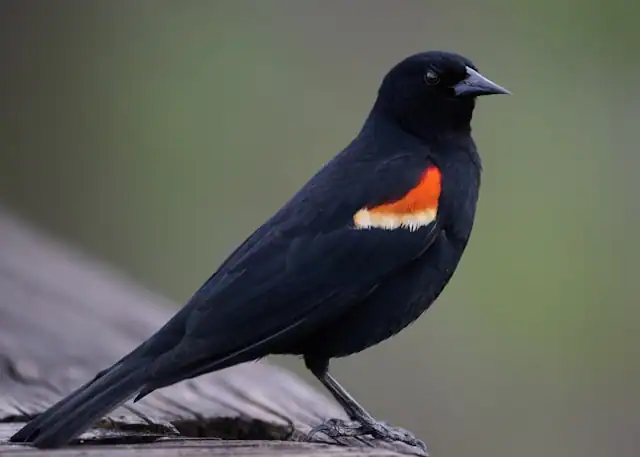
- Red-winged Blackbirds are one of the most abundant and recognizable songbirds in North America.
- Their loud, musical song is considered one of the very first signs that spring has arrived.
- Those native to the United States live year-round in their territory, but those in the northernmost parts of Canada migrate to the U.S. and Mexico for the winter.
- Males are shiny black with bright red and yellow patches on their shoulders called epaulets.
- Females are streaked with brown and white, which helps them camouflage while nesting.
- The males can fold their feathers over the epaulets to hide the red completely if they want to blend in.
- They are medium-sized birds, roughly 7 to 9.5 inches long, and weigh 1.1 to 2.7 ounces.
- They have a sharp, conical beak perfect for cracking seeds.
- They are omnivores, changing their diet with the seasons. In the spring and summer, they hunt insects like dragonflies, beetles, caterpillars, and spiders. In the fall and winter, they eat seeds, grains, and agricultural weeds.
- When these birds look for food on the ground, they can do a special backward-hop trick called a “double scratch.”
- They prefer to live in wet marshlands and wide-open spaces with tall grasses that mimic wetlands.
- They build tightly woven cup nests made of grasses, mud, and weeds, usually attached to upright cattail stalks, reeds, or low bushes just a few feet above water.
- They are incredibly bold and territorial, especially during nesting season, and males will fearlessly dive-bomb animals and humans that get too close to their nesting territory to chase them away.
Blue Jays
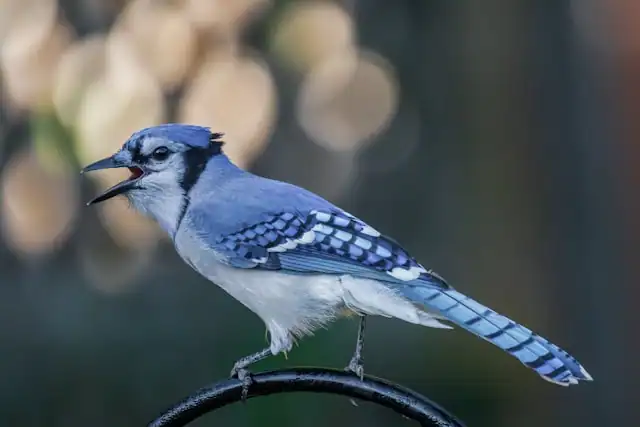
- Blue Jays are one of the most intelligent, vocal, colorful, and easily recognized North American songbirds.
- They belong to the same bird family as crows and ravens (corvids), are genius problem-solvers, and can recognize and remember human faces.
- They are non-migratory birds that live year-round in forests, parks, and suburban backyards throughout eastern and central North America.
- They are very loud and serve as the perfect alarm system for other birds in the garden.
- They can imitate other birds’ sounds (like a Red-tailed Hawk) to fool other birds and scare them away from food.
- Their feathers look bright blue, but they are actually brown. They look blue only because tiny air pockets bounce and scatter blue light.
- Their heads have prominent blue feathers (crest) that express their mood. When they are excited or aggressive, the crest stands straight up. If they are frightened or resting, the crest flattens completely.
- They are fairly large, typically 9 to 12 inches long, and weigh 2.5 to 3.5 ounces.
- They are omnivores with a massive love for acorns, beech nuts, peanuts, seeds, and insects.
- They have a special stretchy pouch in their throat that can hold up to a hundred seeds or multiple acorns at a time.
- They are famous for hiding thousands of nuts in the ground to store for winter. They build bulky, cup-shaped nests in deciduous or evergreen trees from twigs, roots, and bark, often held together with mud.
American Robins
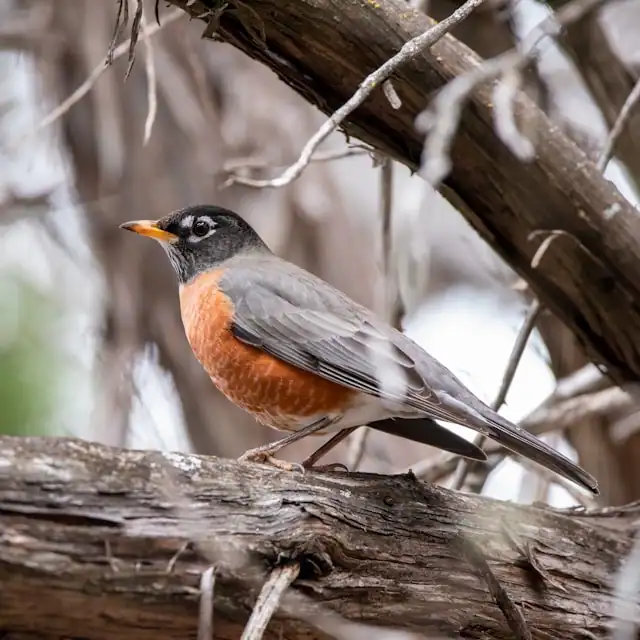
- American Robins are famous North American songbirds, and they can produce one of the loudest songs.
- Male robins are the very first birds to start singing their beautiful, whistling song before dawn and the last to stop after sunset.
- They are recognized for their bright orange-red belly, cheerful morning song, and love for eating earthworms on green lawns.
- They are found in front yards across North America, from Alaska to Mexico, year-round if berry trees are abundant, but many flocks migrate south in winter.
- They are large compared to other songbirds, measuring 8 to 11 inches long and weighing 2.1 to 3.3 ounces.
- They have a round body and long legs.
- Their diet changes with the time of day and season. In the morning, they search lawns for earthworms, grubs, and insects. In the afternoon and winter months, they eat wild berries and fruit.
- They are ground-foraging birds that hunt by sight and sound, tilting their heads sideways to use their sharp eyes to spot tiny movements in the dirt and hopping in quick little bursts.
- Robins love to splash, and the sound of moving water quickly draws them in.
- Females construct sturdy cup nests by weaving coarse grass and twigs together, and reinforcing the interior walls with a smooth layer of wet mud.
- They lay beautiful sky-blue eggs.
- A growing baby robin can eat up to 14 feet of earthworms in just one single day.
- The American Robin is the official state bird for Connecticut, Michigan, and Wisconsin.
Mourning Doves
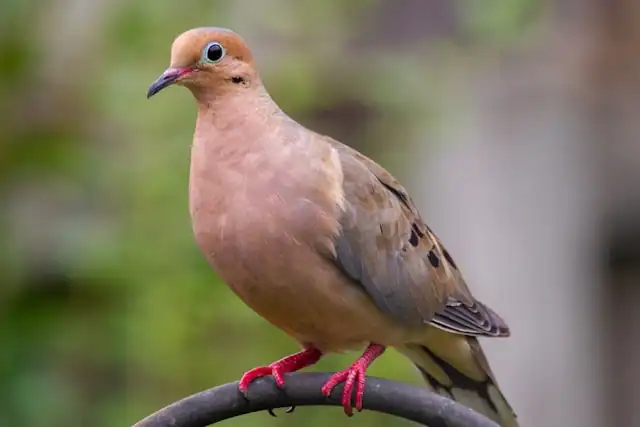
- Mourning Doves are among the most peaceful and widespread songbirds.
- Their name comes from their sad, soft cooing sound, often mistaken for a nocturnal owl’s hooting.
- They are native and abundant across North America, living year-round in open fields, parks, and suburban backyards.
- They are medium-to-large birds, measuring 9 to 13 inches long, and weigh 3.4 to 6.0 ounces.
- They have a sleek, slender body and a long, tapered tail.
- When startled and taking off suddenly, their wing feathers produce a distinct, sharp whistling sound that alerts the rest of the flock to danger.
- They can fly up to 55 miles per hour.
- They have a water-slurping beak that allows them to drink water like a straw.
- They eat seeds from grasses, weeds, and agricultural crops, swallowing seeds whole and storing them in an internal pouch (called a crop) to digest later in a safe location.
- They also swallow tiny sand and small stones (grit) to help crush and digest hard seeds.
- They are monogamous, forming strong pairs that stay together for life and are often seen grooming each other and traveling side by side.
- They build notoriously flimsy, loose nests from a few twigs in trees, on ledges, in old gutters, or in hanging flower pots.
- Both parents feed their babies a special yogurt-like liquid called crop milk, made inside the parents’ throats.
Ruby-throated Hummingbirds
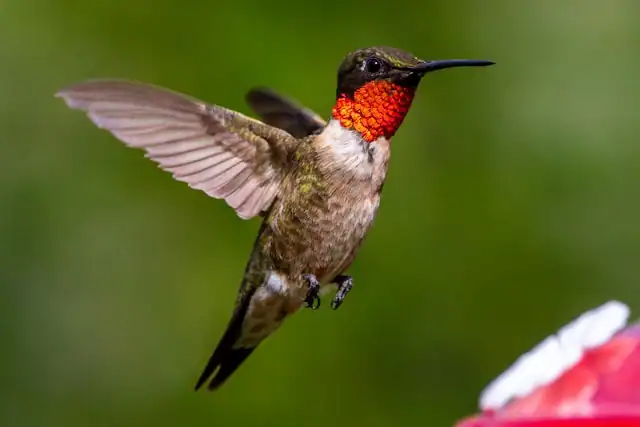
- Ruby-throated Hummingbirds are tiny, extremely fast birds that weigh as much as a single penny.
- They are famous for their shimmering red throat.
- Their legs are very short, so they can perch on branches, but they cannot walk or hop.
- They can flap their wings up to 53 times a second and can fly backward and upside down.
- They can freeze in mid-air by beating their wings in a circular shape.
- They are about 2.8 to 3.5 inches long and weigh 0.1 to 0.2 ounces.
- They primarily feed by sucking sweet nectar from tubular garden flowers with their long, needle-like beak and stretchy tongue, which licks like a tiny straw. They also eat tiny spiders and insects, such as flies, for essential protein.
- They eat up to twice their own body weight in food every single day to stay energized.
- Females build a tiny, walnut-sized, cup-shaped nest and camouflage it with green lichens and spider webs to look like a natural knot on a tree branch.
- At night, they enter a deep, heavy sleep called torpor to save energy, dropping their heart rate.
- They are commonly found throughout eastern North America during the spring and summer breeding seasons, and migrate south for the winter, flying over 500 miles of the ocean without stopping.
American Goldfinch
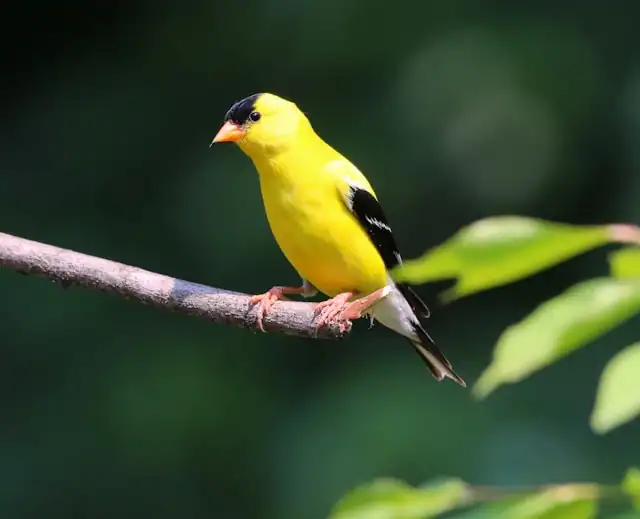
- American goldfinches are wild songbirds, often called wild canaries.
- They are famous for changing their feather colors.
- Only males have eye-catching bright yellow plumage with a black cap during the spring and summer breeding season.
- In the winter, both males and females molt into a dull, camouflaged olive-brown color above, blending to olive yellow below.
- These are found all across North America, especially in areas with thistles or near feeders, though they’re scarce in deep forests.
- They live year-round in most of the United States, but those breeding in southern Canada migrate down into the southern U.S. and Mexico for winter.
- They have a bouncy, rollercoaster-like flight pattern and a distinctive flight call that gives them away in open country.
- Males deliver long, lively songs that vary and repeat in random order.
- They are very small, measuring only 4.5 to 5 inches long, and weigh 0.4 to 0.7 ounces.
- They have a short, conical beak designed to crack open small seeds.
- They are strictly vegetarian and eat seeds exclusively, especially thistle, sunflower, and dandelion seeds, and love hanging upside down on plant stems and bird feeders to grab their favorite seeds.
- They build a cup-shaped nest woven with plant fibers, spider webs, and thistle down so tightly that it holds water, placing them securely in the forks of twigs in bushes or trees.
- They are among the latest-nesting birds in North America. They intentionally wait until July or August to lay eggs because they rely on the peak summer harvest of thistle and milkweed plants to feed their young.
- The American Goldfinch is the official state bird for New Jersey, Iowa, and Washington.
House Sparrows
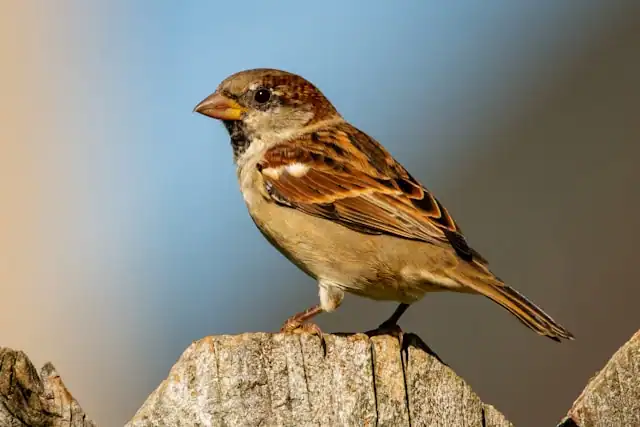
- House Sparrows are tiny, highly social, super smart songbirds that love to live near people.
- This species is native to Europe and Asia. It was introduced to North America in 1851, when 100 sparrows were brought from England to Brooklyn, New York. It is so adaptable that it can now be found in urban, suburban, and agricultural areas on almost every continent.
- Males have a distinct black bib on their throats and chests. Those with larger, darker black bibs are more dominant and hold higher social status within the flock.
- They flap their wings 15 times every second and fly up to 28 miles per hour.
- They are about 5 to 6.5 inches long and weigh 0.85 to 1.39 ounces.
- They have a full chest, a large rounded head, and a stout bill built for cracking seeds.
- They are scavengers and opportunistic eaters that naturally prefer grains, weed seeds, and livestock feed that their stout bill cracks easily. However, they also frequently eat discarded scraps, crumbs, and backyard birdseed.
- When they are on the ground, sparrows move by hopping rather than walking.
- They take dust baths, usually in small groups, kicking up dirt with their wings and flinging dust over their feathers to clean off oil, old skin, and parasites.
- They travel, forage, and nest in noisy, tightly knit flocks that keep up a continuous, rhythmic chirping sound throughout the day.
- They build messy, dome-shaped nests made of grass, feathers, strings, and paper scraps in cavities in building crevices, streetlamps, roofs, old pipes, and nesting boxes meant for other birds.
House Wrens
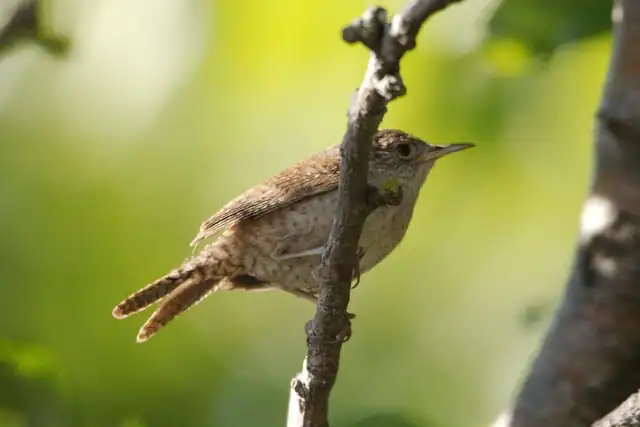
- House Wrens are small, fiercely energetic songbirds.
- This species is very vocal, with a long, rushed, easily recognizable, and pleasant song that can easily be heard from across an entire neighborhood block.
- Males can sing over 600 bubbly songs in a single hour.
- They measure only 4 to 5 inches long and weigh 0.3 to 0.4 ounces.
- They have a compact, brownish body and a short tail that they characteristically cocks straight up into the air.
- They are almost exclusively insectivores and eat large numbers of beetles, caterpillars, spiders, grasshoppers, and snails.
- They are migratory, spending the summer breeding season across the United States and southern Canada and migrating south to spend the winter in the southern U.S. and Mexico.
- Males are incredibly busy builders and claim multiple nesting cavities in hollow tree branches, old woodpecker holes, backyard nest boxes, old boots, tin cans, flower pots, or mailbox crevices, where they build multiple nests with hundreds of twigs. When a female arrives, she inspects the nests, chooses her favorite one, and lines it with feathers and hair to finish it.
- Sometimes they put spider egg sacs inside their nests. When the tiny spiders hatch, they eat little bugs that might hurt the baby wrens.
- They are intensely territorial and will boldly evict larger birds poking holes in their eggs to keep them out of their territory.
Northern Flickers
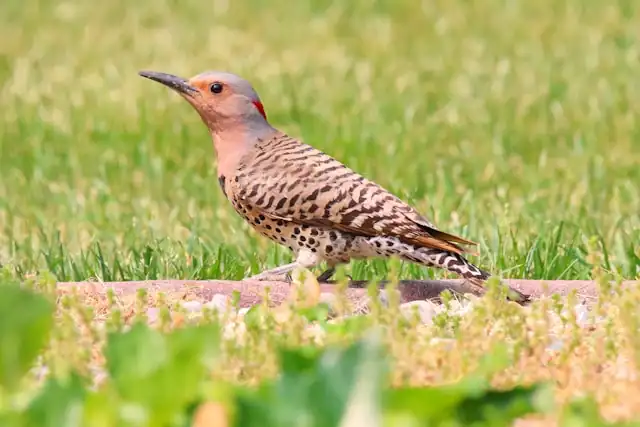
- Northern Flickers are one of the most unusual and striking birds.
- They have a spotted belly.
- Depending on the species, when they fly, they reveal a brilliant flash of color beneath their wings that could be bright yellow (the “Yellow-shafted” flicker found in the East) or salmon pink (the “Red-shafted” flicker found in the West).
- They also feature a stark, highly visible bright white patch on their rump when they take flight, serving as a visual alarm to other nearby birds.
- Male have a black stripe on their face that looks like a little mustache.
- Unlike most woodpeckers, they spend most of their time hopping on the ground or climbing tree trunks to hunt.
- Their favorite food is ants, but they also eat beetles, wild berries, and seeds.
- Each flicker uses its strong beak to dig into the soil, then extends its super-long, sticky tongue that can reach two inches past its beak to slurp up hundreds of ants at a time, and up to 5,000 in a single day.
- Sometimes they let live ants crawl on their feathers to help keep their skin and feathers clean.
- They are large, robust birds, measuring roughly 11 to 14 inches long and weighing 3.9 to 5.6 ounces.
- To nest, they use their heavy beaks to chisel deep nesting holes in dead or decaying tree trunks.
- They are found across almost all of North America. Those living in warmer states stay year-round, but those in the northern forests of Canada migrate south for the winter.
- They mark their territory by drumming rapidly against hard surfaces as loudly as possible, often using metal objects like street signs, metal roofs, or chimney caps.
Red-headed Woodpeckers
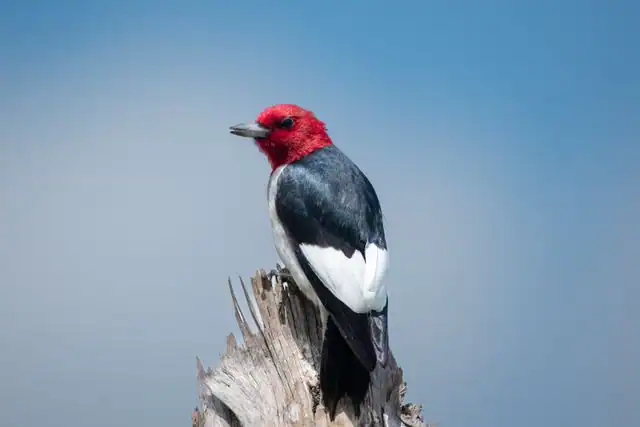
- Red-headed Woodpeckers are one of the most stunning birds in the garden.
- Both males and females are the only woodpeckers in eastern North America with an entirely solid red head, neck, and throat; a snow-white belly; a jet-black back; and black-and-white wings.
- Because of its remarkable colors, early American settlers called this species the “Flag Bird,” as its pattern resembled a flying banner or flag.
- They are medium-sized, measuring roughly 7.5 to 10 inches long, and weighing 2 to 3.4 ounces.
- They peck at tree bark for beetles and ants, and also fly out into mid-air to catch flying insects with their strong, chisel-like bill. They also eat large amounts of acorns, beech nuts, fruits, and seeds.
- They are one of the only woodpecker species known to store and hide food for the winter in deep cracks in tree bark, under roof shingles, or inside fence posts, often covering the hiding spots, called caches, with pieces of wood to hide them from other animals.
- Because they forget where they hide some of their stored acorns and seeds, those seeds grow into brand-new trees.
- They chisel out their nesting holes deep inside dead trees, decaying branches, or telephone poles.
- Chicks are born with brownish-gray heads and keep them until they grow to about one year old.
- They are found throughout the central and eastern United States. Birds in the northernmost states will migrate a short distance south for the winter depending on the availability of acorns and nuts.
Matching Animal Names
This pack also includes a set of cards to match the animal names with their pictures in two versions: one with the names and another blank, so you can choose based on your children’s level.
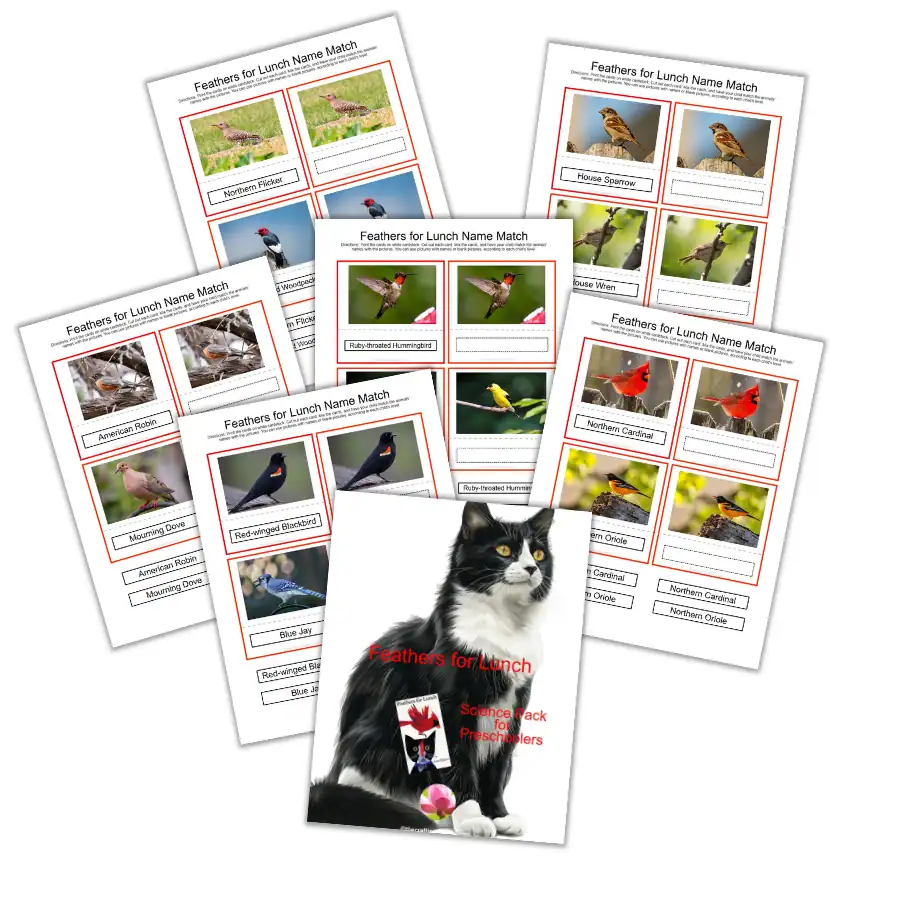
Matching animal names has several benefits for preschoolers, like:
- Improve Language: Learning animal names adds vocabulary and helps children link words to pictures.
- Memory Development: Children improve their focus, attention to detail, and recall by connecting animal names with their pictures.
- Problem Solving Skills: Matching pictures with animal names builds critical and logical thinking.
- Visual and Fine Motor Skills: To match the names with the correct pictures, they have to spot differences, and placing the cards together helps strengthen the small muscles in their hands and fingers, which will help them read and write later.
Matching the Cat’s Body Parts
Preschoolers can learn about some of the cat’s body parts and their functions. I’ve included two versions of the cat’s picture, one with names and another without. Select the option that best fits each child, based on his or her developmental level.
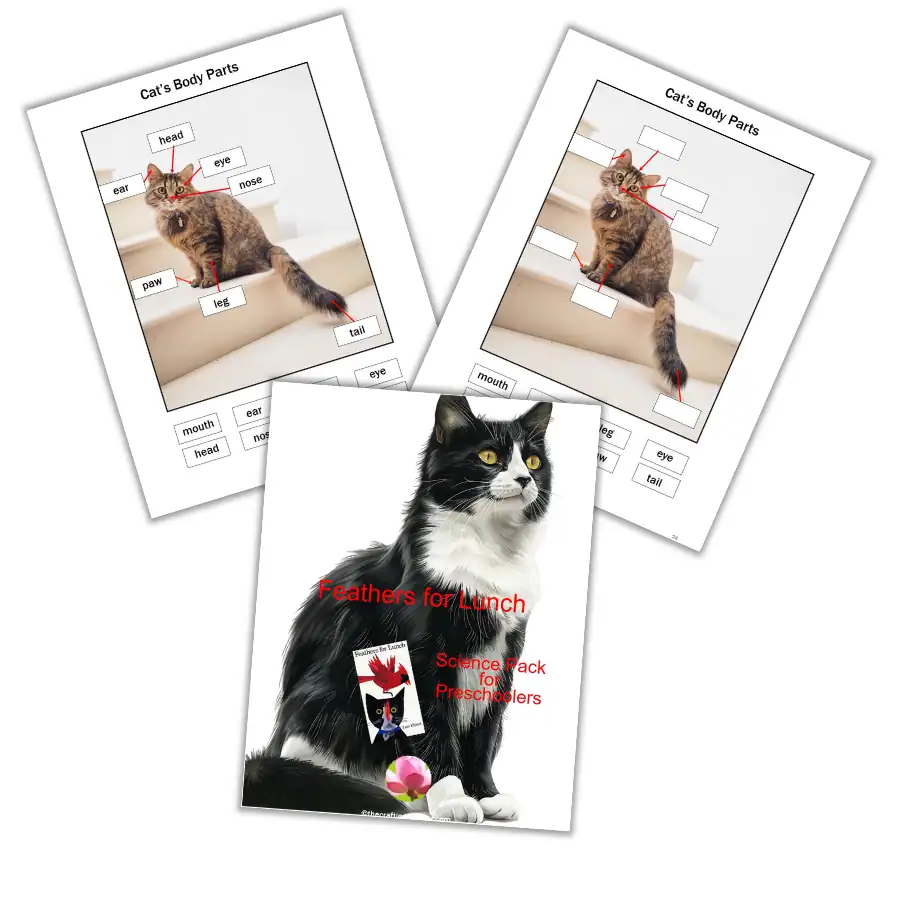
Matching animal body parts is another activity that helps preschoolers build essential cognitive, language, and motor skills like:
- Visual Discrimination: Helps children identify similarities and differences between the animal parts.
- Vocabulary: They learn new words and are encouraged to discuss the features, which helps them develop early literacy skills.
- Logical Thinking and Memory: Their brains are trained to recognize patterns, build spatial awareness, remember details, and focus.
- Fine Motor and Hand-Eye Coordination: Picking up the cards and placing them in the correct spot helps children strengthen the small muscles in their hands and fingers and guides them to the correct place based on what they see.
- Emotional and Social Skills: Matching activities help them manage their emotions and avoid frustration when completing tasks, and doing them with peers encourages them to share, take turns, and talk about what they are doing.
Teaching Camouflage
Explain that some animals’ colors blend into their surroundings, which helps them stay safe because predators have a harder time spotting them. To help them understand this, use hands-on activities and games. These are some ideas:
- Provide them with two sheets of construction paper in the exact same color. Have them cut one sheet into pieces and glue the pieces onto the other sheet.
- Get construction paper in similar colors of walls, tree trunks, sidewalks, and other places on the playground. Cut out bird shapes, tape them to the areas with similar colors when the children are absent, and invite them to find the birds when you go outside.
- Show them pictures or the video below so they can see camouflage in action.
Other Activities:
- Invite a vet or ornithologist to the class to talk about the different birds seen in the story.
- Invite your preschoolers to make a collage using feathers.
- Use large feathers to paint instead of brushes.
- Provide different materials such as twigs, cotton balls, feathers, paper strips, and others, and invite the children to build a bird nest.
- Ask the children to try to imitate the bird calls and body movements mentioned in the story.
- Make bird feeders. You can find excellent ideas on runwildmychild.com.
Related Books
Add related books to your library and to different centers to give children a comprehensive learning experience and variety. Below are some I like.
You can find these books at your local library, used bookstore, or on Amazon. To add them to your collection, you can use my affiliate links embedded in the titles for immediate access.
- The Five Birds and the Cat Queen by Jeff Cortazo. This beautifully illustrated picture book features 29 imaginative full-color illustrations, is written in 4-line rhymes, and includes an original musical score composed by the author and performed by a professional wind quintet.
- Sammy and the Lost Cat by V. Moua. It is the story of a little bird who sees a flyer for a lost cat while walking along the sidewalk and wants to find the cat.
- The Cat and the Bird by Geraldine Elschner. This whimsical tale follows a cat and a bird and explores themes of freedom and friendship, unfolding in a series of playful, brilliantly colored illustrations based on the work of artist Paul Klee.
- Max and Bird by Ed Vere. This story is full of playful humor, punchy text, and attention-grabbing illustrations.
- The Cat with the Bird Nest Hat by B N Pulido is a whimsical tale of shy wishes, gentle magic, and finding your place in the world.
- Cat and Bird by Jo Empson. A beautifully illustrated story that features two opposing characters who observe each other’s strengths as they face different challenges on a journey together. By mimicking the other, they learn that two is better than one.
Pin It For Later
If you are in a rush and don’t have time to read the post and download the printable but want to save it, pin it to your science or another board on Pinterest for later.
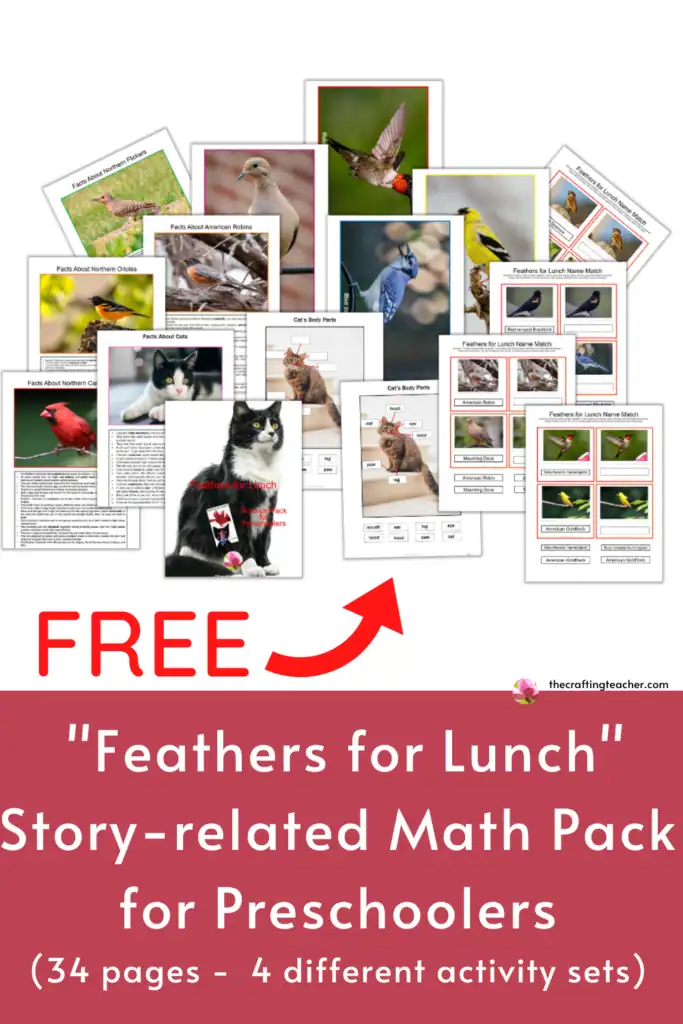
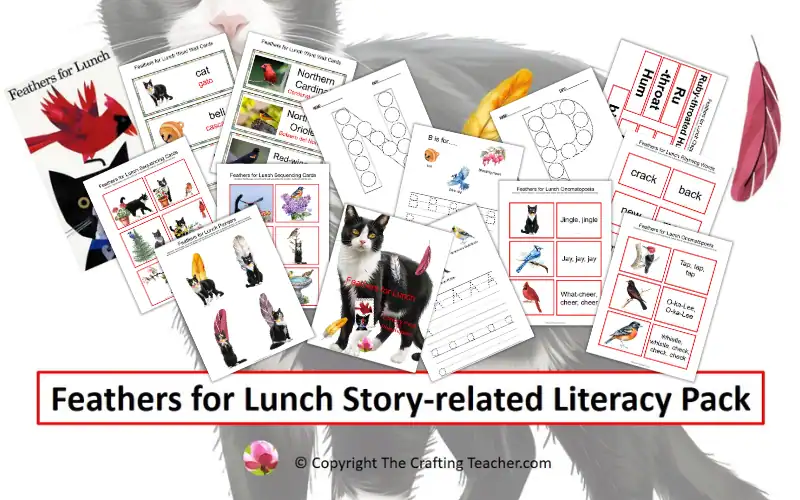
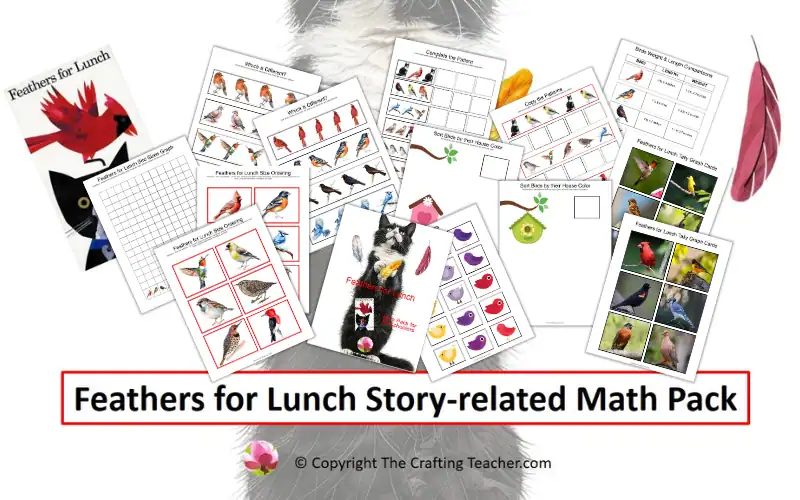
You can use these ideas on their own, but I invite you to combine them with the activities I included in the literacy and math packs I created for this beautiful story, Feathers for Lunch, to take full advantage of the opportunity this book offers. Remember that you should not divorce literacy from math, science, or any other domain to achieve a more comprehensive educational process. They intermingle and complement each other.
Remember to download your FREE Feathers for Lunch Science pack. Click on the link below and type your email to get started.
Be happy, safe, and creative. I wish you well.
Love,

P.S. Let me know if these activities work for you. If you want to see an article or a printable on making something specific, please let me know, and I will try to create it for you.
Other Posts You Might Like: