Feathers for Lunch Story-related Literacy Pack for Preschoolers
Affiliate Disclosure: “This post contains affiliate links, which means I receive a small commission, at no extra cost to you, if you make a purchase using those links.”
Feathers for Lunch by Lois Ehlert is the story of an indoor cat who sneaks out the door and tries to hunt different birds for lunch, but the bell on his collar lets the birds know he’s coming, so he cannot catch any and ends up with just feathers for lunch.
With its rich rhyming text, Feathers for Lunch offers a fantastic opportunity for children to develop their phonemic and phonological awareness and build early literacy skills.
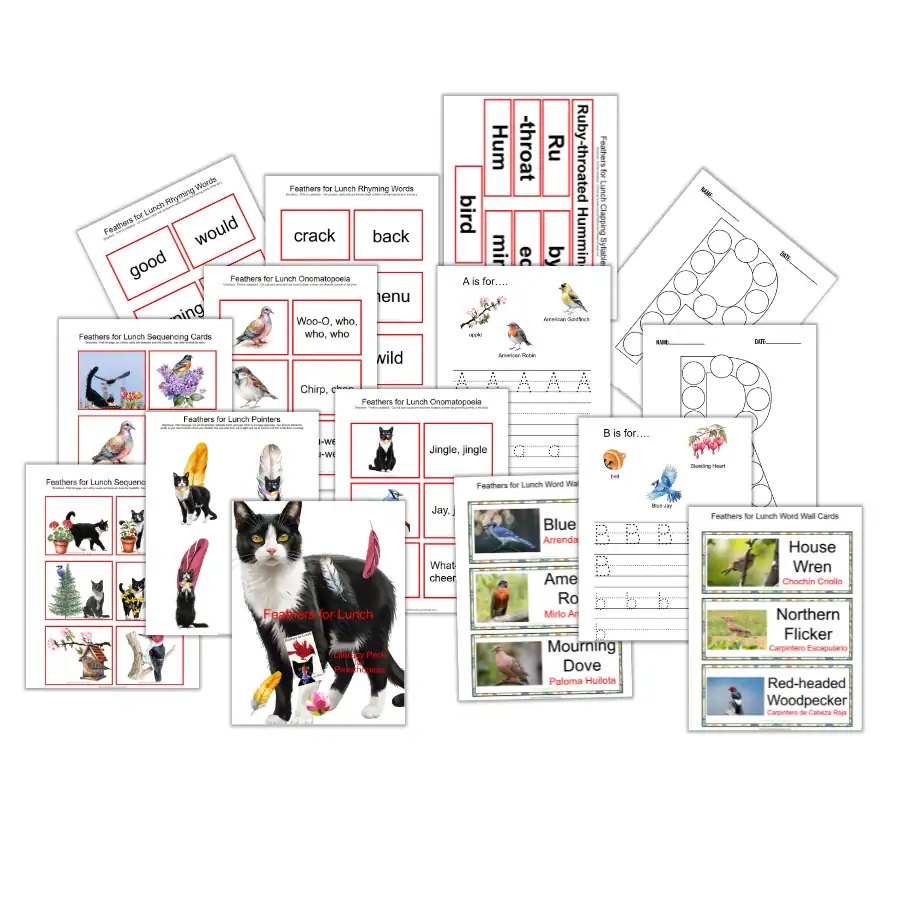
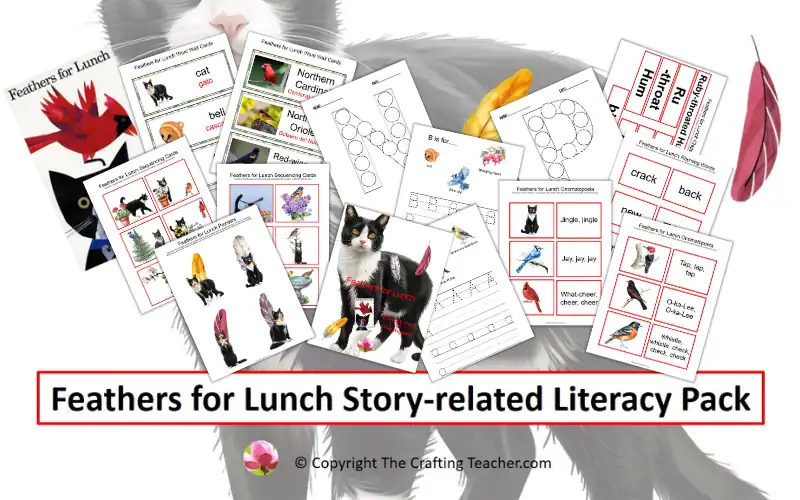
I have created a FREE 52-page Feathers for Lunch Literacy Pack with eight activity sets to accompany this book. You can download it at the end of this post.
Feathers for Lunch Literacy Pack
Feathers for Lunch Literacy Pack is a comprehensive resource that effectively reinforces preschoolers’ literacy skills and vocabulary development. It is designed to be used with the story, providing activities that reinforce learning and deepen understanding by engaging students in hands-on experiences.
Before Reading….
Start by engaging your preschoolers with the book’s illustrations. Encourage them to share their thoughts and observations.
Before reading the Feathers for Lunch story, review the parts of the book: the cover, title, author, illustrator, spine, and back.
Invite your preschoolers to make predictions about the story by asking questions such as:
- What do you think the story is about?
- Can you have feathers for lunch?
- What do you think the cat is going to do?
- Do you think it is easy for a cat to catch a bird? Why? Why not?
Then read it aloud to foster a dynamic learning environment.
During Reading….
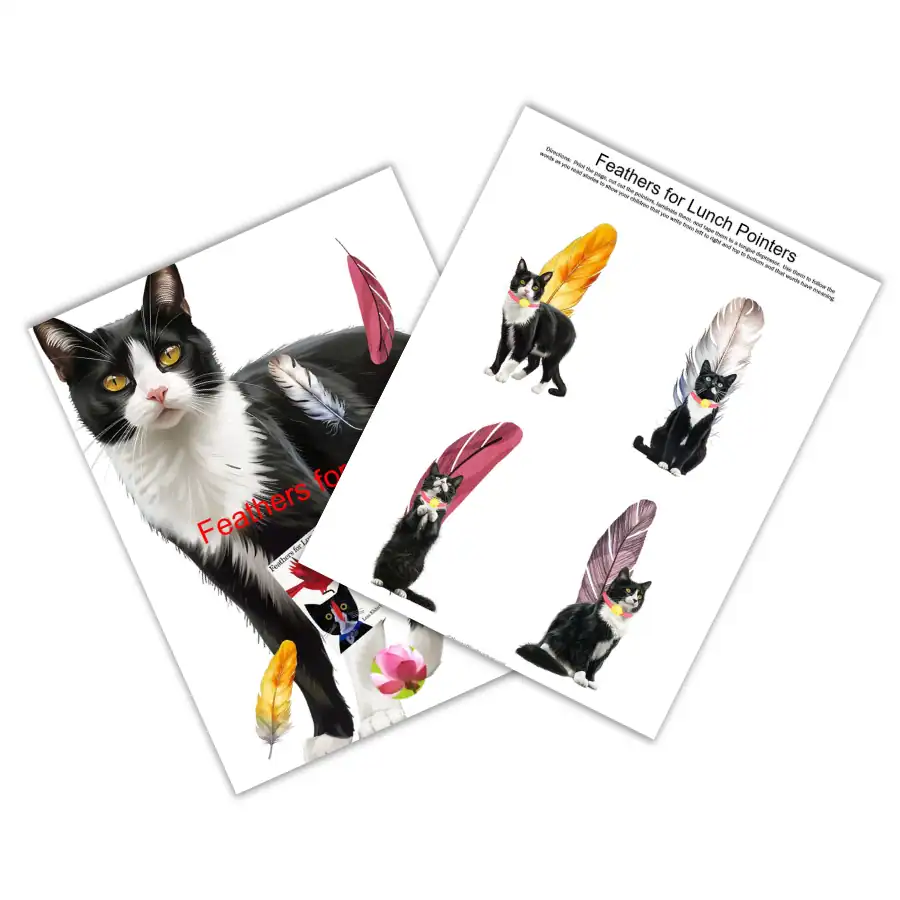
When reading, I find it beneficial to use pointers to guide the preschoolers’ eyes across the page. This simple technique reinforces reading from left to right and top to bottom, as well as the meaning of words.
In the literacy pack for this book, I included four pointers featuring one feather and the cat for your convenience.
During reading, ask who, what, where, when, and why questions, such as:
- Who is the main character of the story?
- Where is the story taking place?
- How many birds are in the story?
- What are the birds doing to keep from getting caught?
You can also ask open-ended questions, such as those about the student’s life experiences, and there can be multiple answers.
After Reading….
Invite children to retell parts of the story by asking questions such as:
- Why couldn’t the cat catch any birds?
- What did the birds do to warn each other about the cat?
- What do you think the phrase “feathers for lunch” means?
Retelling the Story
Retelling Feathers for Lunch helps preschoolers practice and internalize several core literacy skills beyond basic listening comprehension, helping them understand what happened first, then, next, last, etc., and build cognitive foundations for future reading success.
Gather the children in a circle on the floor or around a table. Distribute the story sequencing cards provided in the pack and encourage the children to retell the story using them. They should place the cards on the floor, board, or table to retell the story. When the activity is complete, place the sequencing cards in the Listening or Library Center to invite the children to retell the story independently.
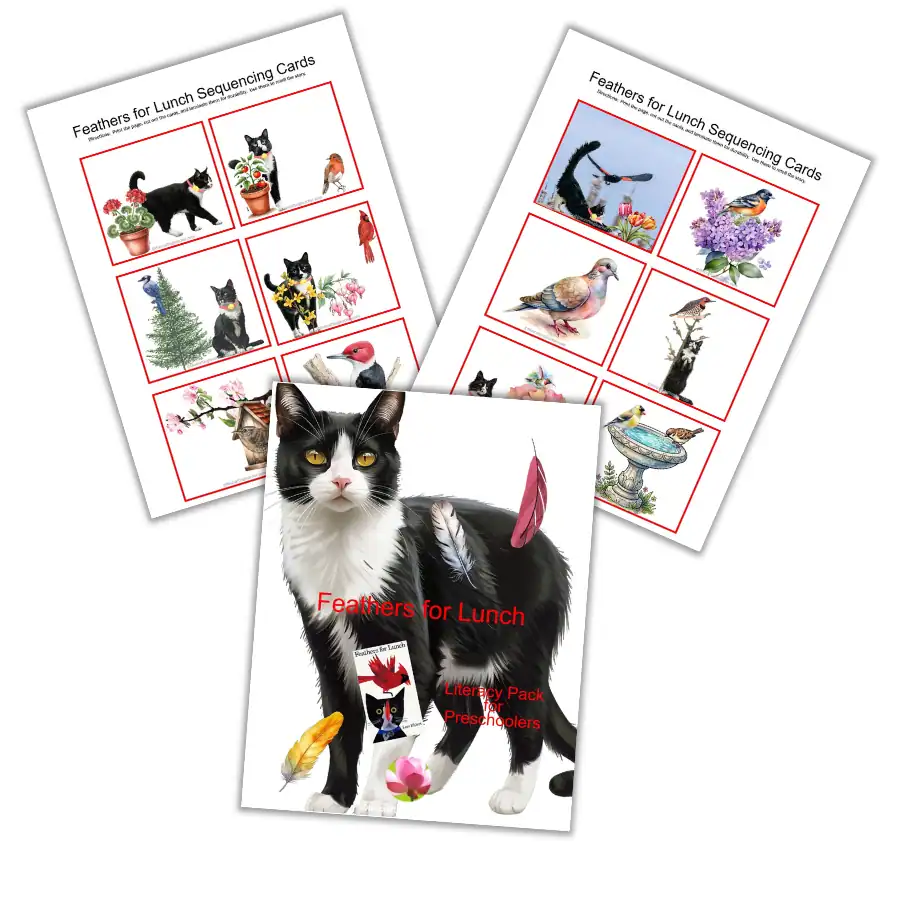
This activity will help preschoolers develop important skills such as:
- Sequencing and Story Structure: Pulling out sequencing cards is especially helpful for teaching cause-and-effect concepts, helping them understand what is happening in the story, and the standard setup of a story (beginning, middle, and end).
- Receptive and Expressive Vocabulary: Listening to the story helps children build receptive language, and using action verbs (such as snooping, sneaking, and prowling) and nouns (like northern cardinal, blue jay, or geranium) to retell the story helps them build expressive vocabulary.
- Reading Comprehension: Retelling the story helps children remember and process details because it requires children to explain the underlying mechanics of the plot instead of just describing individual pictures, which demonstrates deeper critical thinking.
- Making Real Connections: When children retell a story, they build essential comprehension frameworks by connecting the book’s events to their own lives, such as comparing the story’s cat to their own pet or noting that they have seen one of those birds or plants.
Vocabulary Development and Matching
I like to use a word wall because it is a vital literacy tool that helps your children learn the alphabet, letter sounds, and words related to the theme you use that week or month.
Remind your students that words are made up of individual letters. Place the word wall cards provided in the pack on your word wall and in different centers, and use them to teach the children the names of the different birds and plants.
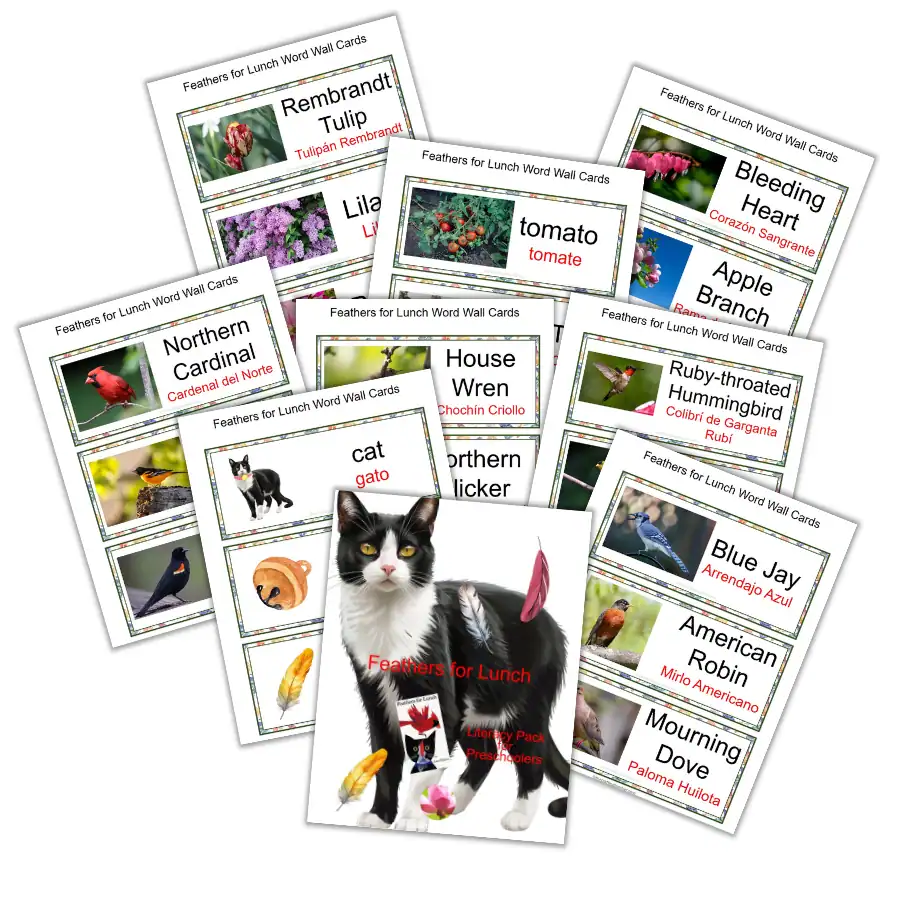
A good way to help the children start learning those names (Cardinal, Blue Jay, Robin, Catnip, Forsythia) after reading the book is by playing a riddle game using the book’s illustrations. Describe a bird using its physical features and colors, and let the children guess the name.
Once the children are familiar with the names of the birds and plants, invite them to match the pictures with the names using the word wall cards. To do that, print another set of the word wall cards for this purpose, and cut them to separate the pictures from the words. You don’t have to use all of them. Remember, the goal is to help them learn vocabulary, not cause frustration.
Word wall cards help preschoolers build strong mental connections that bring important benefits and make reading easier later on. Some of those benefits are:
- Vocabulary Development: Seeing an image with a word helps children learn the real meaning of new words.
- Improved Memory: Pictures give the brain a visual hook, helping children recall words much faster.
- Focus: Pictures catch children’s attention, which helps them improve their attention span.
- Pre-reading Skills: Matching words to pictures helps children start building the foundations for future reading.
- Pre-writing and Fine Motor Skills: They can use the cards to trace and copy the words.
- Cognitive Development: Matching games feel like play, which motivates children to keep learning.
Additional Activities:
You can also use these word wall cards as a reference to plan different pre-reading activities for your students. For example:
- Learn or review the name and sound of the beginning letter of each word.
- Clap the syllables in each word.
- Spell some words.
- Find other words that start with the same beginning letter.
- Identify words that start with the same beginning sound.
- Using the words in a short sentence.
Letters Tracing
Feathers for Lunch Literacy Pack includes twelve letter sheets: Aa is for Apple, American Robin and American Goldfinch, Bb is for Bell, Blue Jay and Bleeding Heart, Cc is for Cat, Ff is for Forsythia and Feather, Gg is for Geranium, Hh is for House Sparrow and House Wren, Ll is for Lilac, Mn is for Mourning Dove, Nn is for Northern Cardinal, Northern Flicker and Northern Oriole, Pp is for Pine and Petunia, Rr is for Red-winged Blackbird, Rubi-throated Hummingbird, Rembrandt Tulip and Red-headed Woodpecker, and Tt is for Tree.
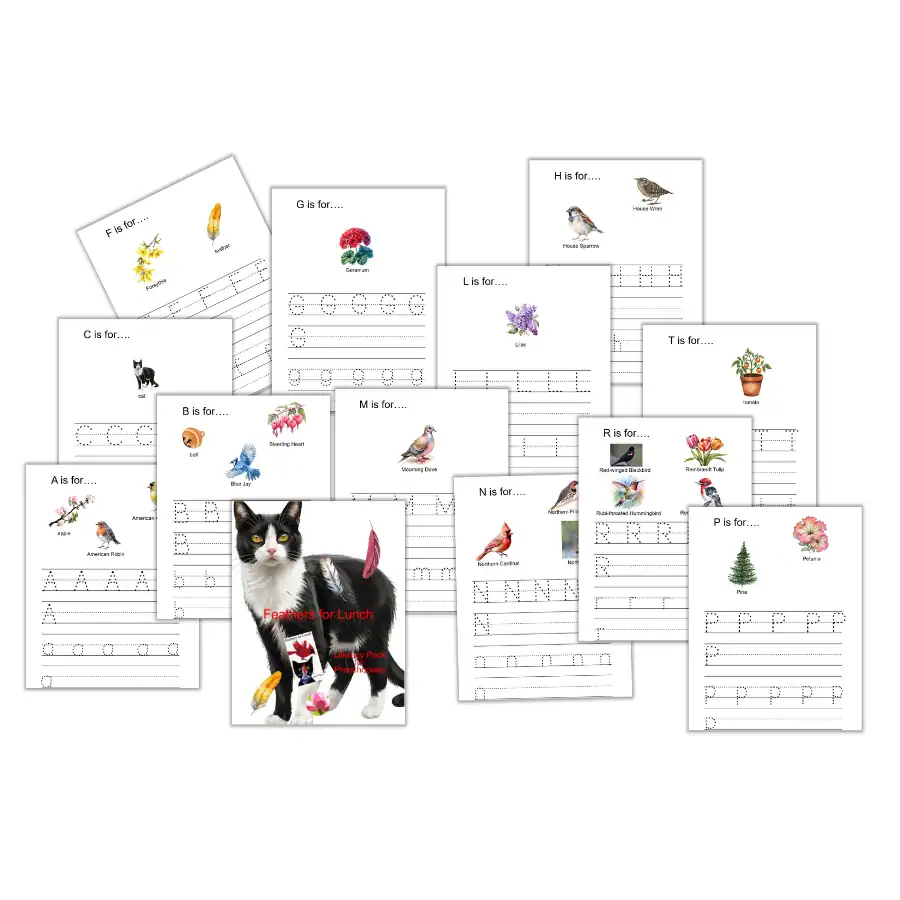
Tracing letters helps preschoolers build a powerful bridge between physical movement and early literacy, developing important core skills such as:
- Fine Motor Muscle Strength and Pencil Grip: Tracing dotted letters like Cc for cat or Bb for bell requires children to use their hands, fingers, and wrists for small, precise movements, helping them learn to hold a pencil or marker securely.
- Directionality Awareness: It is not uncommon for children to form letters upside down or in any place on a paper. Templates help them learn to write from top to bottom and left to right, which helps prevent bad writing habits.
- Hand-Eye Coordination and Visual-Motor Integration: To trace, children must use their eyes to guide their hand along a path. This practice helps their brain develop the ability to connect what they see with a motor response, which is essential for future writing, drawing, cutting with scissors, and manipulating small toys, among other tasks.
- Letter Recognition and Muscle Memory: When children draw uppercase and lowercase letters repeatedly, they build tactile muscle memory, allowing them to recognize the alphabet automatically and lay the foundation for independent writing.
- Attention and Focus: Tracing requires concentration and physical control, which allows preschoolers to experience success, boosting their sense of accomplishment and building the patience and confidence needed to take on more complex academic tasks later on.
Dot-Dot Letters
I have included twelve Feathers for Lunch story-related dot-to-dot letters on the pack: A, B, C, F, G, H, L, M, N, P, R, and T.
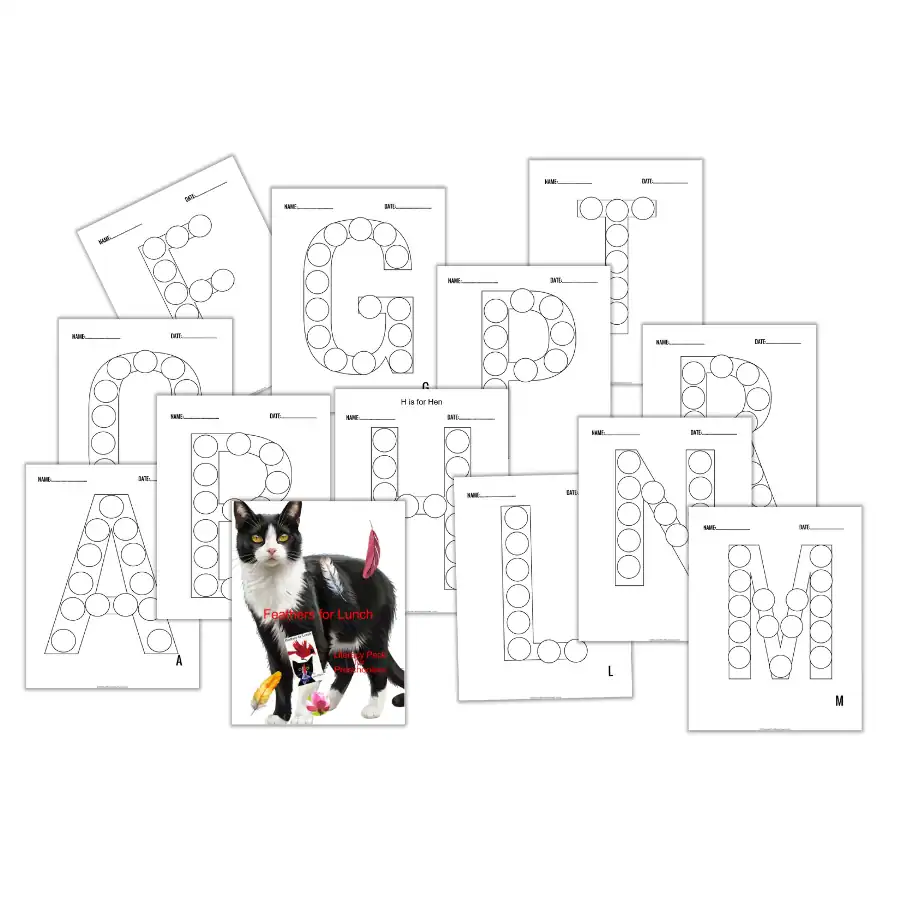
These activities help preschoolers build the foundational physical and cognitive skills needed for early literacy, such as:
- Fine Motor Control and Hand Strength: Using markers to cover the dots on the letters requires precise hand and finger movements, which strengthens the small muscles in their hands and helps develop proper pencil grip.
- Letter Identification: Children learn to identify letters represented in different ways.
- Pre-writing Skills: They learn to apply enough pressure to the paper with markers to create a circular print.
- Spatial Awareness: They develop an understanding of each letter’s size, direction, and orientation.
- Concentration: They learn to focus on what they are doing.
Teaching Onomatopoeia
Onomatopoeia, or phonetic sound words, are words that sound like the noise they describe, and teaching them to preschoolers is a fantastic way to build early phonics and language skills.
Feathers for Lunch is rich in these words, giving you a perfect opportunity to start teaching onomatopoeia to your children. The onomatopoeia featured in the story are:
- Jingle, jingle – The constant sound made by the bell on the cat’s collar as he sneaks around the yard.
- Jay, jay, jay – The sound made by the Blue Jay.
- What-cheer, cheer, cheer: The distinct whistle sung out by the Northern Cardinal.
- Tap, tap, tap: The rhythmic drumming sound made by the Red-headed Woodpecker as it pecks the tree bark.
- O-ka-Lee, O-ka-Lee – The Red-winged Blackbird call.
- Whistle, whistle, check, check, check: The loud call used by the Northern Oriole.
- Woo-O, who, who, who: The soft, low cooing made by the Mourning Doves.
- Chirp chep: Another quick, sharp warning sound made by the House Sparrow.
- Su-wee, su-wee: The American Goldfinch responding to the House Sparrow sound.
I’ve included a set of cards with the picture of each bird and the sound it makes, to give preschoolers a visual clue.
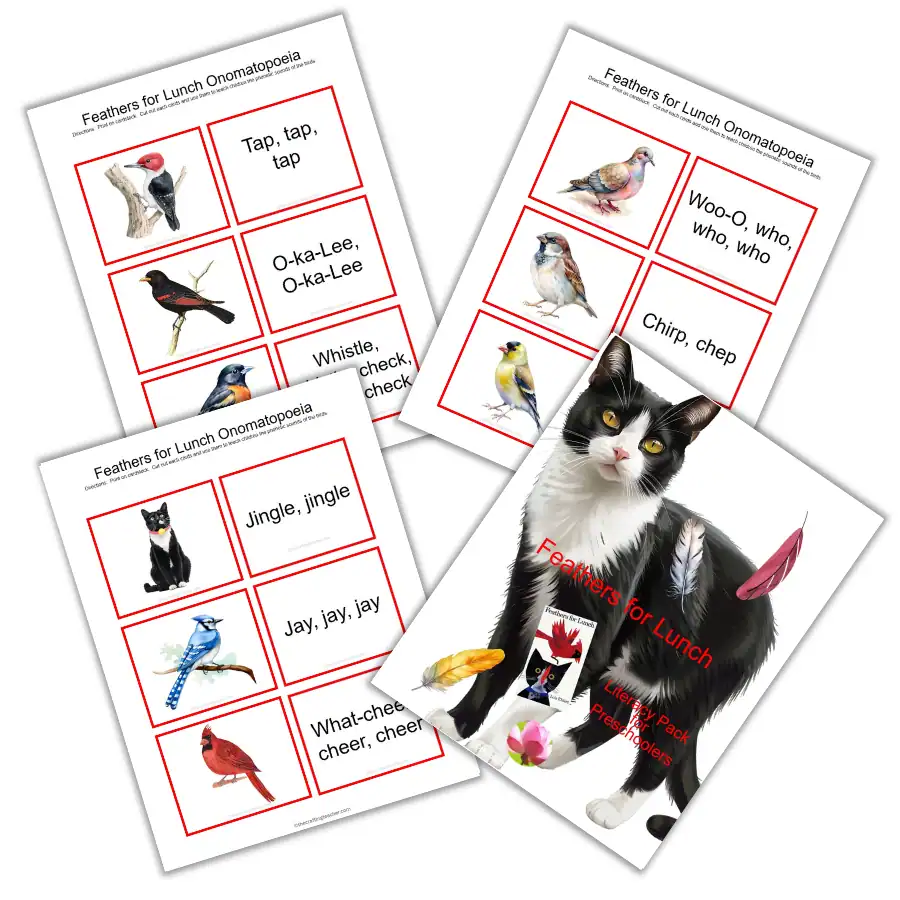
You can introduce and practice these sound words dynamically using the following multi-sensory strategies. These are some ideas:
- Before reading, show children a real jingle bell. Tell them that every time the cat moves, they will hear the bell sound.
- Every time a bird appears on a page, try to mimic the sound that the bird makes to emphasize that the sounds represent real actions.
- Have them listen to recordings of the birds’ sounds. Below are videos you can use.
- Show them the visual chart included in the pack, with the picture of each animal next to the sound it makes, to build visual hooks for their memory.
- After reading the story a couple of times, have children point to the correct animal on the chart when you mimic the onomatopoeia.
Teaching Rhyming Words
Explain what rhyming words are and use active, hands-on rhyming activities to help preschoolers develop auditory discrimination skills and learn to identify them.
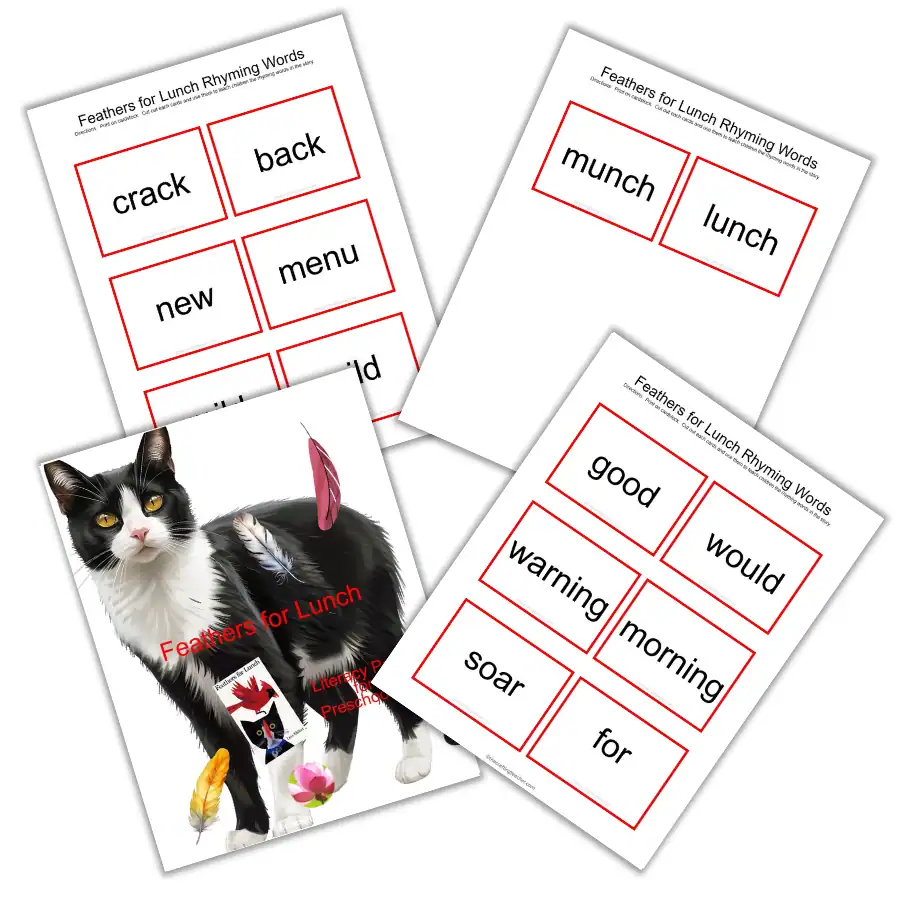
The rhyming words found in Feathers for Lunch are:
- Crack and Back (“Uh-oh, doors left open just a crack. My cat is out, and he won’t come back!”)
- New and Menu (“He’s looking for lunch, something new, a spicy treat for today’s menu.”)
- Mild and Wild (“His food in a can is tame and mild, so he’s gone out for something wild.”)
- Good and Would (“….these birds sure look good. If he could catch one, he’d eat it he would.”)
- Warning and Morning (“But when his bell jingles, birds call a loud warning: Big cat got out early this morning.”)
- Door, Soar and For (“Oh, oh, door’s left open a crack. But cats can’t fly, and they can’t soar, and birds know what their wings are for.”)
- Munch and Lunch (“So he keeps prowling hoping to munch, but all he catches are feathers for lunch.”)
This pack includes cards with these words to help you remember them.
One activity you can do is the Bell Game. Give each child a jingle bell. Call out pairs of words. If the words rhyme, children must shake their jingle bells. Here are some ideas:
- Cat, hat, mat, pat, sat, and cap.
- Crack, back, pack, sack, track, black, quack, snack, and tack.
- New, menu, blue, chew, clue, do, few, glue, grew, shoe, too, two, view, who, you, and zoo.
- Mild, wild, child, smiled, piled, filed, and tiled.
- Good, would, could, should, stood, wood, and hood
- Warning, morning, mourning, scorning, adorning, corning, horning, yawning, dawning, fawning, and spawning.
- Door, soar, for, floor, more, store, roar, four, core, score, shore, chore, and pour.
- Munch, lunch, crunch, bunch, punch, hunch, brunch, and scrunch.
Clapping Syllables
Teaching preschoolers to segment words into syllables provides essential cognitive and literacy benefits that lay the foundation for formal reading and writing. A good way to do that is by clapping the syllables.
I’ve included cards with each bird’s name in syllables to give preschoolers a visual clue.
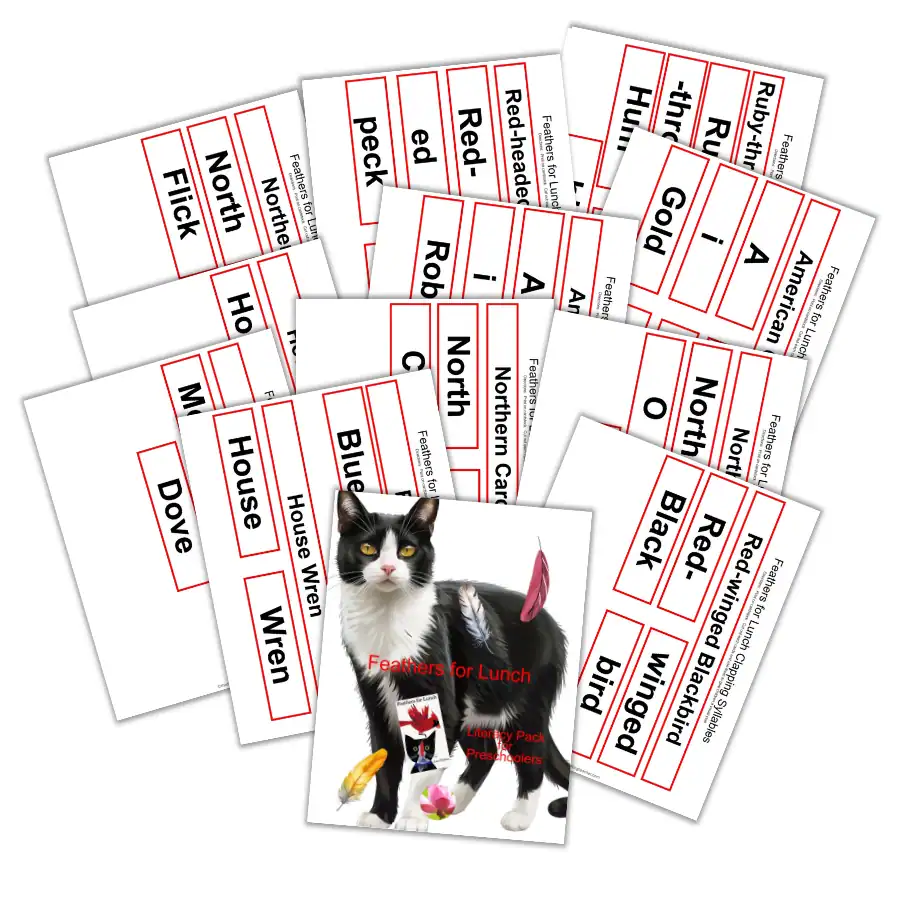
These are the birds’ names in Feathers for Lunch, separated into syllables.
- Blue Jay: Blue / Jay
- House Wren: House / Wren
- Mourning Dove: Mourn/ing / Dove
- House Sparrow: House / Spar / row
- Northern Flicker: North / ern / Flick / er
- Red-winged Blackbird: Red / winged / Black / bird
- Northern Cardinal: North / ern / Car / di / nal
- Northern Oriole: North / ern / O / ri / ole
- American Goldfinch: A / mer / i / can / Gold / finch
- American Robin: A / mer / i / can / Rob / in
- Red-headed Woodpecker: Red / head / ed / Wood / peck / er
- Ruby-throated Hummingbird: Ru / by / throat / ed / Hum / ming / bird
The most important foundational literacy skills that children develop by clapping syllables are:
- Phonemic Awareness: When preschoolers learn to hear and manipulate larger chunks of spoken language, they can isolate individual letter sounds (phonemes) more easily.
- Cognitive Development: Dividing words into chunks helps children learn how to decode sound units and recognize emerging syllable patterns, setting up the foundation for reading fluency.
- Spelling and Writing Development: When children know how to break a spoken word down into smaller segments, they can systematically write the letters that correspond to each sound rather than guessing an entire word at once.
- Vocabulary Development and Comprehension: Learning to recognize syllables helps children decode vocabulary words and understand unfamiliar words, which enhances language retention, pronunciation, and text comprehension.
- Strengthens Sound Perception and Pattern Recognition: As preschoolers practice syllable games, they begin to notice recurring word structures and rhyme families.
Write a Class Story to Make a Book
beginning, middle, and end. Use chart paper to take dictation.
Encourage them by asking what they want to write about, then go from there. Take dictation of the phrases they say, and then print each one on a different page or half page. Have the students illustrate each page. Then, put it together as a book for the library and make a copy for each author.
When preschoolers write a class story and see that their teacher writes down their exact words, it helps preschoolers understand that:
- Spoken words have meaning and can be written.
- Improve their language and literacy skills.
- Learn vocabulary through the words suggested by their classmates and teacher.
- Improve their communication skills.
- Learn that a story must have a beginning, middle, and end.
- Build a sense of classroom community.
- Make early literacy fun.
- Improve their social-emotional skills.
Additional Activities:
Invite children to:
- Paint with feathers, boosting their fine motor skills and creative thinking.
- Sequence the different birds the cat encounters before ending up with just feathers.
- Discuss cause and effect by talking about how the cat’s jingle bell warns the birds, leaving it with feathers for lunch.
- Have children isolate the very first sound (the onset) of the birds by asking: “What is the first sound you hear in Cat?” (/k/). Repeat for Robin (/r/), Blue Jay (/b/), etc.
Related Storybooks
Add related books to your library and to different centers to give children a comprehensive learning experience and variety. Below are some I like.
You can find these books at your local library, used bookstore, or on Amazon. To add them to your collection, you can use my affiliate links embedded in the titles for immediate access.
- The Five Birds and the Cat Queen by Jeff Cortazo. This beautifully illustrated picture book features 29 imaginative full-color illustrations, is written in 4-line rhymes, and includes an original musical score composed by the author and performed by a professional wind quintet.
- Sammy and the Lost Cat by V. Moua. It is the story of a little bird who sees a flyer for a lost cat while walking along the sidewalk and wants to find the cat.
- The Cat and the Bird by Geraldine Elschner. This whimsical tale follows a cat and a bird and explores themes of freedom and friendship, unfolding in a series of playful, brilliantly colored illustrations based on the work of artist Paul Klee.
- Max and Bird by Ed Vere. This story is full of playful humor, punchy text, and illustrations that command attention.
- The Cat with the Bird Nest Hat by B N Pulido is a whimsical tale of shy wishes, gentle magic, and finding your place in the world.
- Cat and Bird by Jo Empson. A beautifully illustrated story that features two opposing characters who observe each other’s strengths as they face different challenges on a journey together. By mimicking the other, they learn that two is better than one.
- I Wish I Were a Cat by V. Moua is a cute story of a bird that wants to be a cat.
Pin It For Later
If you are in a rush and don’t have time to read the post and download the printable but want to save it for later, pin this to your Literacy board on Pinterest.
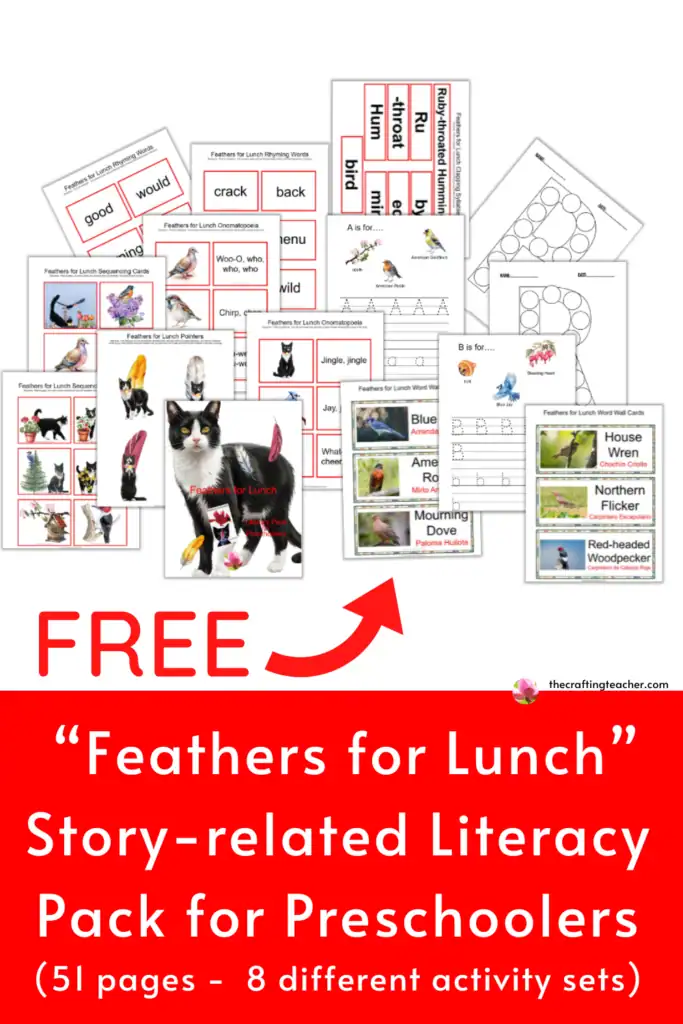
Don’t forget to download your FREE Feathers for Lunch Literacy Pack. Click the link below and type your email for an immediate download.
Be happy, safe, and creative. I wish you well.
Love,
P.S. Let me know if these activities work for you. If you want to see an article or printable on how to make something specific, please let me know, and I will do my best to create it for you.
Other Posts You Might Like: