How Parents Can Help Preschoolers Develop Literacy Skills
The term literacy and its importance is attach to anything we might read regarding preschoolers, and adults might confuse it with the ability to read. In reality, literacy is much more than that. It is not something that we can simply teach when children enter school. It is a process that should start at birth to lay the foundation for language and writing skills.
Literacy includes four components: listening, language, reading, and writing. For children to develop all of these components, it is necessary that the adults in their lives constantly stimulate them through their interests, provide rich experiences, and respond positively to their desire to learn every single day.
Since parents are their children’s first teachers, the role they play in their development is crucial and begins at birth: reading aloud, having conversations with them, and, in general, creating stimulating and rich experiences with books and language.
Children learn when they have genuine, hands-on experiences using all their senses and rich interactions with different people and places, which help them understand their world and develop multiple skills, including literacy.
Things Parents Can Do to Help
There are many ways parents can help their children develop literacy skills. These are some ideas:
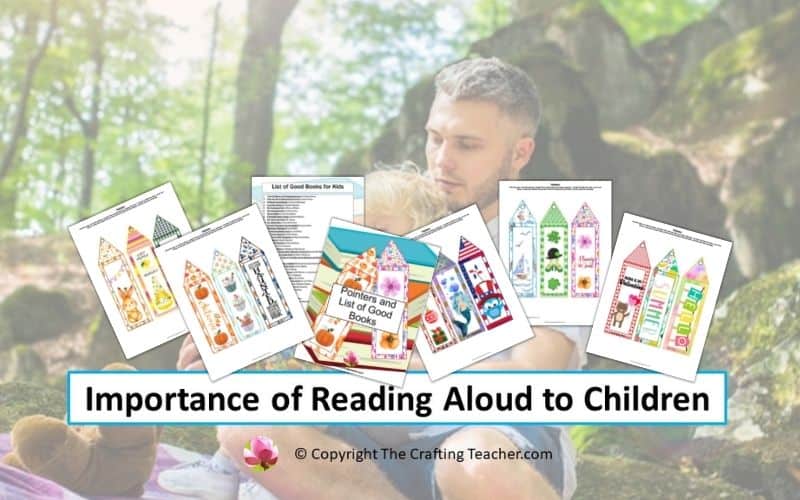
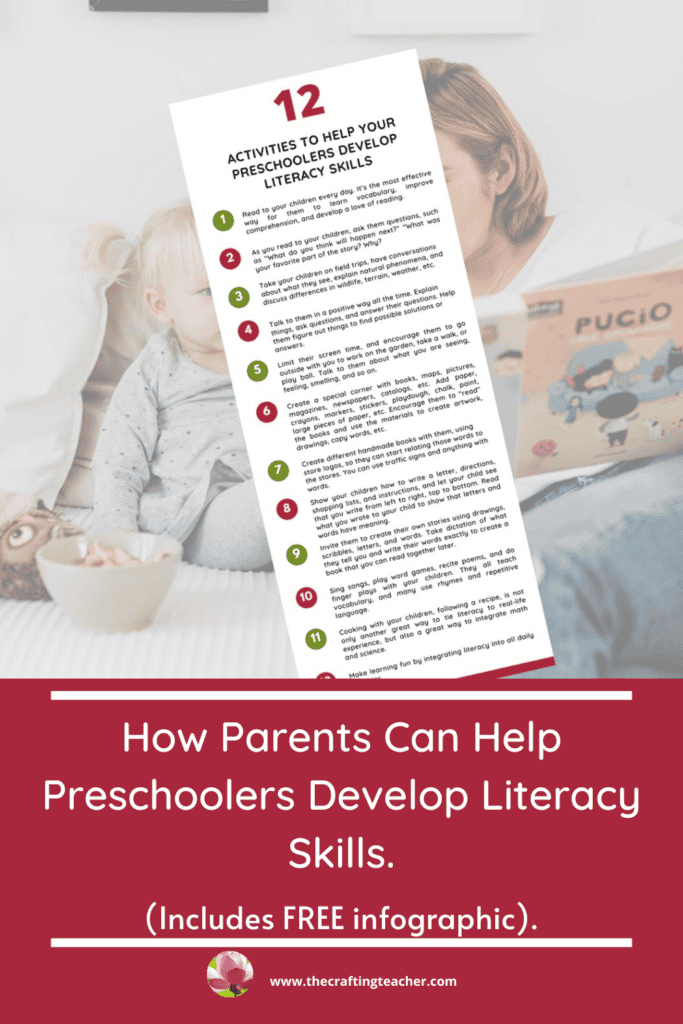
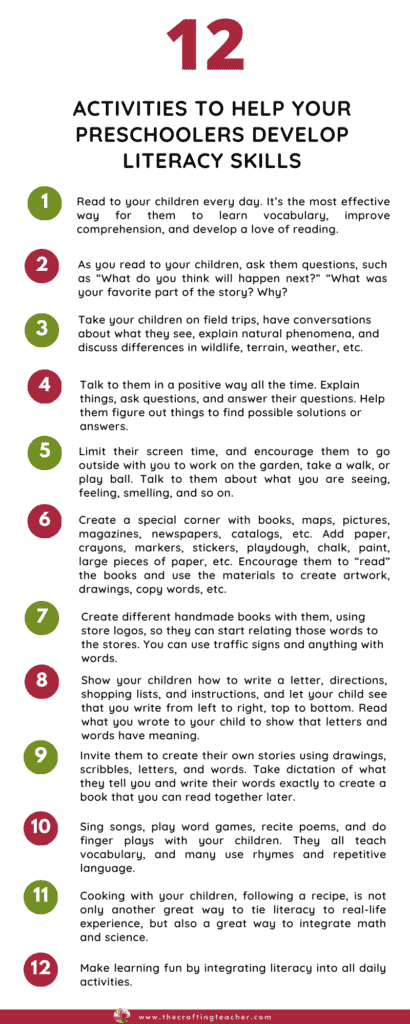
- Read to your children every day since they are born. It is the most effective way for them to learn vocabulary, improve comprehension, and develop a love of reading. You can use books with colorful illustrations and interesting stories to keep them engaged. You can also use magazines, newspapers, cookbooks, etc. Follow the words with your finger to show children that you read from left to right, top to bottom, and that words have meaning.
- As you read to your children, ask them questions, such as “What do you think will happen next?” “What was your favorite part of the story? Why? Use the opportunity to let them know that all books have a title and an author, a beginning, a middle, and an end. Point out words in the book you’re reading that begin with the same letter, to help your children become familiar with letters and words, and count objects on the page together to help them also strengthen their mathematical skills.
- Take your children on field trips to parks, farms, zoos, wildlife reserves, museums, mountains, rivers, lakes, beaches, festivals, stores, libraries, and bookstores. Have conversations about what they see, explain natural phenomena, and discuss the differences in wildlife, terrains, weather, etc.
- Talk to them in a positive way all the time. Explain things, ask questions, and answer their questions. Help them figure out what to look for to find possible solutions or answers. Some examples are: “Don’t get close to that animal because….” “What do you think might happen if….?” “Our cat is a great pet. Do you think a lion can be a good one, too?
- Limit their screen time, including TV and video games. Encourage your children to go outside with you to work on the garden, take a walk through the neighborhood, or play ball. Talk to them about what you are seeing, feeling, smelling, and so on.
- Create a special corner with books, maps, pictures, magazines, newspapers, catalogs, etc. Add paper, crayons, markers, stickers, playdough, chalk, paint, large pieces of paper, cookie cutters, stencils, printing pads, and stamps, etc. Encourage your children to “read” the books and use the materials to create artwork, drawings, copy words, etc.
- Create different handmade books with your children. One could be with logos, he sees like McDonald’s, Target, Wendy’s, and so on, so they can start relating those words to the stores. Another one could be the traffic signs they see while driving. Another one could be with cutouts from supermarket ads with products that you have at home.
- Show your children how to write a letter, directions, shopping lists, and instructions, and let your child see that you write from left to right, top to bottom. Read what you wrote to your child to show that letters and words have meaning.
- Invite your children to create their own stories using drawings, scribbles, letters, and words. It doesn’t have to be perfect. You can always take dictation of what they say and write their words exactly to create a book you can read together later.
- Sing songs, play word games, recite poems, and do finger plays with your children. They all teach vocabulary, and many use rhymes and repetitive language.
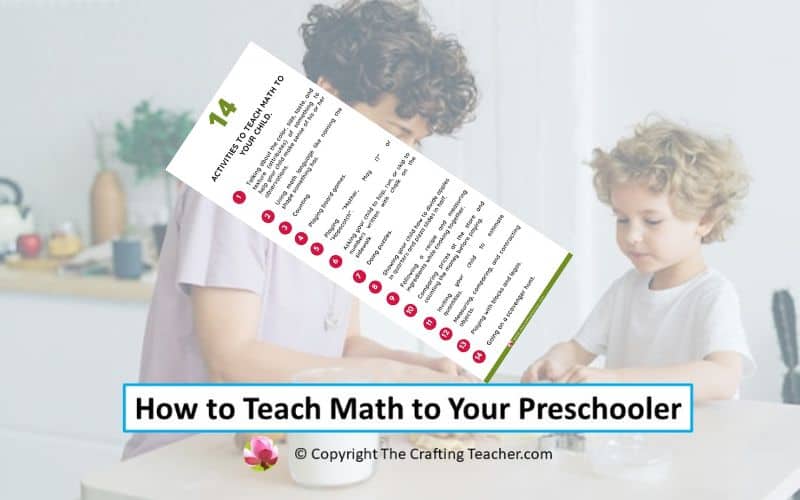
- Cooking with your children, following a recipe, is not only another great way to tie literacy to real-life experience, but also a great way to integrate math and science.
- Make learning fun by integrating literacy into all daily activities.
Great Book Suggestions
I have used the following books in the classroom for many years, and they are still used at my center because they are loved by all preschool children. These books also feature great illustrations and dialogue, keeping your preschooler truly engaged.
To read more about the ones that interest you, just click their title, and it will take you directly to Amazon, where you can get the information and price.
- Chicka Chicka Boom Boom by Bill Martin Jr. is a classic book that uses lively alphabet rhyme.
- Who’s the Beast? by Keith Baker. This cute story tells of a friendly tiger who is confused when jungle animals flee from a beast, until he discovers he is the beast.
- The Very Hungry Caterpillar by Eric Carle. This classic book uses repetitive language, pretty illustrations, and cut-out pages with different types of food that children love.
- Polar Bear, Polar Bear, What Do You Hear? by Bill Martin Jr. With this book, children will chant the rhythmic words, imitate the animals’ sounds, and pretend to be the zoo animals featured in the book.
- Green Eggs and Ham by Dr. Seuss. With unforgettable characters and signature rhymes, kids will love the terrific tongue twisters as the list of places to enjoy green eggs and ham gets longer and longer.
- The Very Busy Spider by Eric Carle. This multi-sensory board book allows children to feel the pictures as well as see them, and, with its rhythmic text, it becomes an experience to touch, see, and hear.
- The Baby Beebee Bird by Diane Redfield Massie. This is a fun story about a baby beebee bird, new to the zoo, who keeps singing all night long, and the animals cannot sleep until they come up with a plan to teach the baby beebee bird that nighttime is best for sleeping.
- Dr. Seuss’s Book of Colors by Dr. Seuss. This simple rhymed riff about color is illustrated with art from some of this author’s most beloved books.
- Panda Bear, Panda Bear, What Do You See? by Bill Martin Jr. and Eric Carle. Using repetitive text, the authors address the important topic of animal conservation, using different types of wild animals, rhythmic text, and vibrant images.
- Chicka Chicka 123 by Bill Martin Jr. Children will have fun learning numbers and counting with this joyous book.
Pin It For Later
If you are in a rush and don’t have time to read the post and download the printable, but want to save it later, pin it to one of your Pinterest boards.
Remember that helping your preschoolers develop strong literacy skills will lead to academic success in reading and writing and will build their motivation, curiosity, memory, prediction skills, and other important skills.
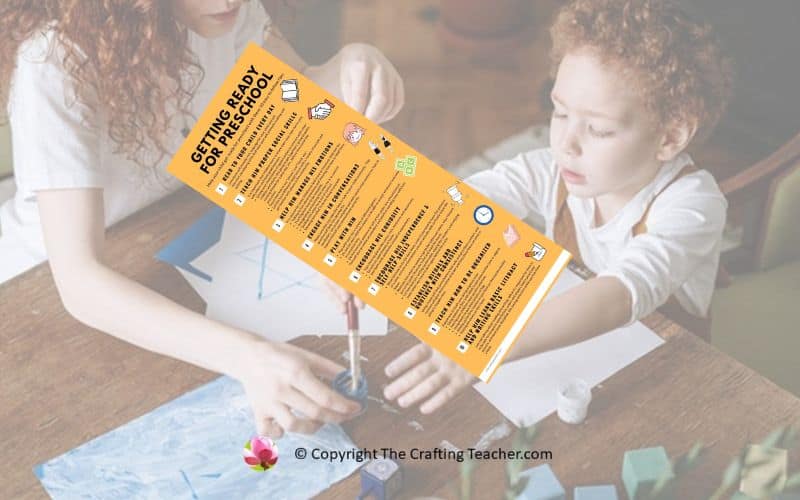
Don’t forget to grab your FREE infographic! Just click on the button below to download immediately.
I hope you find these ideas helpful, and you have a successful time with your kiddos, full of learning.
Be happy, safe, and creative. I wish you well.
Love,

P.D. Please let me know if any of these ideas worked for you. My goal is to help you in any way I can.