Assessments For Preschoolers
Affiliate Disclosure: “This post contains affiliate links, which means I receive a small commission, at no extra cost to you, if you make a purchase using those links.”
The Assessments for Preschoolers are a very useful way for teachers and parents to know the developmental level of their children, not only academically but also physically, mentally, and emotionally, to follow each child’s progress, and to design individual activities to help each child reach the benchmarks at every stage of his or her life.
To do this more accurately, best practice is to use assessments, since they provide a wealth of useful information about each child’s progress and needs in key skills that need to be developed to ensure school readiness, and this FREE Assessments pack will help you do that.
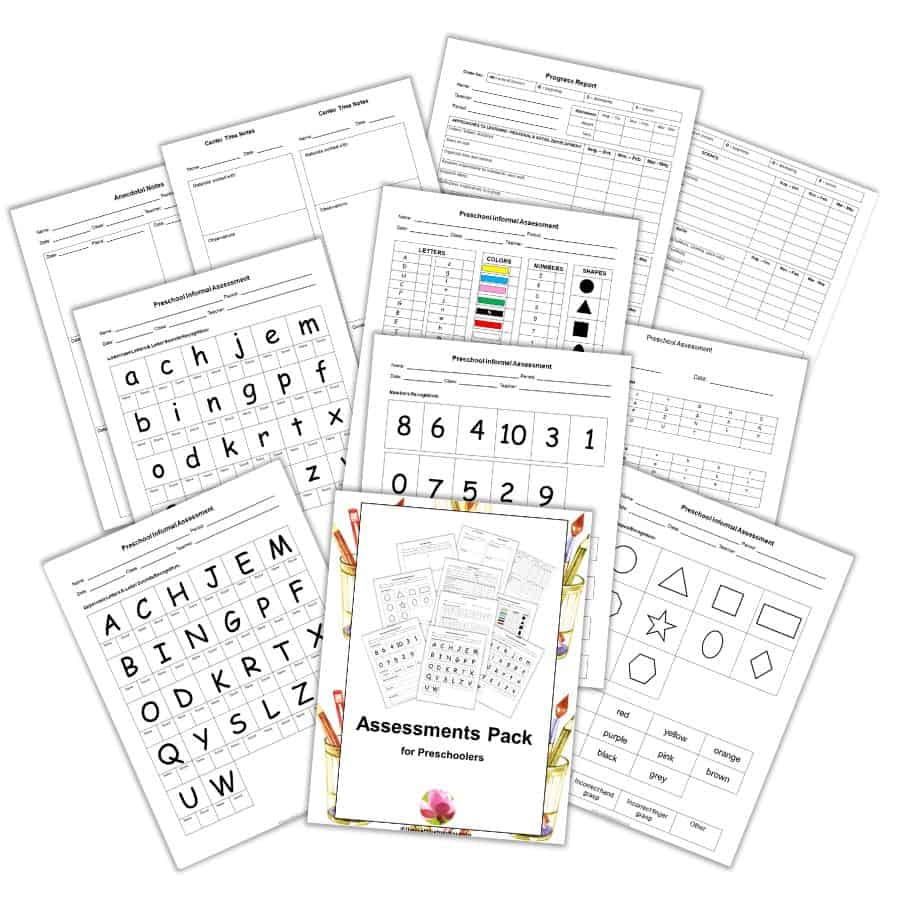
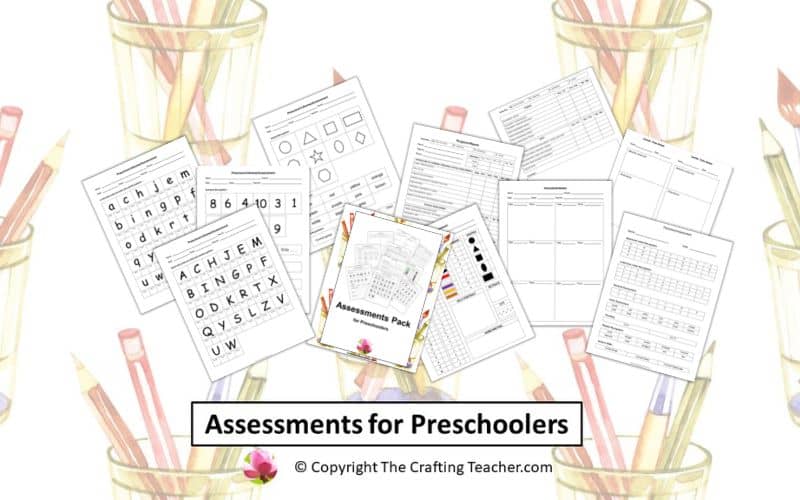
This post includes a FREE 10-page set with six types of informal assessment templates, two anecdotal note templates, and one progress report, all at the end.
What Are Assessments In Preschool
An assessment is a tool designed to check the level of development of a child when he or she comes to your classroom, and when used regularly, it will track the progress of that child throughout the year and what skills they should focus on to help the child develop the right skills for his or her age.
Assessments also help you check whether your curriculum and/or lesson plans are effective or need to be modified, and they give parents an accurate overview of their child’s developmental stage and skills during teacher-parent conferences.
Importance of Preschool Assessments
Preschoolers are expected to develop certain milestones at each stage. Of course, every child is unique and not all develop all these skills simultaneously, but it is important to know whether each child is learning those skills at the right pace.
Since tests are completely inappropriate for this young age, preschool teachers rely on observations, which should be documented. The information gathered will help teachers and parents:
- Find out how each child is progressing developmentally; in other words, what skills he or she has developed, and in what areas that child needs help to reach the next milestone.
- What are the different strengths the children have, and what is their preferred style of learning?
- Provide information about which child might have a learning disability or impediment that needs a professional diagnosis to get the benefit from special needs assistance.
- Collect samples of what each child is capable of at the moment to keep the parents well-informed about their child’s progress and needs.
- Provide feedback to teachers and administrators about what is working and what is not, to find better ways to support preschoolers’ learning.
Types of Assessments in Preschool
Observations
This is an informal but very helpful assessment to use every day. When you watch how a child completes different tasks, interacts with the teacher and friends, and demonstrates the skills he or she has already developed, you can learn about the child’s abilities. You can also ask the child to perform a particular task, such as identifying letters, shapes, and numbers, or writing his or her name, and take notes about your observations on those tasks.
Some of the most common skills preschool teachers usually observe throughout the year are:
- Recognition of colors.
- Math skills, including recognition of shapes, numbers 1 to 10, ability to count and do puzzles, and simple addition and subtraction operations.
- Fine and Gross motor skills, including eye-hand coordination, drawing, tracing, painting, running, playing with blocks, dancing, jumping, etc.
- Social and emotional skills, including taking turns, making friends, respecting other people’s spaces, sharing, cooperating, etc.
- Language, literacy, and auditory development, including how the child can follow and tell a story, pronounce words, have a conversation, recognize letters, follow directions, and express his or her thoughts, needs, and desires.
- Self-awareness skills, including knowledge of personal information such as his or her full name, name of parents and teachers, address, phone number, and names of pets.
It is a good practice to record this observation in an Anecdotal Form to make sure you don’t forget.

Portfolios
Since portfolios store anecdotal notes, samples, photographs, assessments, and teacher-parent conference results of a child’s overall performance, reviewing them gives you an idea of what tasks the child can perform and where he or she needs help. Also, if you ask the child to perform the same tasks multiple times throughout the year, you can see the child’s progress on those particular tasks.
Parent’s Input
Having the parents’ input regarding their child not only provides you with information about their child’s abilities, personality, reactions, etc., that you might not see at school, but also helps you to create a partnership between you and your parents based on trust and a desire to reach a common goal, which is to help their child develop to his or her full potential.
Checklists and Rubrics
Checklists and rubrics can be provided by the curriculum you’re using or the state, or done by you focusing on the specific skills you want to evaluate.
As the name suggests, a checklist is a list of skills you want to evaluate, and you just check off the tasks the child can already perform.
Rubrics, however, use a three-level scale for each skill. For these, you can use different indicators such as numbers (1, 2 & 3), letters (N = not yet, S = sometimes, and A = always), or any other type that fits your classroom, but always taking into consideration that the lowest level means the child doesn’t perform that specific task, the middle one means that the child performs that task sometimes, and the highest means that the child has mastered that task.
This type of assessment should be done multiple times throughout the year to see if the child is progressing in learning the skills.
Formal Assessments
In Florida, the Early Learning Coalition provides early learning schools with information about the type of assessments they want the teachers to use. Until this year, we used the Ages and Stages Questionnaire (ASQ) in all preschool classrooms. This year, they want us to use Florida’s Assessment of Student Thinking (FAST) using Star Early Literacy for the VPK program for 4-year-old children.
Unfortunately, I cannot speak for the entire country or other countries, since they might be different. That is why I suggest you research what type of assessments your county or country wants you to perform if you don’t know it yet.
How to Administer Assessments in Preschool
First, find out whether parental consent to administer the assessment to preschoolers is mandatory in your area. Here in Florida, it is not, but I like to inform the parents that it’s going to happen anyway and that we will share the results with them during teacher-parent conferences. We like to perform ASAQs three times a year, and we always send a package home for them to do. That way we can compare results and have a broader picture of each child’s abilities and skills.
Observations and portfolios should be a normal part of any preschool teacher’s day-to-day routine. However, there should be one formal assessment at the beginning, middle, and end of the school year to better understand each child and their class progress, and which areas need more focus.
Some people say the director should administer the assessments and observe the children, then make changes based on the results. I don’t agree with that, because I think that watching the children for a short period is not enough. In my opinion, teachers are with the children at all times, and they can observe them consistently and accurately.
Formal assessments should happen in a positive, relaxed environment where preschoolers feel comfortable. Otherwise, if the time becomes stressful for them, the results might not be accurate.
Using Assessments to Create Individualized Lessons
Since not all children develop the same skills at the same time, a preschool teacher should use the results of the assessment to tailor each child’s individualized lessons to meet the needs of each of her children, detect any deficiencies that need attention, and inform parents of the situation, providing them with resources that will help the child improve those skills, which will also help the teacher as well.
This is also true for children who are above expectations for their age, in which case the teacher can encourage the child to continue growing instead of holding him or her back.
Conclusion
Preschool teachers should always remember that each child is unique, developing and learning at his or her own pace. Also, not all children might master all the desired skills before going to kindergarten.
This means that in a class, it is normal to find children developing skills at different times, and teachers should not worry unless a child is falling too far behind or showing signs of a disability.
Preschool assessments are an excellent tool for early childhood programs to ensure teachers identify each child’s progress and that children receive the help and care they need to succeed.
Teachers should conduct the first assessment at the beginning of the year to identify each child’s developmental level and create a baseline for lesson planning and future assessments.
It is recommended that teachers perform a combination of formal and informal assessments to have a better picture of each child’s skills, to be able to improve their teaching efforts, create developmentally appropriate lessons with activities designed to benefit the entire group and each child’s individual needs, and create a learning environment to enrich the children’s learning experience, especially for those with special needs.
Preschool teachers should involve their children’s parents in the process not only to create a partnership and exchange reliable and important information, but also to guide parents on an appropriate course of action based on the results of the assessment, and involve another specialist such as a speech and/or occupational therapist, psychologist, or psychiatrist, to help children develop to their full potential.
Finally, include these results in the children’s portfolios to take with them to the next class or new school, providing valuable information about their developmental level and strengths and weaknesses. This will help the next teacher adapt her lessons and materials to cater to the children’s needs.
Pin It For Later
If you don’t have time to review these ideas but want to save them for later, pin them to one of your Pinterest boards.
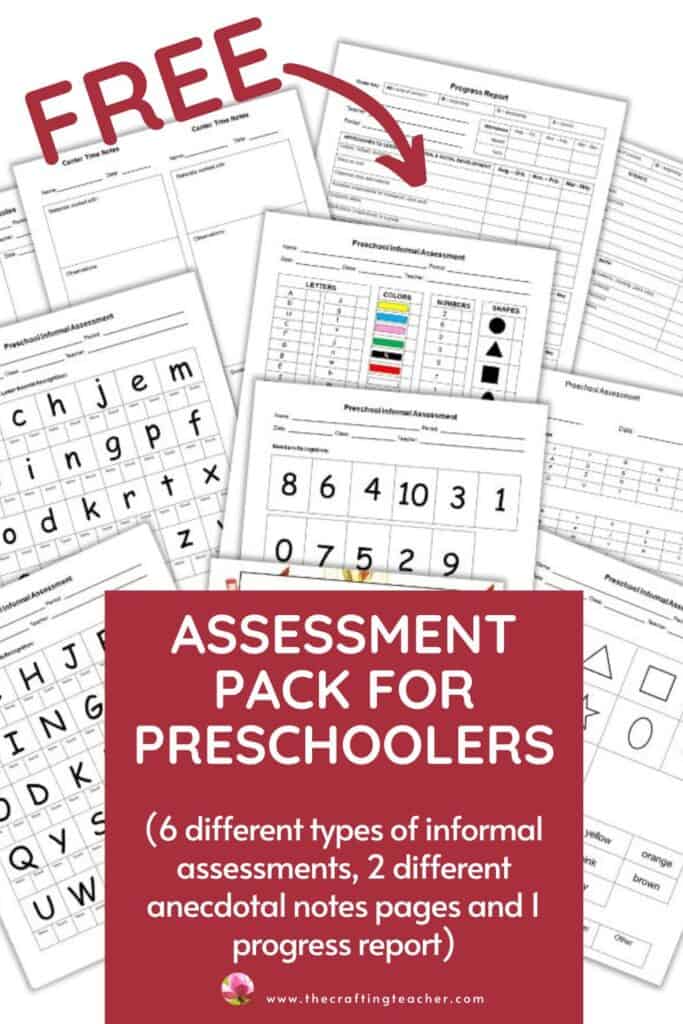
Good luck to you, and don’t forget to download your FREE Editable Assessment Pack as a token of my appreciation for visiting my post. Just click the link below and enter your information for an immediate download.
Be happy, safe, and creative. I wish you well.
Love,

P.S. Your feedback is really important to me because my goal is to always create things that you will find useful. Please let me know if you like the activity or if you think I should change something.
Other Posts You Might Like: