
Black History Month for Preschoolers
Affiliate Disclosure: “This post contains affiliate links, which means I receive a small commission, at no extra cost, if you make a purchase using those links.”
Black History Month celebrates the achievements of African Americans and recognizes their essential role in American history.
We must teach our children about the many important African Americans who have contributed to our society and raise them to respect the history, culture, and accomplishments of all races, so they grow up to be positive contributors and more tolerant of everyone in our diverse country.
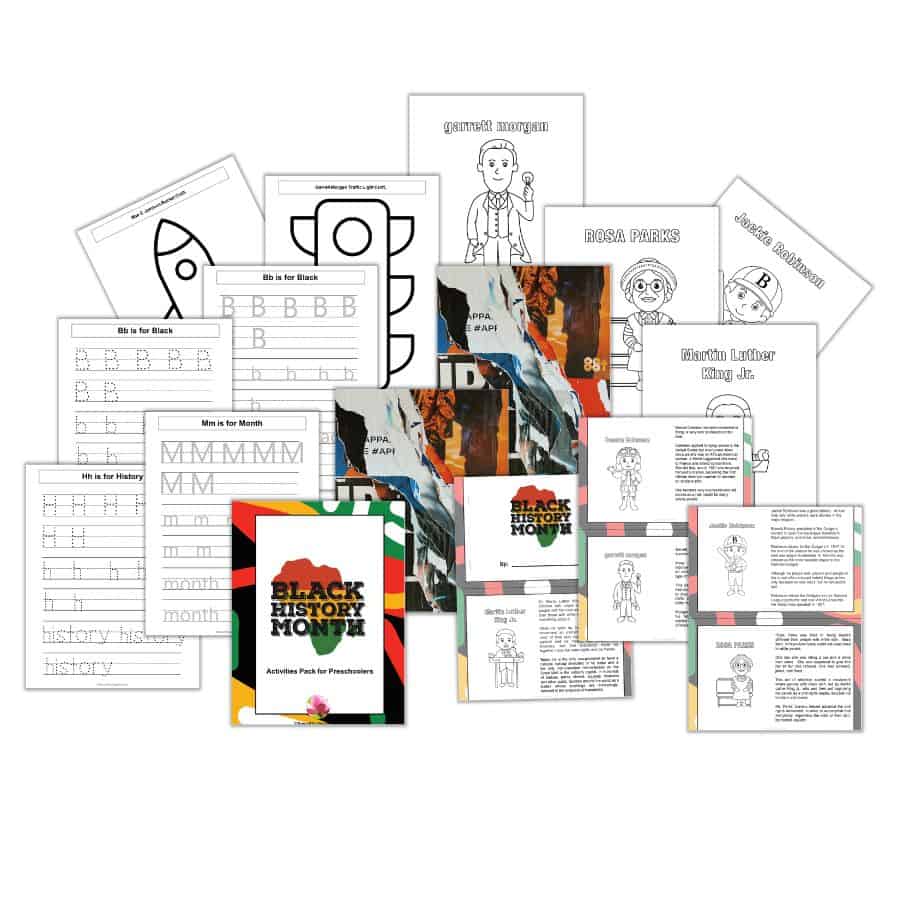
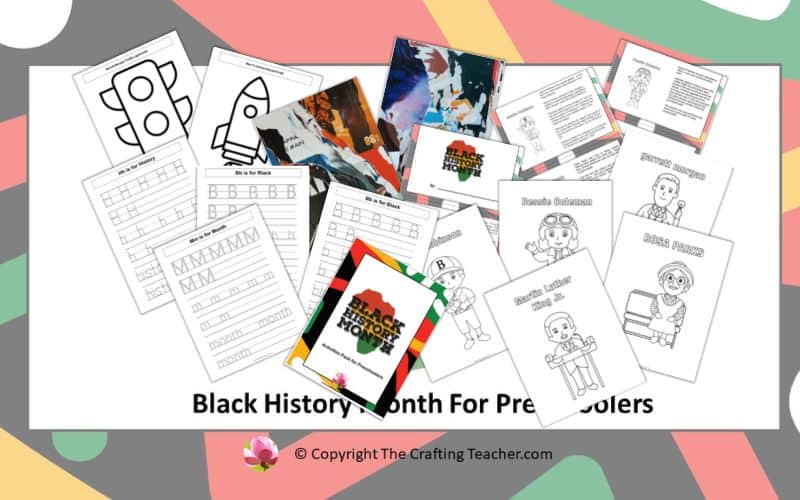
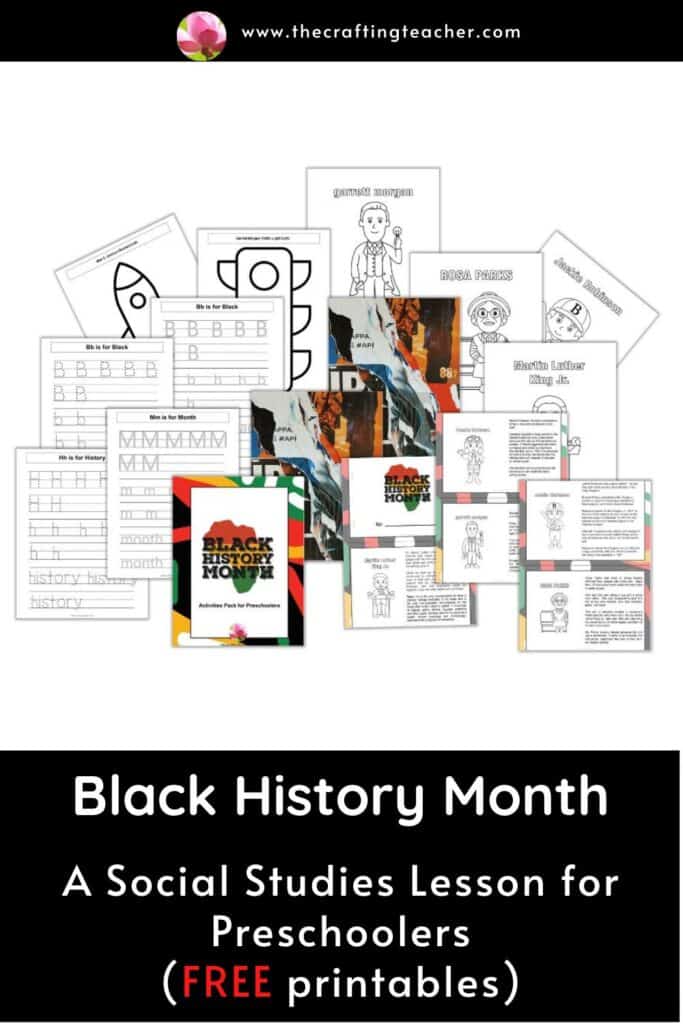
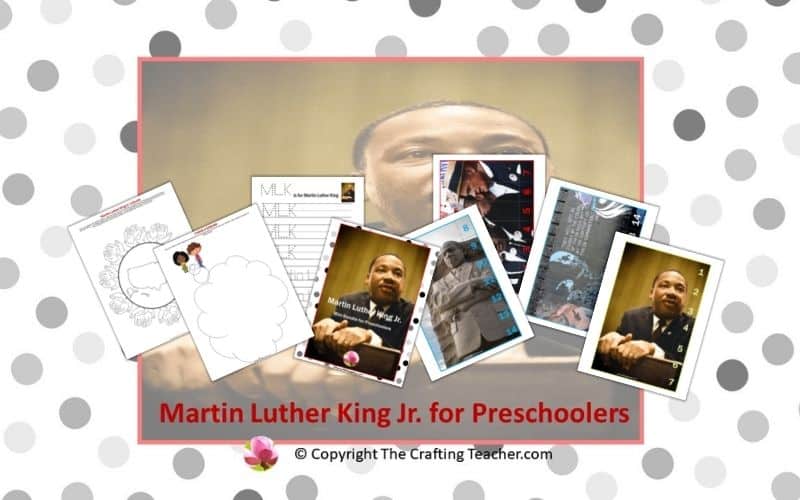
This post includes a FREE 24-page pack to complement your social studies lessons. You can get it at the end of this post.
How Black History Month Started
It all started in February of 1926, when Dr. Carter Godwin Woodson and other African American and white scholars launched “Negro History Week” with the purpose of educating and highlighting American culture, encouraging American children and adults to reflect on the history and contributions of African Americans, and also to fight for equality using a positive celebration.
Many communities embraced the idea of celebrating Black history and adopted the entire month of February as an unofficial Black History Month.
Then, in 1976, President Gerald Ford recognized this celebration of African American history and encouraged Americans to participate throughout February, turning it into Black History Month.
Today, it is recognized as an important celebration across the United States and used as a conversation point and social studies lesson in schools, libraries, museums, and many other institutions throughout the country.
How to Celebrate Black History Month
If you’re a teacher, you know how important it is to include social studies in your lessons. Celebrating Black History Month gives you the perfect opportunity to teach your children details about this culture, encourage them to respect this race, and appreciate what so many African American men and women have done for this country.
If you are a parent, no matter your family’s racial makeup, your children will be enriched when you incorporate more diversity into their lives.
Try the following activities to help your students honor African American history:
Watch Documentaries and Movies Featuring or About African-Americans
Many documentaries and movies are available to watch and show your children. These are some ideas:
- March On! The Day My Brother Martin Changed the World, which includes parts of the book written by Dr. Martin Luther King Jr.’s sister, Dr. Christine King Ferris, about the March on Washington.
- Garrett’s Gift is based on the story of Garrett Morgan and teaches us that we are all born with a gift.
- The Journey of Henry Box Brown tells the story of a former slave and how he reached freedom. Along the way, he meets several animals and teaches them about slavery and what it means to be free.
- Dancing in the Light: The Janet Collins Story tells the story of the first African-American ballerina at the Metropolitan Opera House, who was asked to paint her face white.
- The Princess and the Frog (most suited for children aged 6 and over). A Disney movie based on the fairy tale The Princess and the Frog, featuring Tiana, the first African American Disney princess.
- Hidden Figures (most suited for children aged 10 and over). This movie tells the story of Katherine Coleman Goble Johnson and two other women at NASA. An incredible untold true story about how these women were instrumental in one of history’s greatest operations: launching astronaut John Glen into orbit.
Have Children Listen to Black Music
Many Black creators are making amazing music and video content for young children. You can find many songs written by Black artists for children on the Chicago Parent website and on Spotify. You can also find a collection of the best jazz for children HERE and on YouTube.
/p>
Teach Your Preschoolers African-American Dances
One of the most traditional and recognizable types of African-American dance is stepping, which involves the whole body making sounds and rhythms. You can watch the videos I posted below with your children to follow their movements.
Also, one of the songs I love the most is Jerusalema. It is originally from Angola, southwest Africa, but I think it is one of the most fun songs of Black culture. It was introduced to the world in February of last year, and it started a dance revolution worldwide. I’m sure it will be fun to have your children dance it. Below are two videos: one danced by Masaka kids and another by teenagers to help you out.
Serve and Invite Your Families to Try African-inspired Food
This is one of the best ways to get to know a culture, and making a dish with your child is also very educational and fun. You can find easy-to-make recipes at kobokofitness.com, globetrottinkids.com, thegingerwhisk.com, and tinybeans.com. If you want more recipes, Food52.com offers 38 Recipes From Black Creators to Celebrate Black History Month.
Have Your Children Create a Collage to Represent Black History Month
Provide photos of Black figures or magazines for children to cut out and glue side by side to make a collage. Use the opportunity to talk to them about their contribution to Black history while children work.
Another idea is to use pieces of different skin-colored construction paper, to represent the different races.
Organize a Field Trip to Visit Your Local Children’s Museum
Normally, children’s museums schedule special exhibits or themed days to honor special holidays and celebrations, such as Black History Month. This is an excellent way to show children firsthand what you’re talking about.
Invite Your Families to Go to Local Kid-friendly Events in Your Town
Many public libraries, museums, and other institutions offer storytime events, classes, and other activities to celebrate Black History Month. It is a fun and educational way to expose your preschoolers to that culture.
Turn Your Classroom Into a Museum
You can create a home project and ask parents to choose a prominent African American and create a poster with their children to display in your classroom or school hallway. You can invite other classes to come and have the children explain who the person on their poster is, and even dress up like that person to make it more fun. You can offer them a list of black history figures to choose from. Some names you can use are:
- Martin Luther King Jr. (civil rights activist who fought for equality).
- John Lewis (civil rights activist who marched with Dr. Martin Luther King, Jr.).
- Malcolm X (civil rights activist).
- Jean-Michel Basquiat (an artist who invented graffiti).
- Jackie Robinson (the first African American professional baseball player).
- Rosa Parks (refused to give up her bus seat to a white man, helping advance the civil rights movement).
- Daisy Bates (journalist and civil rights activist).
- Fannie Lou Hamer (political activist and co-founder of the Freedom Democratic Party).
- Bayard Rustin (civil rights activist and organizer of the March on Washington).
- Jesse Owens (track-and-field athlete who set a world record in the long jump, and kept it for 25 years).
- Dr. Daniel Hale Williams (inventor of open-heart surgery).
- Bell Hooks (professor and promoter of feminism and education).
- Toni Morrison (novelist and essayist).
- Clara Luper (teacher and civil rights activist).
- Frederick Douglas (born a slave, became a voice for ending slavery).
- Bessie Coleman (first African-American woman to obtain an international pilot’s license).
- George Washington Carver (born a slave, he was a scientist and an inventor who found hundreds of uses for peanuts. He also invented adhesives, bleach, buttermilk, instant coffee, and shaving cream).
- Percy L. Julian (developer of innovative drugs and industrial chemicals from natural soya products).
- Shirley Chisholm (first African-American woman to serve in the United States Congress).
- Katherine Johnson (a mathematician who helped NASA send astronauts to the moon and return them safely home).
- Dorothy Johnson Vaughan (a mathematician who helped launch satellites and later humans into space).
- Harriet Tubman (risked her life as a “conductor” on the Underground Railroad, helping enslaved people escape to freedom in the North).
- Mark E. Dean (one of the top IBM engineers).
- Mae C. Jamison (first female African-American space traveler).
- Sarah Breedlove Walker (inventor and one of the largest employers of African-American women of her time).
- Ethel Waters (Blues singer and the first African-American to have a TV show, and was nominated for an Emmy).
- Gwendolyn Brooks (first Black author to win a Pulitzer Prize).
- Alice Coachman (first African-American woman in history to win an Olympic Gold Medal).
- Jane Bolin (first Black woman to attend Yale Law School and first female judge in the United States).
- Maria P. Williams (first Black woman to produce, write, and act in her own movie).
- Barack Obama (first African-American president of the United States).
- Garrett Morgan (African-American inventor who patented the 3-position traffic signal).
- Maya Angelou (writer and civil rights activist).
Honor Dr. Martin Luther King Jr. With an Activity About Equality
Ask each child to draw a self-portrait on paper and crayons. Have them share their drawings and tape them to a previously designated wall. Explain that we are all equally important, no matter how different we might look or where we come from. Have them look at each other and find differences and similarities.
Explain that discrimination is treating somebody differently because they don’t look like you, they think differently, they have physical challenges, or don’t speak your language, etc. Use concrete examples of discrimination such as:
- “You cannot play with me because you’re a girl and I’m a boy”.
- “You are ugly because you don’t have blue eyes”.
- “I cannot be your friend because you don’t go to my church”.
Then form pairs or small groups of children that don’t usually play together, and have them do an activity in one of the centers.
Invite Your Children to Paint a Graffiti
Use the three graffiti samples in the pack to explain what graffiti is, and talk about Jean-Michel Basquiat. Then provide children with paper, crayons, markers, pencils, and tempera paint, and invite them to create graffiti that honors him.
Have a Baseball Game
After you talk to the children about Jackie Robinson, provide balls, bats, and gloves, and invite them to play baseball on the playground. Maybe you can invite one of your parents to come and serve as a coach for this activity.
Use Band-Aids and Shaving Cream to Introduce George Washington Carver
Ask your preschoolers what they know about band-aids and shaving cream. Talk about what they have noticed about these items, and what experiences they have had with them. Tell them that these items were invented by George Washington Carver, who was a great man, and what his accomplishments were. Then do some or all of the following activities:
- Have them create a collage using construction paper and different band-aid colors and sizes.
- Provide different colors and shapes of band-aids. Laminate them first for durability. Invite the children to count, sort, and create patterns with them.
- Pour shaving cream on your table or on trays. Invite the children to write or draw in it.
- Pour some shaving cream into different cups. Use different colors of food coloring or tempera paint to color the shaving cream in each cup. Invite the children to use brushes and paint using the shaving cream on white paper. Let it dry. Ask each child to tell you something about their paint, and write down what they say.
Do a Sweet Potato Experiment with Your Children
Invite children to grow sweet potato plants with this fun science experiment that shows how to grow potatoes in water, honoring George Washington Carver. Children will be able to observe how the potato starts growing roots, then a little stem, and finally leaves, to become a plant that you can keep in the classroom. That way, children can watch it grow, see how it changes, measure it, and take care of it.
Honor Mae C. Jamison with a Rocket Craft
Print the rocket template provided in the pack. Cut it into pieces along the lines, glue the pieces separately on a piece of white paper, and make copies using white cardstock or construction paper. Place a picture of the full rocket so the children can see it. Give each child a set of pieces and have them glue them together to shape the rocket.
More advanced children might be able to cut out the pieces themselves, glue them, and use red and yellow tissue paper to represent the fire at the end of the rocket.
Have Children Do a Traffic Light Craft
Discuss what a traffic light is and what it is used for. Ask the children what they think will happen if this light didn’t exist. Explain that the traffic light was invented by Garrett Morgan, and talk to them about who this man was and what his accomplishments were.
Then have them do a traffic light craft. Print the traffic light template provided in the pack.
Less advanced children can color the traffic light and glue red, green, and yellow pieces of construction paper to represent the different color lights. They can also use tempera paint or playdough instead of paper.
For the most advanced children, you can cut the template into pieces following the lines. Glue the pieces separately onto a piece of white paper, then make copies on white cardstock or construction paper. Place a picture of the full traffic light so the children can see it.
Give the children the pieces and have them glue the pieces together to shape the traffic light. Some might be able to cut out the pieces themselves, glue them, and paste red, green, and yellow pieces of construction paper to represent the different light colors.
Read Books About Racial Diversity That Portray or Are Written by African-Americans
When you read books to children, you help them visualize and understand the story better as they look at the illustrations while you read.
This collection of books includes books with Black characters, books that are written by Black authors, and books that will introduce the children to influential African-American figures from the civil rights movement to the election of the first Black president, changing history forever.
- I Am Martin Luther King, Jr. by Bard Meltzer. This is a friendly, fun version of Martin Luther King, Jr.’s biography. One great role model at a time, this book encourages kids to dream big.
- Young Jackie Robinson by Edward Farrell. This biography tells the story of the first Black player in modern American major league baseball, emphasizing the prejudice he had to overcome through sheer courage.
- I Am Rosa Parks by Rosa Parks. In simple, lively language, Rosa Parks describes her life from childhood to the present and recounts the events that shook the nation when she refused to give her bus seat to a white man.
- Black Is a Rainbow Color by Angela Joy and Ekua Holmes. A child reflects on the meaning of being Black in this moving and powerful anthem about a people, a culture, a history, and a legacy that lives on.
- My First Heroes by Editors of Silver Dolphin Books. This book tells the stories of Rosa Parks, Nelson Mandela, Maya Angelou, and Serena Williams, and how their bravery changed the course of history.
- Dream Big, Little One by Vashti Harrison. Features 18 black women in American history who did extraordinary things, making the world better for generations of girls and women to come.
- Little Legends: Exceptional Men in Black History by Vashti Harrison. With beautiful illustrations, this book tells the true life stories of exceptional black men in history.
- M Is for Melanin: A Celebration of the Black Child by Tiffany Rose. This book teaches children the ABCs and includes affirming, Black-positive messages that encourage them to love the skin they’re in.
- Full, Full, Full of Love by Trish Cooke. The author introduces a gregarious family and the special bond between a child and his grannie.
- Barack Obama: A Kid’s Book About Becoming the First Black President of the United States by Mary Nhin. Children will learn a little about Barack Obama and how growing up around many different cultures shaped his view of the world and his values.
- Dancing in the Wings by Debbie Allen. Tells the story of Sassy, a little girl who dreams of becoming a ballerina, and it is loosely based on actress/choreographer Debbie Allen’s own experiences as a young dancer.
- Sulwe by Lupita Nyong’o. Using a little girl with skin darker than everyone in her family who wants to be as beautiful and bright as her mother and sister, the author creates a whimsical, heartwarming story that inspires children to see their own unique beauty.
Pin It For Later
If you are in a rush and don’t have time to read the post and download the printable but want to save it for later, pin it to one of your Pinterest boards.
Children are very observant, and no matter their age, they notice physical differences like skin color, and it is crucial that we, as teachers and parents, teach our young children to be tolerant, have empathy, and appreciate and love humanity in general, regardless of skin color, traditions, appearances, place of origin, etc.
We can support this learning through different experiences representing diversity through storybooks, music, artwork, and other activities, and having conversations about respect, tolerance, and appreciation of differences among people. In my opinion, this is the only way we can raise good humans and make a positive difference in the world.
Don’t forget your FREE Black History Month pack. Click the link below and enter your information for an immediate download.
Be happy, safe, and creative. I wish you well.
Love,

P.S. Please let me know if any of these ideas worked for you, or if you think I need to add or replace something. My goal is to help you however I can.
Other Posts You Might Like:
My Amazon Picks:
