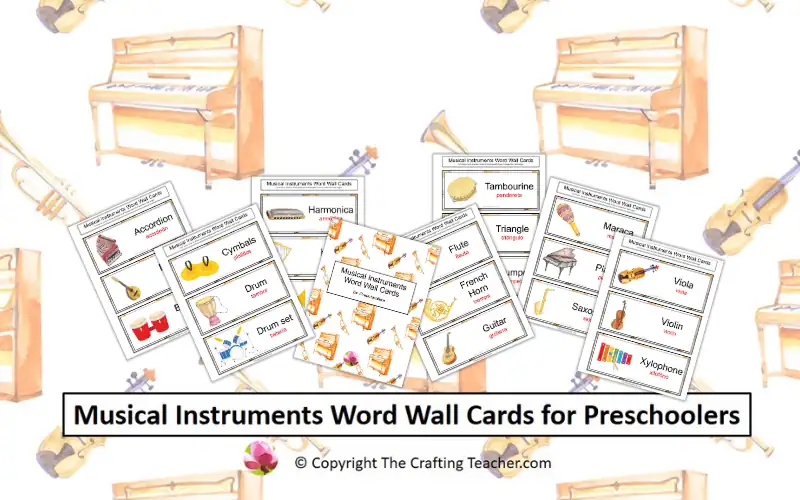
Musical Instruments Word Wall Cards
Affiliate Disclosure: “This post contains affiliate links, which means I receive a small commission, at no extra cost to you, if you make a purchase using those links.”
These Musical Instruments Word Wall Cards are a useful literacy tool to help your preschoolers learn the names of some instruments and how to write them.
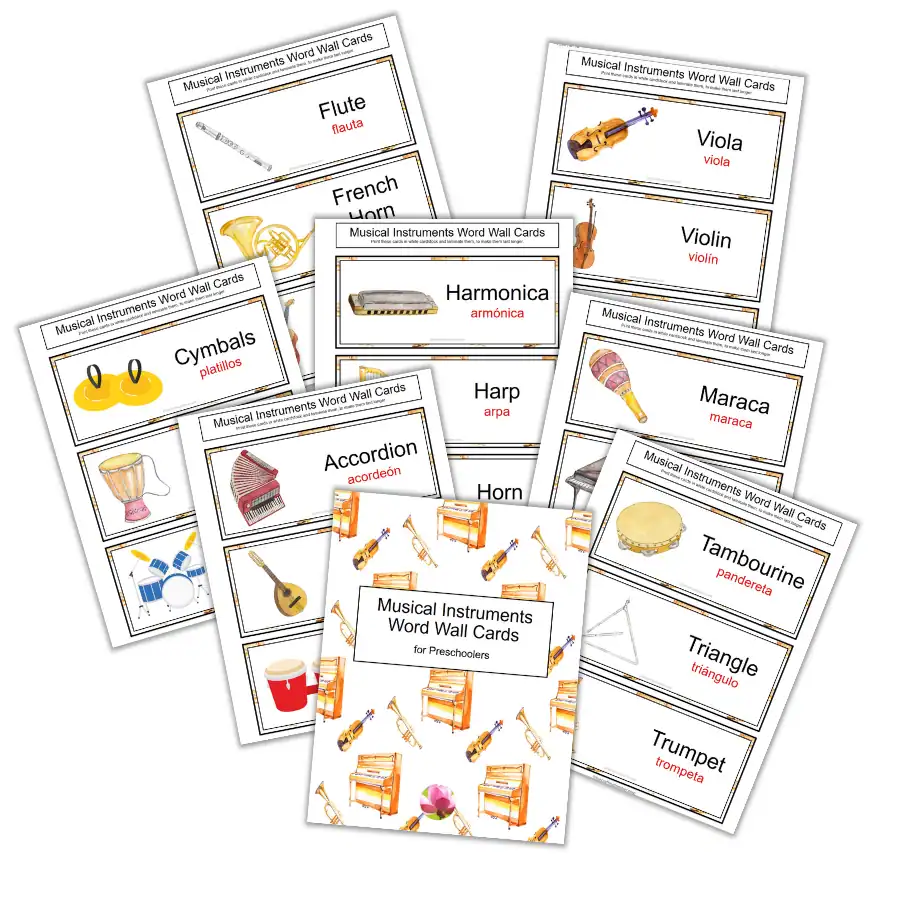
This FREE Musical Instruments Word Wall Cards pack includes seven pages, each with three cards, for twenty-one cards. The musical instrument name in English is entirely black, and underneath, you will find the Spanish version in red. You can download the cards at the end of this post.
Musical Instruments Word Wall Cards
Word wall cards are a vital literacy tool that helps your preschoolers build essential literacy and cognitive skills, especially alphabet and letter recognition, phonological awareness, and vocabulary, building up the foundation for future reading and writing.
The most important skills your preschoolers will develop using word wall cards are:
Language and Literacy Skills
- Language Development – When children talk about the pictures in the cards and describe their attributes, characteristics, colors, etc., and connect these words with real objects and sounds.
- Letter Identification – When they match initial letters of familiar words or names to the alphabet.
- Letter Recognition and Phonics – When children notice that some words start with the same letter, like viola and violin.
- One-to-one correspondence – matching magnetic, foam, or wooden letters with the letters in the musical instruments’ names.
- Print Awareness – The children learn that print runs from left to right, carries meaning, letters form distinct words, and matches spoken language.
- Pre-writing and Fine Motor Development – Copying the words with magnetic, foam, or wooden letters, crayons, markers, or pencils, and tracing them with dry-erase markers.
- Phonological Awareness, Syllable Segmentation and Phonics – These cards can be used to sound out the beginning sounds (like /d/ in drum) and the syllables in the words. They also help children link letters to sounds, reinforcing early phonics.
- Vocabulary – These word cards introduce objects (musical instruments). Other types of word cards can also introduce descriptive words and concepts.
- Pre-reading and Labeling – When they observe the picture and say its name (word), they also learn the exact names of these instruments, instead of using generic words.
- Categorization – Children can group these words by properties (wood, metal), or types of instruments (strings, percussion, wind).
Cognitive Skills
- Visual Discrimination – Looking at the pictures on the cards helps children notice details and differences and similarities between images of different instruments, which supports letter recognition.
- Memory – Looking at the pictures and words on the cards helps children store information and use it when needed, strengthening their memory.
- Pattern Recognition – Observing the words can help them develop their capacity to spot repeating letters, shapes, and sounds.
- Classification and Sorting – When children use these cards to group the instruments into families, or by initial letters, colors, or attributes, they develop logical thinking, information-organizing skills, and early mathematical skills.
- Auditory, Visual and Verbal Processing – Matching the pictures on the cards to the sound of the instruments builds sensory connections, and naming and talking about the instruments expand the children’s vocabulary, language, and phonological awareness.
Social Skills
- Independence – When children use the cards on their own during free play to match the pictures with real instruments or write, copy or read the words.
- Self-regulation – These cards offer visual clues that encourage children to pause and perform tasks that require concentration and patience, such as copying or writing the words and sorting the instruments.
- Teamwork and Cooperation – Children can use these cards to select an instrument to play and form a band, or work together to match the pictures with real instruments.
How to Prepare and Display the Musical Instruments Word Wall Cards
These cards do not require a lot of materials to keep the budget under control, and you probably already have all or most of them. You will need:
- Musical Instruments Word Wall Cards (found at the end of this post).
- printer
- white cardstock
- scissors
- laminator machine
- laminator pouches
Print out the pages with the cards using white cardstock. Then cut out and laminate each card to protect it and make it last longer. Remember, you will need one set for the word wall and one set for each center where you want to place them.
Display these cards where children can see them on the word wall and in other areas. That way, you and your children can use them for large- and small-group activities. Some ideas and areas I can give you are:
- Word Wall – take one set and place the cards on your word wall under the same alphabet letter as the beginning letter of each word. That way, your students will recognize the correct letters.
- Writing Area -Invite your preschoolers to practice their pre-writing skills by matching the words with magnetic, foam, or wooden letters, tracing them with dry-erase markers, and copying them with crayons, markers, or pencils.
- Music Area – encourage the children to match the pictures with the physical musical instruments. They can also select an instrument to play and form a band.
- Art Area – invite them to use the pictures on the cards as models for them to draw or paint their favorite instrument, or sculpt it using play dough.
- Library – encourage the children to look for the exact words in books and to find books that show these instruments.
- Math Area – Give the children opportunities to classify instruments by properties (wood, metal), types (strings, percussion, wind), sizes (small, medium, large), or colors.
- Sensory Table – Provide the sensory table or tray with sand or salt and the instrument cards, and invite the children to observe the words and trace them with their fingers in the sand or salt.
Other Activities:
- Sound Match: Play an audio clip of an instrument and have children race to find its matching card.
- Syllable March: Select a card like vi-o-lin and have children march and stomp out the three distinct syllable beats.
- Sound Sorting: Group multiple cards together by their starting or ending letter sounds, or onset and rhyme.
- Air Band: Show them an instrument card and have the children pretend to play it, while mimicking its sound.
- Mystery Box or Bag: Hide small musical instruments in a box or bag. Invite a child to feel it without looking and try to guess what instrument it is, saying its name out loud. Then take it out and match it to the wall card.
Musical Instruments-related Books
These are some books you can use for story time or your library. You can find them at your local library, a used bookstore, or on Amazon. For your convenience, I added my affiliate links to each title, which will take you to the Amazon website in seconds.
- ABCs of Musical Instruments by Little Acorn Press. Filled with bright, joyful illustrations of each instrument in action, this book introduces instrument names and how each instrument works and sounds.
- Hello, World! Music by Jill McDonald. This book teaches all about musical instruments and the sounds they make, with colors, shapes, sizes, and simple facts.
- Toodle Oodle OOPS! My First School Band Instrument by Bryan Jones. This rhyming book introduces children to band instruments, offering flowing cadence, musical sounds, and some funny oops moments.
- My Piano by Jen Fier Jasinski. This book uses lyrical text and a cumulative structure to introduce the instrument and encourage readers to appreciate its beauty and design.
- Family Dynamics: Embrace Your Sound by Courtney Vowell Woodward. Tells the story of Violin, who always hears beautiful music throughout the music store where she lives, but can never make the same sounds; she meets new instrument families along the way and learns how their unique sounds and qualities create the symphony orchestra.
- The Curious Kid’s Book About Musical Instruments by Wendy Adams. With colorful illustrations and easy-to-understand text, this book shows how instruments work and how they come together to make beautiful sounds.
- Let’s Play an Instrument by Rachelle Burk. Using simple language and big, beautiful illustrations, this book teaches children about woodwind, string, brass, and percussion instruments, what each one is called, how it works, the sounds it makes, and why it helps make music.
Pin It For Later
If you are in a rush and don’t have time to read the post and download the printable but want to save it for later, pin this to one of your Pinterest boards.
Remember to grab your free Musical Instruments Word Wall Cards! Click on the link below to download them immediately and start using them daily in your classroom.
I hope you and your preschoolers enjoy this printable and that it becomes a fun and useful resource for all of you.
Be happy, safe, and creative. I wish you well.
Love,

P.S. Please let me know your thoughts on these cards, and whether you would like to see more word wall cards.
Other Posts You Might Like: