Celebrating World Tapir Day With Preschoolers
Affiliate Disclosure: “This post contains affiliate links, which means I receive a small commission, at no extra cost, if you make a purchase using those links.”
World Tapir Day is celebrated every year on April 27 to raise awareness and educate about unique mammals among critically endangered species, advocate for their protection to prevent extinction, and raise funds to support conservation efforts.

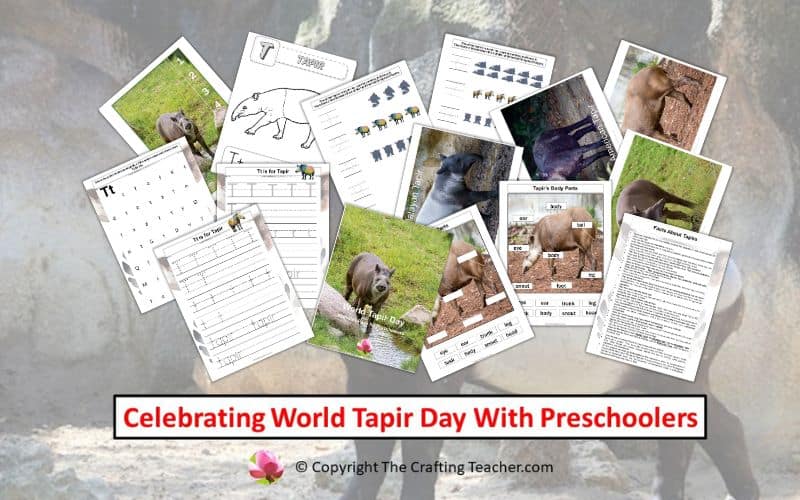
I have included a FREE 17-page World Tapir Day activities pack with Literacy, Science, Math, and Fine Motor activities for your preschoolers, available for download at the end of this post.
History of World Tapir Day
Tapir lovers and conservationists worldwide banded together to establish this special animal day to educate people about the importance of sustaining healthy ecosystems and the serious threats tapirs face from habitat loss and hunting, which has caused all four tapir species to be listed as vulnerable or endangered.
Through their call to action, they motivated zoos, other conservationists, and wildlife organizations worldwide to get involved by creating educational programs, hosting events, and running campaigns to spread the word.
What started as a simple effort has grown into a global, multi-step campaign to protect our planet’s biodiversity and avoid the extinction of these interesting mammals and other endangered species, so future generations can get to know them as well.
Today, worldwide organizations such as Fondation Segré World Tapir Conservation Programme and the IUCN Tapir Specialist Group, have created special projects such as the Guatemala Baird’s Tapir Conservation Programme, the Nicaragua Baird’s Tapir Project, the New Conservation Assessment of Mountain Tapirs in Colombia, the Lowland Tapir Conservation Initiative (LTCI), the Conservation of Malayan Tapirs, and the Fragmented Landscapes Project in Sumatra, San Diego Zoo Wildlife Alliance, and the Brevard Zoo, LTCI, are using technology, GPS collars, cameras, best management practices, research, biological and genetics studies, and other resources to protect fragmented landscapes and the biomes where the tapirs live, sharing this information with local communities and offering financial solutions to create partnerships and help them coexists better with these animals.
Facts About Tapirs
- Tapirs are considered to be living fossils because they appeared in North America about 55 million years ago.
- They are the largest land mammals in South America.
- Although they look like a mix of a pig and an elephant, they are genetically closely related to horses and rhinoceroses.
- Their eyes and ears are small, and their teardrop-shaped body has short, bristly hair in varying shades of red, brown, gray, or black, with large, protruding rumps.
- Their skin is tough on their back and neck, which protects them from many predators.
- They have four toes on each front foot and three on the back foot. Their toes splay to help create traction in mud and on hillsides.
- Their coloring allows them to blend into their surroundings.
- Tapirs like to be in the water, and they can even forage underwater.

- Tapirs are herbivores. They consume leaves, shoots, fruit, branches, and tree bark. They eat twice a day, in the morning and the evening.
- They have between 42 and 44 flat teeth.
- They help new plants grow by spreading seeds they eat while foraging and defecating.
- Their snout and upper lip are fused into a trunk-like nose called a proboscis that can move in all directions. It’s flexible enough to grab fruits, leaves, and other food items; it also acts as a snorkel underwater and helps them detect odors through dense vegetation.
- They have stubby tails and short legs, and they can run through the bush pretty fast.
- They are also nocturnal, which means they are more active at night when it is cooler.
- Depending on the species, they can reach more than six feet long, nearly three feet high, and weigh 400 to 800 pounds. The largest is the Malay tapir, and the smallest is the Woolly tapir. Male tapirs are slightly smaller than females.
- They are secretive animals that live in wetlands, forests, savannas, and rainforests with diverse, dense undergrowth, low fire incidence, and undisturbed ecosystems. Three species live in Mexico, Central America, and South America. One species, the Malayan Tapir, lives in Malaya and Sumatra, in Southeast Asia.
- Tapirs can communicate using high-pitched sounds, foot stamping, and urine markings.
- They often graze in pairs or small groups called a candle.
- They have a low birth rate. Every two years, a female tapir has one calf while standing, and she stays with it for more than a year.
- The calf is born with its eyes open, can stand one or two hours after birth, and has patterns with lines and spots on its body that help it camouflage.

- There are four species of tapir: Baird’s Tapir, the Brazilian Tapir, and the Mountain Tapir, distributed across South and Central America; and the Malayan Tapir, which is found in Southeast Asia.
- The Baird’s Tapir is also called the Central American Tapir; the Brazilian Tapir is also called the Lowland Tapir or South American Tapir, and the Mountain Tapir is also called the Woolly Tapir.
- The Malayan Tapir is also called Asian Tapir, Asiatic Tapir, Oriental Tapir, Indian Tapir, Piebald Tapir, or Black-and-White Tapir.
- Their lifespan is between 20 and 30 years in the wild and in captivity.
- Tapirs are in danger. People hunt them for their meat and hide, and even for sport in Costa Rica. Other threats include climate change and habitat loss due to farming, cattle grazing, plantations, and development.
- All four species are listed as Endangered on the International Union for Conservation of Nature (IUCN) Red List of Threatened Species. It is also included in the List of Endangered Species of Guatemala (LEA) and the Convention on International Trade in Endangered Species of Wild Fauna and Flora (CITES).
How to Celebrate World Tapir Day
Tapirs are unknown to many people worldwide; we should learn about them and spread the word to inform others, especially our preschoolers. Participating in the events World Tapir Day promotes, watching videos, posting on social media, going to the zoo to observe them in person, and using this opportunity to teach our children important scientific lessons will help preserve these amazing mammals.
Below are some ideas of activities you can do:
- Start by learning more about tapirs. You cannot teach what you don’t know. Educate yourself to educate others.
- Print a tapir mask for each child and invite them to dress up as a tapir in grey, black, or white-and-black clothes. Have a parade to spark curiosity among observers, and use the opportunity to share information.
- Plan tapir artwork for your children, like the Tapir Printable Craft from Learn Create Love, or have your children create drawings and paintings, then prepare an exhibit to share with the public or on social media, including facts and information about tapirs.
- Show your children, family, and friends tapir documentaries. You can find some on YouTube, like The Tale of the Tapir, TAPIRS: Nature’s Strange Swimming Submarine, What in the World is a Tapir? by National Geographic, and Tapirs by San Diego Zoo.
- Include tapir toys in your different areas, like this Malayan tapir, this baby tapir, and this Brazilian tapir. You can also add stuffed tapirs like this one, this one, or this one.
- Research what activities and special events zoos and conservation organizations in your area are doing today, and participate with your children and their families.
- Find out if your local zoo has a tapir exhibit, and plan a field trip with your children to observe these animals in person and learn about them firsthand. If you cannot make it in person, research which zoos offer virtual tours, especially during World Tapir Day.
- Promote a symbolic tapir adoption with the National Wildlife Federation, the Hertfordshire Zoo, or the Zoo Society. These funds will support these organizations’ efforts to protect tapirs and other wildlife and promote healthy ecosystems.
- Use your social media to spread awareness for tapirs by posting facts and promoting their conservation. You can use #WorldTapirDay, join the World Tapir Day Facebook group, and follow the groups on Instagram and Twitter.
- Create a campaign to raise funds to support organizations and projects fighting for tapir conservation. One way is to invite your families to purchase an item from the World Tapir Day store. There is pretty stuff in there.
Other Activities:
- Help your children measure a tapir size in the playground, using pieces of string or steps.
- Play “Follow the Tapir”, like you would “Follow the Leader”, or “Pig, Pig, Tapir” like you would “Duck, Duck, Goose“.
- Invite preschoolers to copy the tapir names with pencils, markers, or crayons, or match them with magnetic, wooden, or foam letters.
- Have children spell the tapir names.
- Have them color a tapir with crayons or markers, or paint it with tempera paint.
- Add water, rainforest mini toys that include the tapir, pebbles, moss, and small branches to the sensory table for the children to play with.
- Present pictures of tapirs and have them compare their characteristics.
- Have them find other words that have the same beginning sound.
- Have them find rhyming words.
- Have them clap the syllables of the tapir names.
- Invite an expert to the classroom to talk to your children about tapirs and what we can do to help protect them.
Tapir-related Books
Never forget to read to your preschoolers. Listening to stories brings children in, sparks their interest, and helps them visualize and learn better. To be honest, I haven’t been able to find many books about tapirs, but I wanted to include the ones I use below. I don’t know if you can find these books at your local library or used bookstore (maybe you can find different ones), but you can definitely find them on Amazon. I included my affiliate links to make it easier to find the right page.
- Can Tapir Play? by Sabina Gibson. This story presents a baby tapir sliding and rolling in the mud, tiger cubs learning to leap, and baby monkeys attempting to swing and climb.
- Facts About the Tapir by Lisa Strattin. This educational book presents facts, full-color photographs, and carefully chosen words to teach children about the Tapir.
- The Tapir Scientist: Saving South America’s Largest Mammal by Sy Montgomery. In this nonfiction picture book, the author joins a tapir-finding expedition led by the Brazilian field scientist Pati Medici, and includes descriptions of fieldwork and the use of high-tech science in tapir life.
- The Tapir. Do Your Kids Know About This? by Tanya Turner. This children’s picture book teaches facts about tapirs.
Pin It For Later
If you are in a rush and don’t have time to read the post and download the printable but want to save it for later, pin it to one of your Pinterest boards.

Children must have a better understanding of tapirs and other endangered species, and you, as teachers and parents of preschoolers, can encourage them to love, support, and protect these animals. This World Tapir Day, make a vow to teach your children all of this, so they can become protectors and advocates for our planet and its inhabitants, so we all can have healthy ecosystems where every life thrives.
I hope you enjoy these ideas and that they help you have fun celebrating World Tapir Day with your preschoolers. To get the FREE pack, click on the link below and enter your information for an immediate download.
Be happy, safe, and creative. I wish you well.
Love,

P.S. Please let me know if any of these ideas worked for you, or if you came up with different ideas you’d like to share; I would love to post them as well.
Other Posts You Might Like: