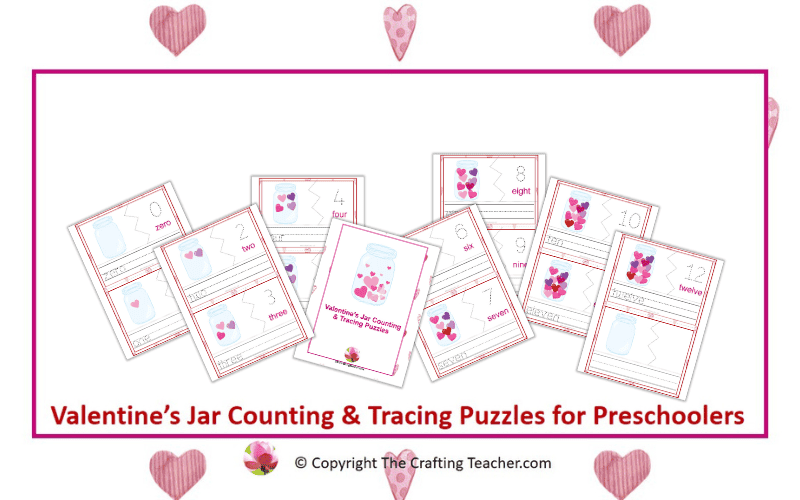
Valentine’s Jar Counting & Tracing Puzzles for Preschoolers
Affiliate Disclosure: “This post contains affiliate links, which means I receive a small commission, at no extra cost to you, if you make a purchase using those links.”
These FREE Valentine’s Jar Counting and Tracing Puzzles will allow you to provide your preschoolers with a combined Math and Pre-writing activity, perfect for February.
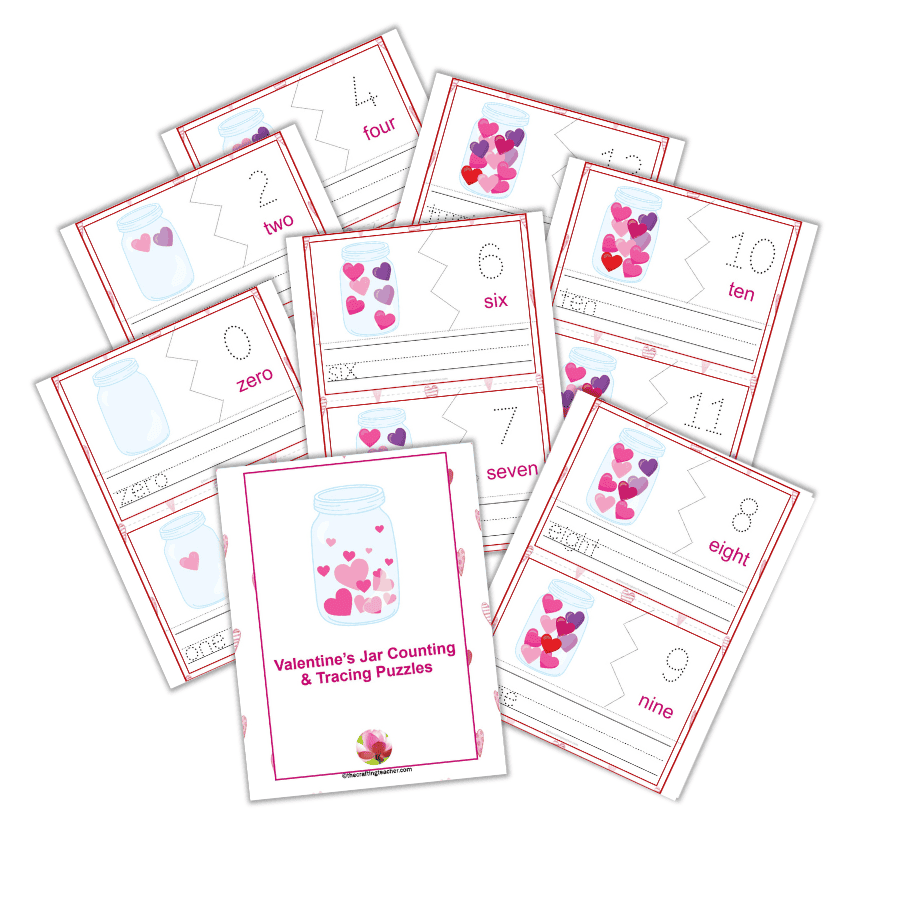
These Valentine’s Jar Math and Tracing Puzzles set includes seven sheets, each with two puzzles, covering numbers 0 to 12. The last card is blank, so you must enter as many numbers as possible. You can download it at the end of the post.
Valentine’s Day Counting and Tracing Puzzles
These Valentine’s Day Counting and Tracing Puzzles are designed taking into consideration the different levels that your children might be in by making them available for you to divide them into two or three parts:
- One part includes the object at the specified amount.
- The second part shows the written numeral, in dotted font, indicating the number of objects and the number word.
- The third part includes the written number word in dotted form, which preschoolers can trace, and they then write the word next to it.
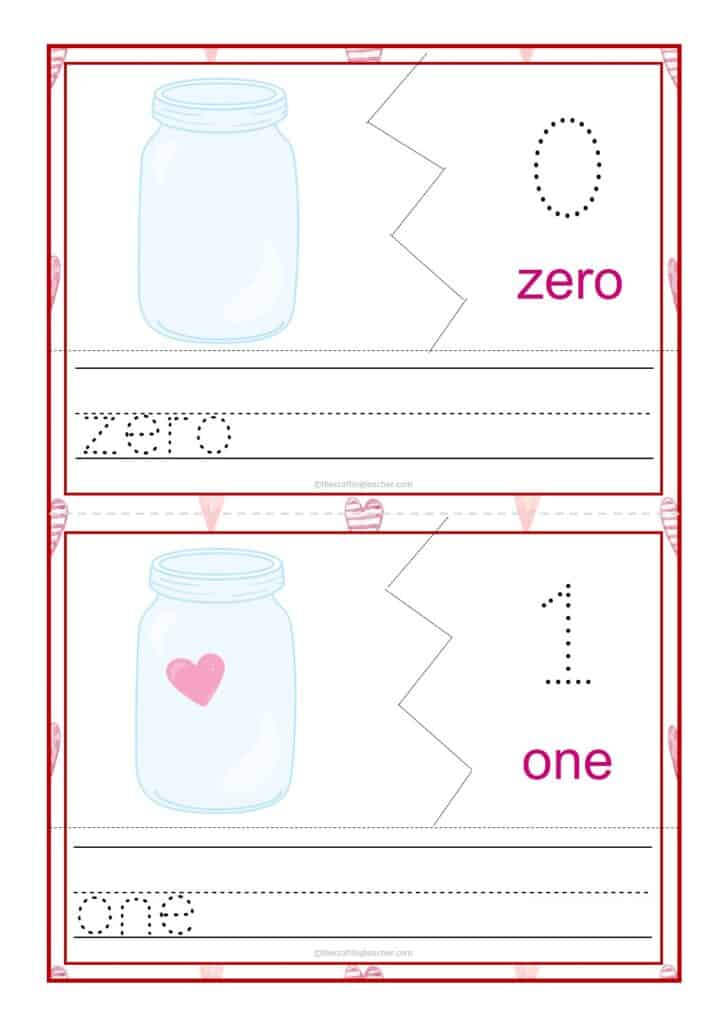
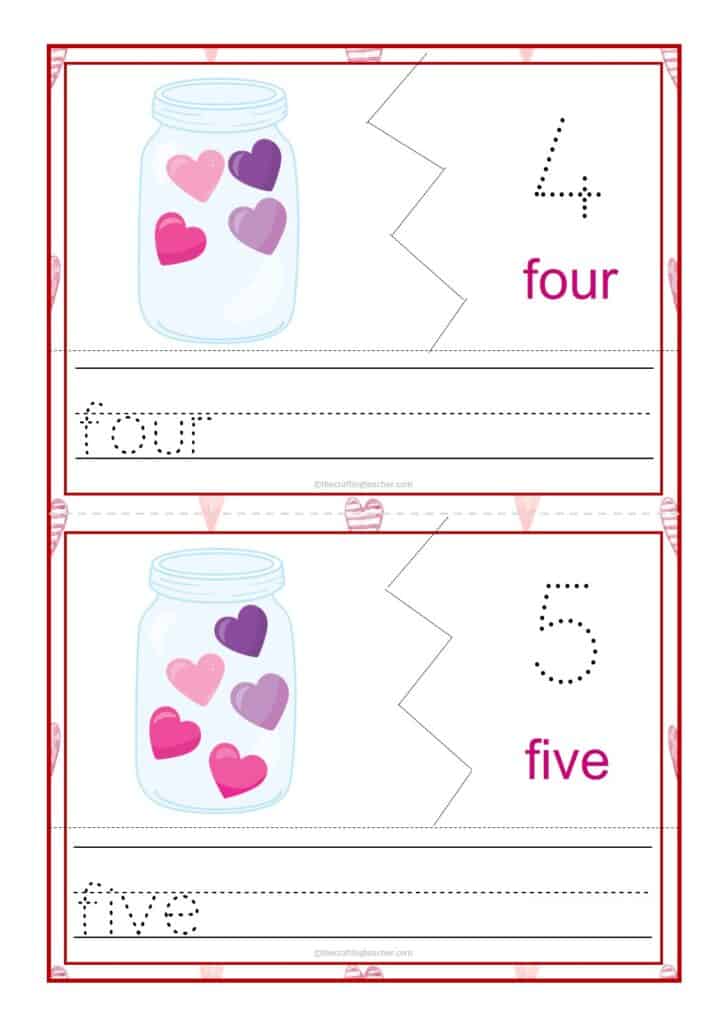
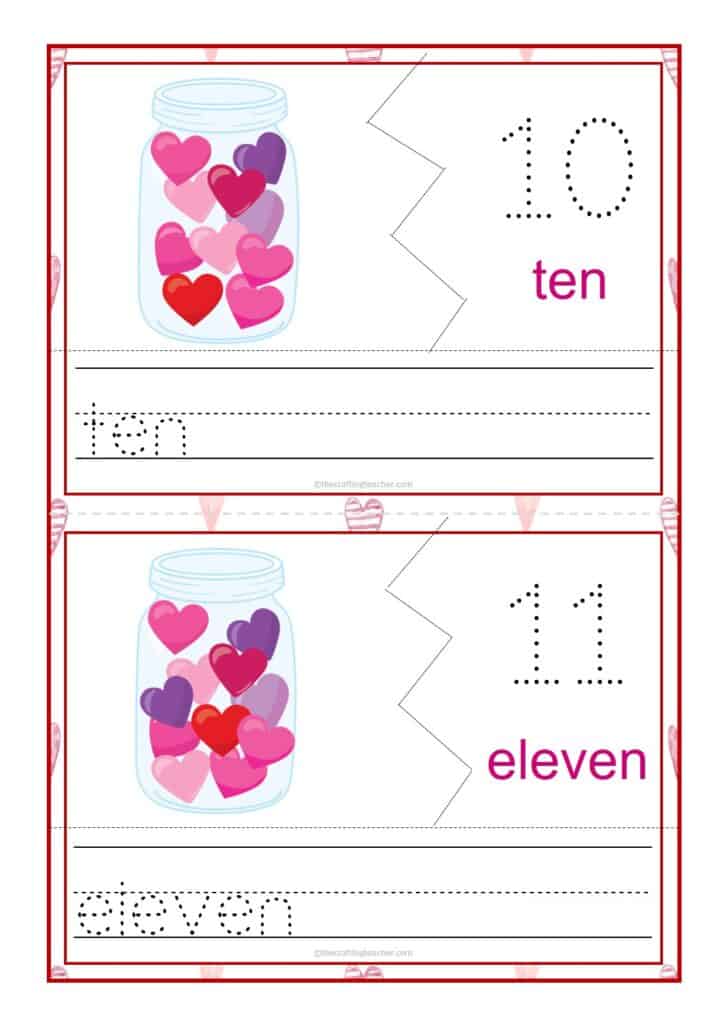
If your children begin to recognize numerals and numbers in their written form, you can divide them into three groups. For children who do not recognize the written word but just the numeral, you have to keep that part intact and not cut it.
These puzzles can be used in many ways, such as:
- Small group activity.
- Math center option.
- Writing center option.
- Take-home activity.
- Quiet area option.
Benefits of These Puzzles
The Valentine’s Jar Counting & Tracing Puzzles will allow preschoolers to practice:
- Counting abilities (counting the objects).
- Number recognition (identifying the number that matches the number of objects).
- Fine motor development (putting the pieces of the puzzle together).
- Hand-eye coordination and control (placing the correct pieces in the right place).
- Concentration skills (focusing on the different tasks).
- Language development (naming the numeral and identifying the written name).
Also, this fun activity will boost their confidence, making them proud of their accomplishments. If you add additional tracing materials and themes, it helps develop their creativity.
How to Get the Puzzles Ready
To get these low-prep puzzles ready, you will need a handful of materials, such as:
Print each page using white cardstock. Cut out the cards along the dotted lines and laminate them to extend their lifespan. I suggest making several copies, cutting the puzzles into two or three parts based on your children’s needs, and having them work on these puzzles individually or with a partner.
At the end of the month, you can put your puzzles in a small Ziploc bag and store them in a pencil box or binder for the following year, so you can have them ready for many Valentine months in the future.
Before you place the mats in the different centers, it is recommended that you introduce them to your preschoolers first. Circle time might be the perfect time to do this. There is no point in placing these puzzles in centers if participants don’t know how to use them.
An excellent way to do this is by:
- Introduce the puzzles to the children and discuss each part and its characteristics.
- Talk about small and large numbers, such as number 3, which has fewer pictures than number 8 because it is smaller.
- Explain that they have to point and count out loud the pictures on each part, find the number that goes with it to put the parts together, then find the written word for that number to put all the parts together, and trace the numbers and number words.
I recommend observing your children as they work on these puzzles to monitor their progress and take notes on which numbers and number words they recognize and how well they count. This will allow you to build on that and help those who don’t remember all of them.
Extension Activities
You can also add Valentine’s-related activities to your centers to expand opportunities and keep your preschoolers motivated and engaged. If you don’t want to use many simultaneously, use one or two different ones daily.
Some ways to do this are:
- Add manipulatives such as heart mini erasers, red-heart acrylic gems, buttons, pom-poms, or other small items, and have the children match each number to the same number of objects.
- Have the children trace the numbers and number words using dry-erase markers.
- Have them copy it using pencils, crayons, or markers.
- Match each number with magnetic, foam, or wooden numbers.
- Provide copies of the pages and have your preschoolers cut out the cards and glue them back together on a piece of construction or regular paper.
- Draw the pictures.
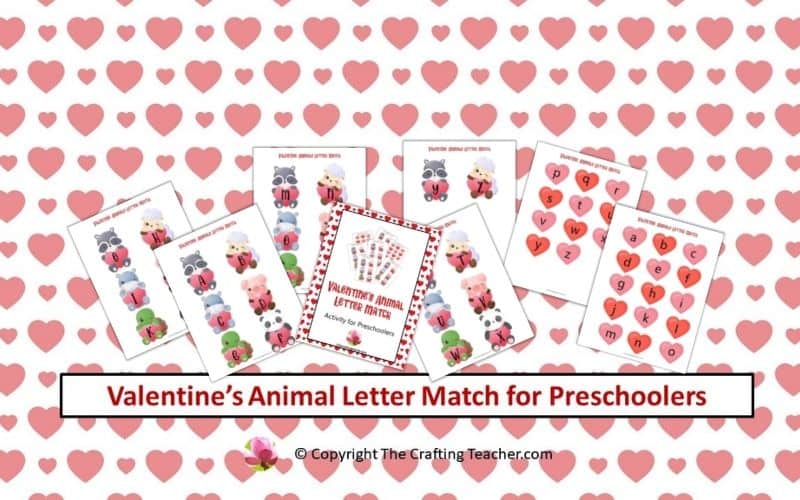
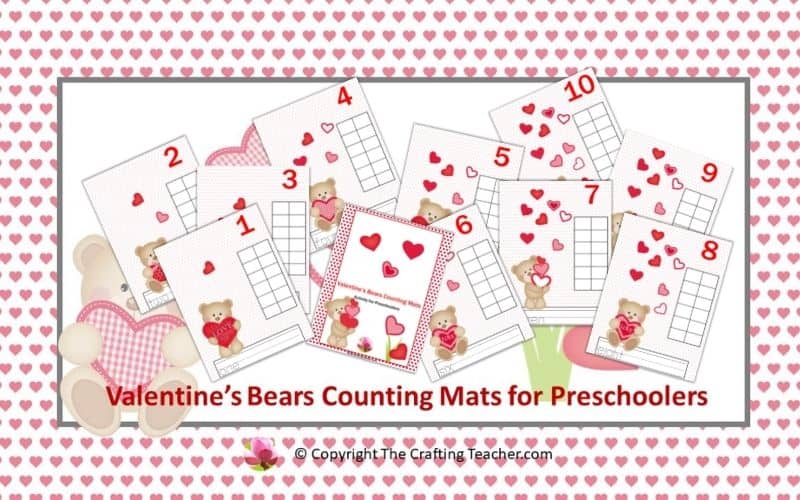
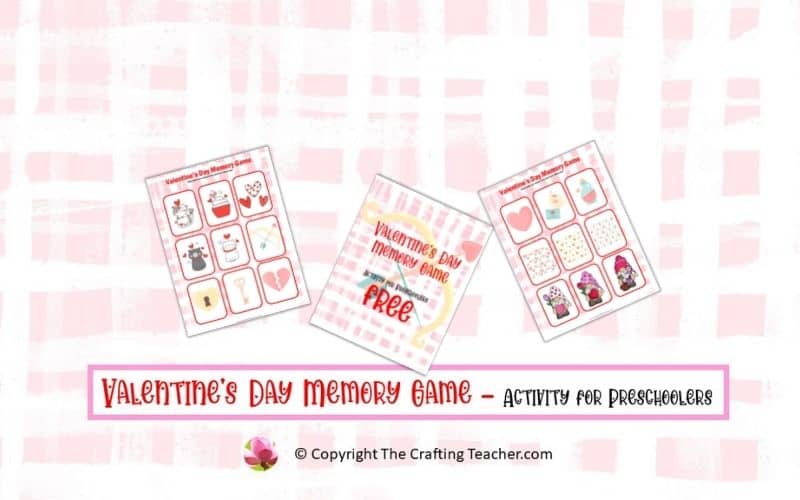
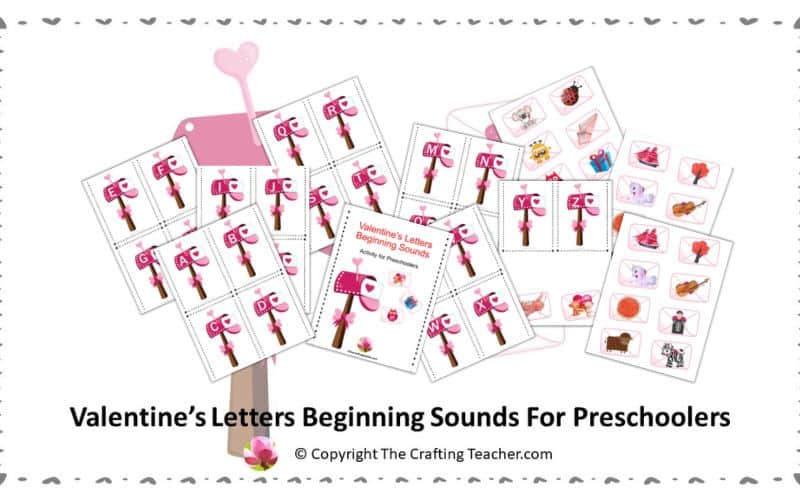
- Mix them with other Valentine’s Day activities such as Valentine’s Animal Letter Match, Valentine’s Bears Counting Mats, Valentine’s Beginning Sound Clip Cards, Valentine’s Day Bingo, Valentine’s Day Find the Letter activities, Valentine’s Day Memory Game, Valentine’s Day Math Puzzles, Valentine’s Day Word Wall Cards, Valentine’s Day Tracing activities, Valentine’s Day Beginning Sounds, and Heart Letter Match activities. They all come with FREE printables for you to grab.
Valentine’s Day-related Story Books
As usual, I suggest that you never forget books. They are magical instruments for your children’s inspiration, imagination, and learning. Most importantly, reading books is a fun activity that every child loves.
Here are some examples to get you started. You can find these books at your local library, used bookstore, and on Amazon. If you want to purchase some, my affiliate links embedded in the titles will take you to the right page in seconds.
- How to Catch a Loveosaurus by Alice Walstead. Blending exciting traps and STEAM concepts with hilarity and chaos to encourage reading, learning, and imagination, tell the story about how the kids are on the chase again, this time to trap a dinosaur that escaped from the museum and wants to spread love and kindness.
- Dr. Seuss Lovey Things uses the signature Dr. Seuss rhyme, highlighting how Thing One and Thing Two share, care, smile, hug, and blow kisses.
- The Littlest Valentine by Brandi Dougherty tells the story of Emma, who is the littlest in the Valentine family, but knows that she has what it takes to help the family business get ready for the holiday.
- Little Blue’s Truck Valentines by Alice Schertle tells the story of how Little Blue Truck delivers Valentine’s Day cards to all his farm animal friends.
- There Was an Old Lady Who Swallowed a Rose by Lucille Colandro uses rhyming text and hilarious illustrations to show how the Old Lady swallows a rose, some lace, some glitter, and more to make a special gift for her Valentine!
- Pete the Cat: Valentine’s Day is Cool by James Dean is about Pete the Cat realizing how much fun Valentine’s Day can be and deciding to make valentine cards for his family and friends.
- Happy Valentine’s Day, Mouse! by Laura Numeroff features Mouse as he makes valentines for all his friends, highlighting what he loves most about each.
Pin It For Later
If you’re in a rush and don’t have time to read the post and download the printable but want to save it later, pin it to your Math, Writing, or Valentine’s Day board on Pinterest.
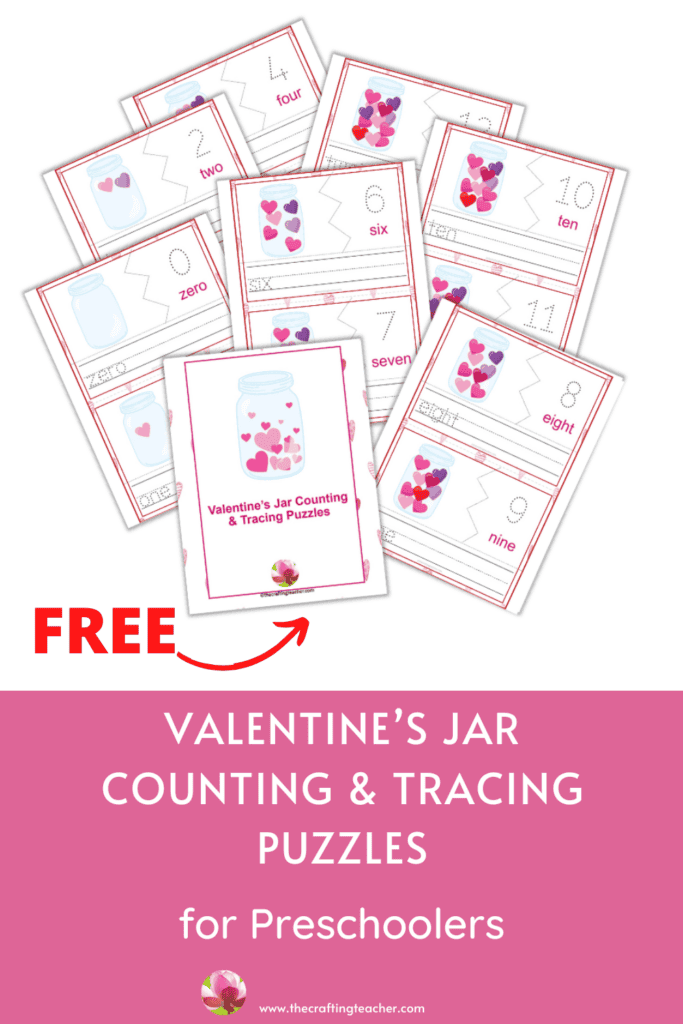
Don’t forget to get your FREE printable. Click the link below to download immediately.
I hope you and your preschoolers enjoy these puzzles and that they help make your lesson planning a little easier.
Be happy, safe, and creative. I wish you well.
Love,

P.S. Please let me know how these puzzles work for you. I am very interested in what you have to say, so I can improve what I offer you