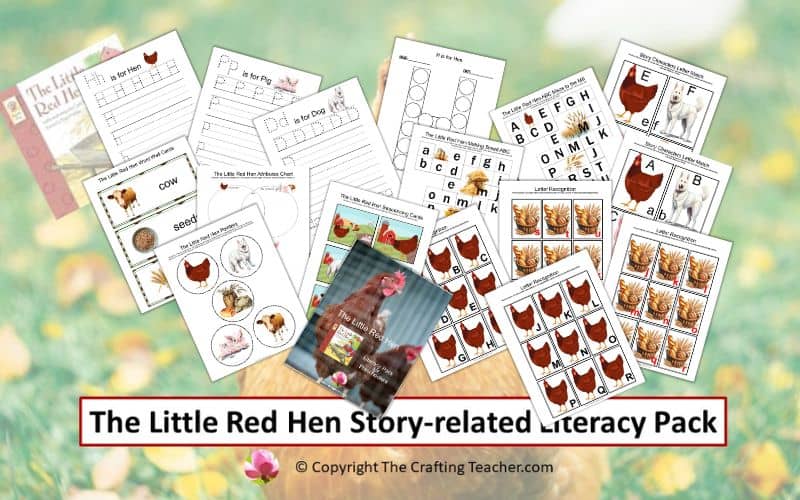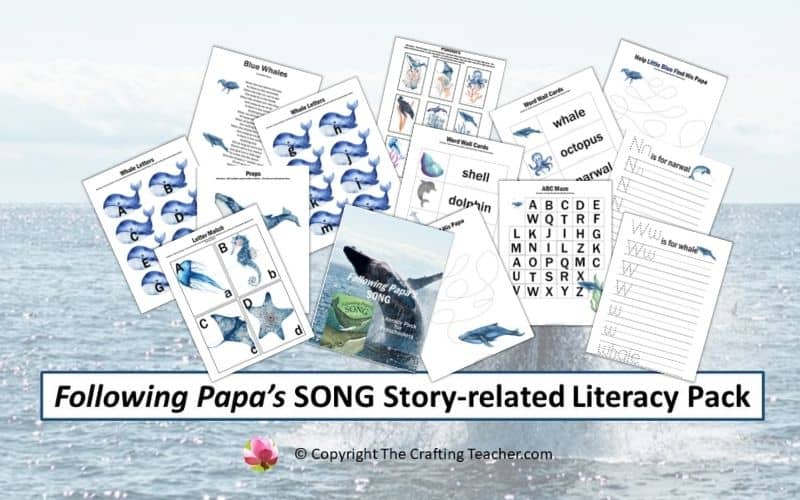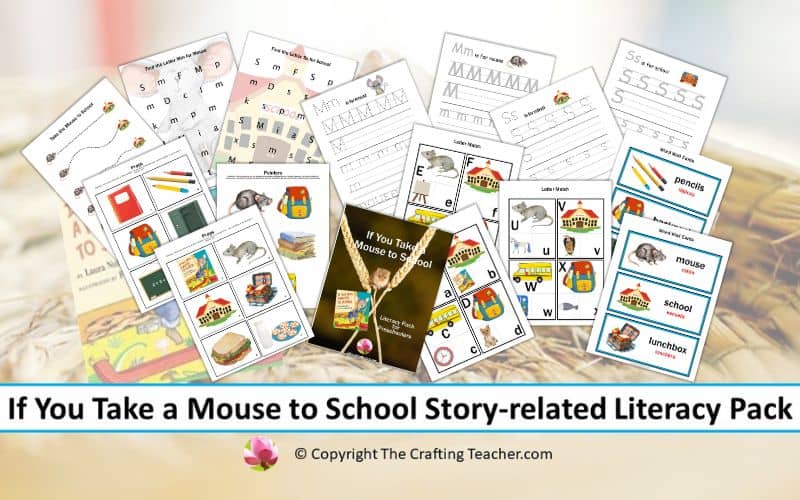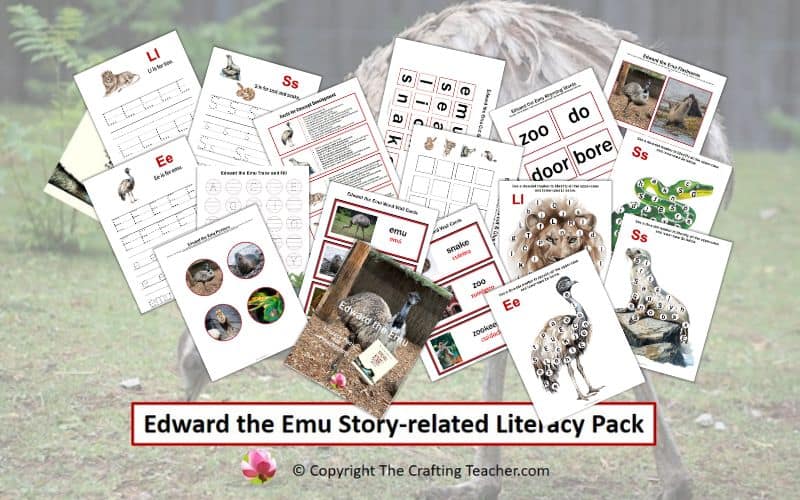
The Napping House Story-related Literacy Pack for Preschoolers
Affiliate Disclosure: “This post contains affiliate links, which means I receive a small commission, at no extra cost to you, if you make a purchase using those links.”
The Napping House, by Audrey Wood, is a classic children’s book designed to help children understand patterns, using cumulative rhyme and illustrations to tell the story of a sleeping granny, a child, and animals who pile up in a bed until a flea bites the mouse and wakes everyone up.
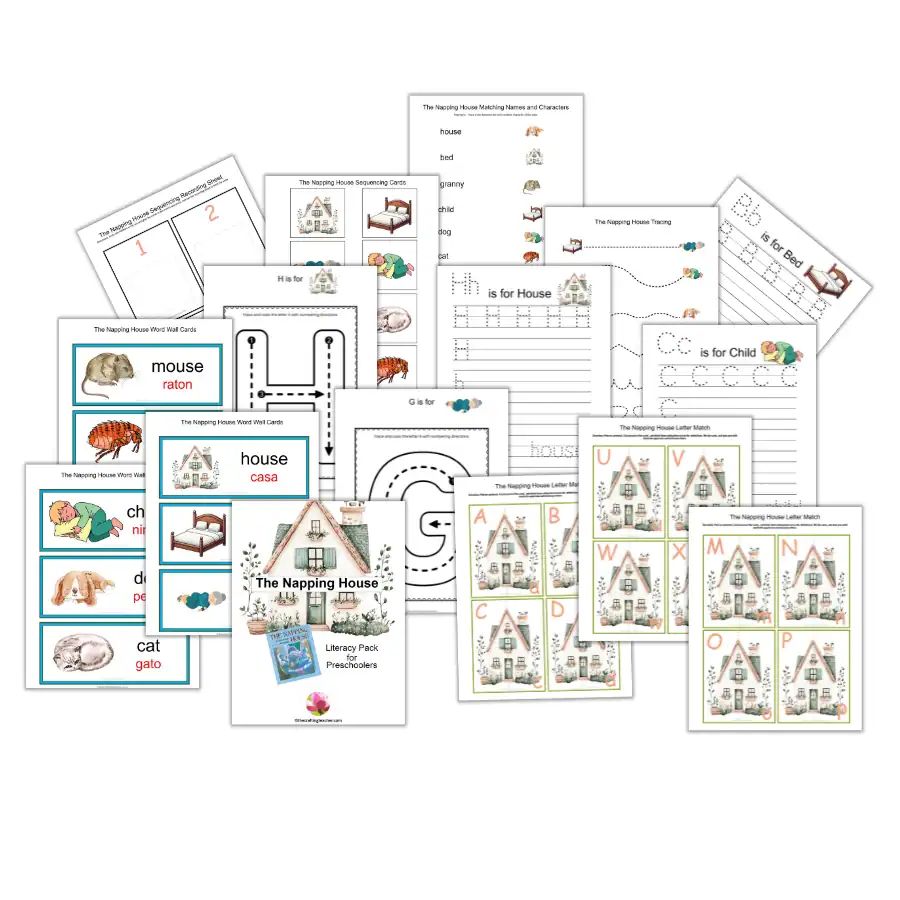
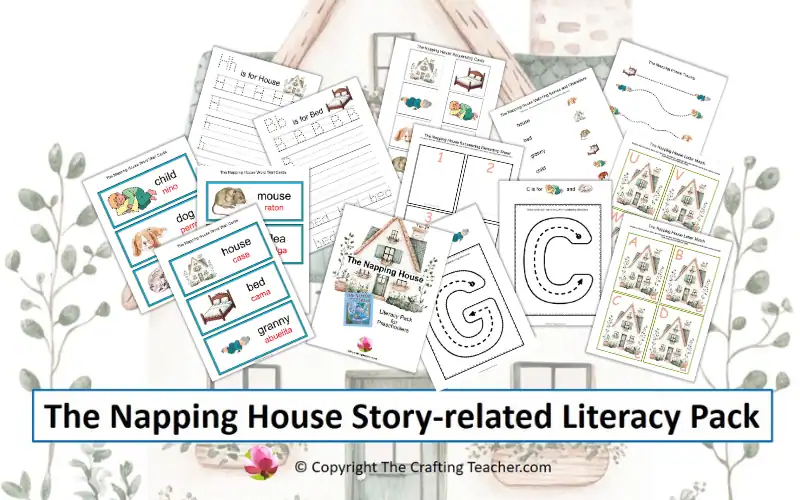
I have created a FREE 30-page The Napping House Literacy Pack with seven activity sets to accompany this book. You can download it at the end of this post.
The Napping House Literacy Pack
The Napping House Literacy Pack is a comprehensive resource that effectively reinforces preschoolers’ literacy skills and vocabulary development. It is designed to be used with the story, providing activities that reinforce students’ learning and deepen their understanding of the text through hands-on experiences.
Before reading the story, set the tone to make it interesting. Gather the children on the floor around you, and have them get cozy with blankets, pillows, and stuffed animals, and dim the light. Review the parts of the book: the cover, title, author, illustrator, spine, and back. Engage your preschoolers with the book’s illustrations. Encourage them to share their thoughts and observations. Then read the story for the first time in a soft, whispery voice, yawning as you turn the pages, and foster a dynamic learning environment by asking questions.
Point to each of the characters as they climb onto the bed. When you get to the page where the flea bites the mouse, change your voice to one of surprise and a faster pace. The interactive nature of these activities will keep the children engaged and excited about learning.
Questions About The Story
During reading, ask who, what, where, when, and why questions, such as:
- Who are the main characters of the story?
- Where is the story taking place?
- Why do you think it’s called The Napping House?
- What is the weather like at the beginning of the story?
- What do you do on rainy days?
- Why do you think everybody was asleep at the same time?
- Do you think you can sleep if somebody is on top of you?
After reading, you can ask questions about the story, such as:
- What would happen if the flea fell asleep, too?
- Why do you think the mouse jumped when the flea bit him?
- How do you think they felt when they started jumping on the bed?
- Why do you think they went outside after they woke up?
- What do you think is the message of the story?
- Do you think this story is real or make-believe? Why? Why not?
Also, ask open-ended questions, such as those about the student’s life experiences, to elicit multiple answers.
After reading the story a few times, make your next reading interactive by pausing right before the repetitive phrase “where everyone is sleeping” and having your student say it.
Don’t forget to place the book where the children can reach it often. If you have more than one copy, place each copy in a different center. This practice will encourage them to return to the book frequently and, hopefully, promote their love of reading.
Finding the Flea in The Napping House Story
After they read the story a few times, ask them where they think the flea was at that time. See if they can find it. Then, start reading the story on page 2 and show the students that the flea was actually in the room the whole time.
Show them that the flea has a glow around it and is on the top of the chair where the child is napping. Turn each page and have the students search for the flea as it moves around the room while the other characters sleep.
Retelling The Napping House Story
Invite volunteers to retell the story using props. For example, a child can place a big doll (Granny) on a doll bed while he/she says that portion of the story; another student can put a smaller doll on top of Granny (the child) and say that part of the story; the next student will add the dog, and so on. The last student will have the flea that bites the mouse.
The students who originally placed a prop will remove it in the correct sequence. If they don’t know how the story goes, you can always help by reading it.
Another idea is to make two sets of character copies, glue them on cardstock, and laminate them for durability. Place one set of cutouts in a basket for children to use to order the pictures in the order they jumped in and out of the bed.
Another set can be used as feltboard pieces by adding Velcro on the back.
The Napping House Sequencing
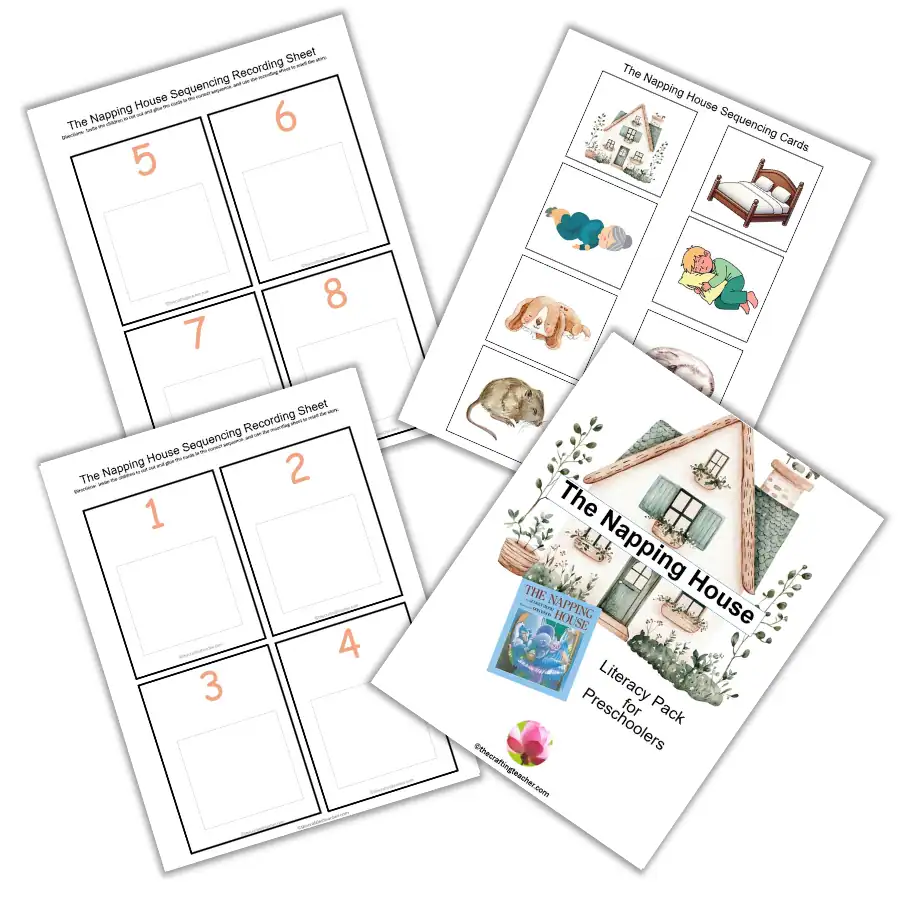
Gather the children in a circle on the floor or around a table. See if children can remember the order of the people/animals napping on Granny’s bed. Retelling the story can help preschoolers understand what happened first, then, next, last, etc.
Then, in small groups, invite them to retell the story again. Present the sequencing activity, in which children cut out or use pre-cut sequencing cards to glue onto the recording sheets in order of appearance in the story. Then cut out the cards on the recording sheets and staple them together as a mini book, which children can use to retell the story independently.
Oral Language and Vocabulary Development
I like to use a word wall because it is a vital literacy tool that helps your children learn the alphabet, letter sounds, and words related to the theme you use that week or month.
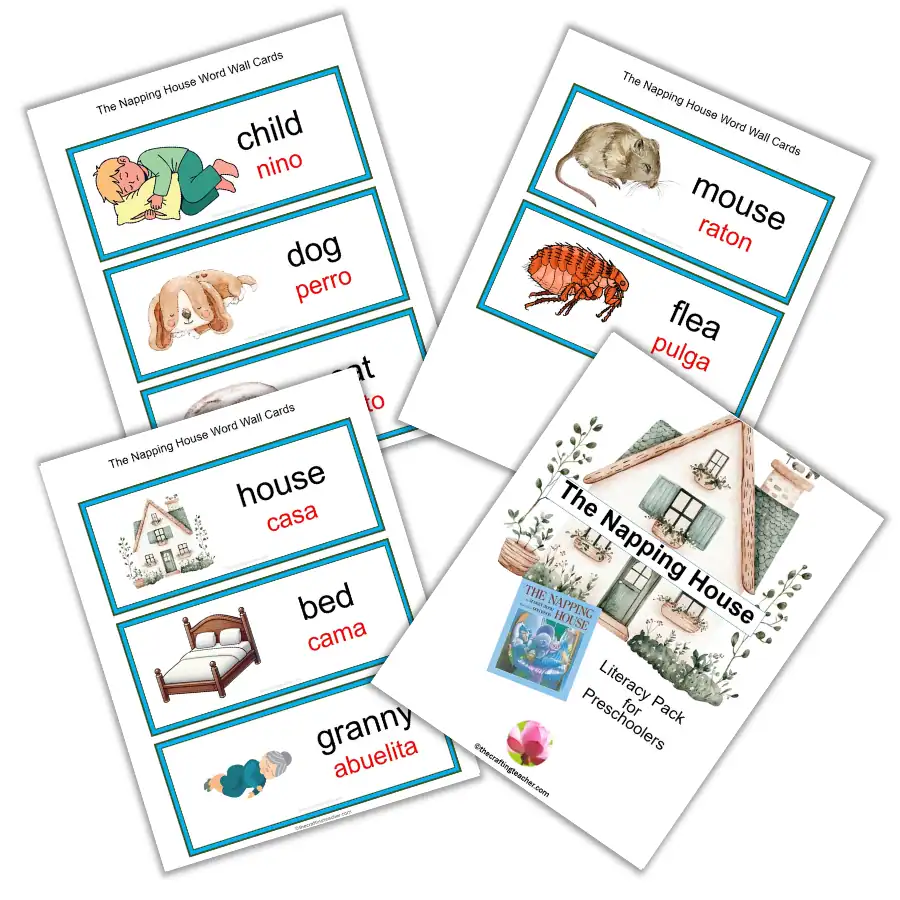
I included the words house, bed, granny, child, dog, cat, mouse, and flea in the pack. Print them on white cardstock and laminate for durability. Add the words to your Word Wall to help your students learn to read and spell.
Remind your students that words are made up of individual letters. These word wall cards can serve as a reference for planning various pre-reading activities for your students. For example:
- Learn or review the name and sound of the beginning letter of each word.
- Clap the syllables in each word.
- Spell some words.
- Find other words that start with the same beginning letter.
- Identify words that start with the same beginning sound.
- Using the words in a short sentence.
Phonics
If your children are learning the alphabet and letter sounds, use this story to introduce different letters, such as S for Sleeping. One fun activity to introduce a letter is to place different objects in a basket and invite the children to select an object at a time, say what it is, and decide whether the word starts with the letter S.
The repetitive rhyme of this story is also a great way to help your children learn language patterns, giving them a foundation for future reading skills.
You can also introduce the concept of synonyms using the ones the story includes for sleeping (snoring, dreaming, dozing, slumbering), and invite your students to think about synonyms for common words such as big, small, happy, and sad.
Tracing Letters and Words
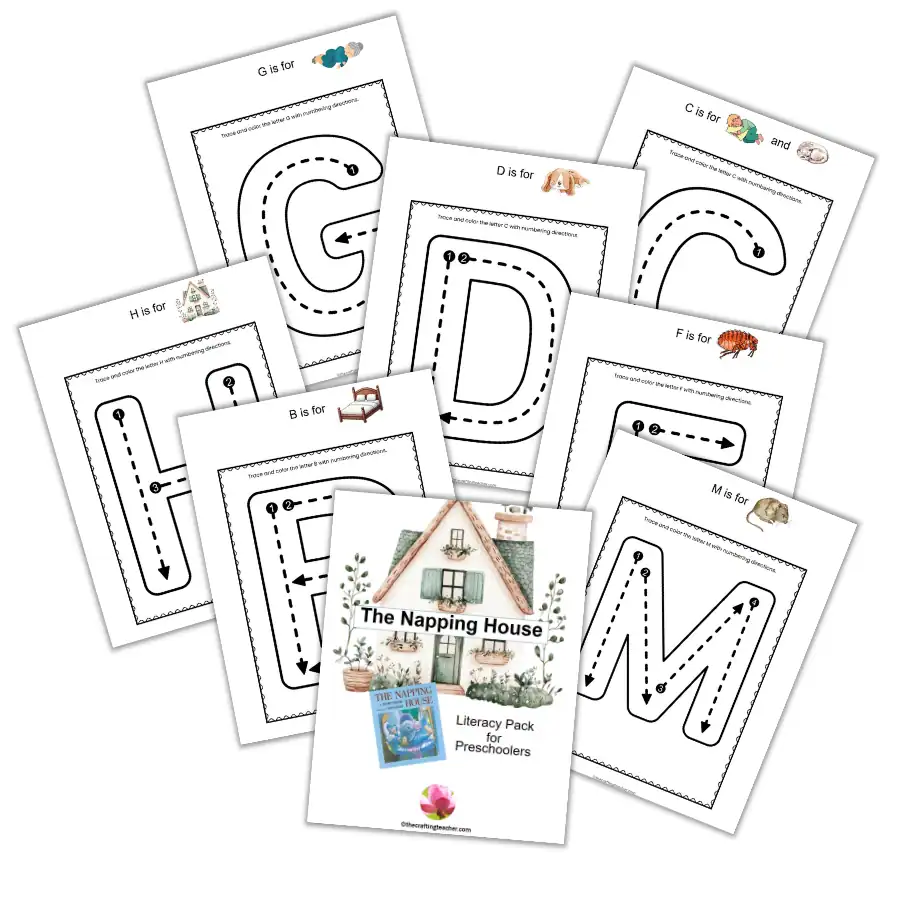
The Napping House Literacy Pack includes two different activity sets with seven letter sheets: Hh is for House, Bb is for Bed, Gg is for Granny, Cc is for Child and Cat, Dd is for Dog, Mm is for Mouse, and Ff is for Flea.
In the first activity set, the children can say the name and sound of each letter, then trace the lines in numerical order.
The second set helps students practice writing the letters and words used in The Napping House (house, bed, granny, child, dog, cat, mouse, flea).
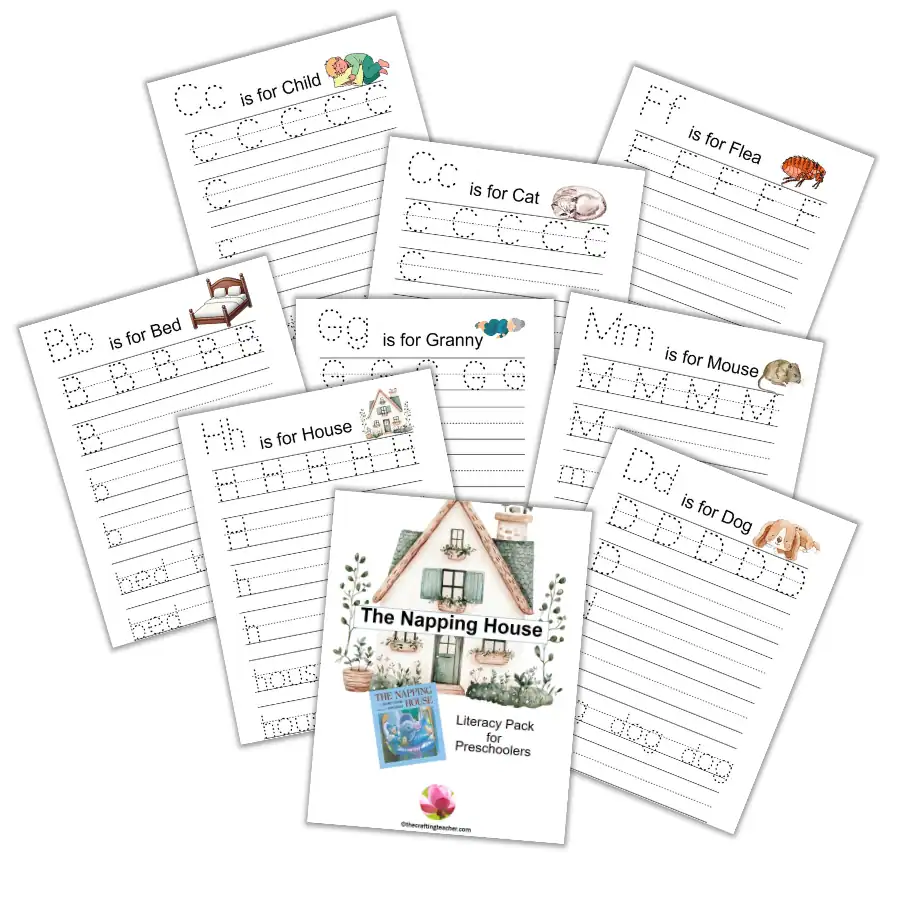
These activities strengthen the children’s language, letter recognition, pre-writing, and fine motor skills. These activities give preschoolers multiple benefits, such as:
- Language – children learn new words and beginning sounds. You can also introduce or reinforce vocabulary with multiple meanings.
- Letter Recognition – children learn to identify letters represented in different ways.
- Fine motor skills development – they learn to grip a pencil, which helps them develop pencil control.
- Pre-writing skills – they learn to apply pressure to the paper with markers and create a circular print.
- Spatial awareness – they develop an understanding of each letter’s size, direction, and orientation.
- Concentration – they learn to focus on what they are doing.
To extend the activity, you can use them to:
- Use a dry-erase marker to trace the letters and words.
- Copy the words with a pencil, crayon, or marker.
- Match each letter and word with magnetic, wooden, or foam letters.
- Copy the letters and words with playdough.
The Napping House Letter Recognition & Matching
This activity helps preschoolers recognize which uppercase and lowercase letters match, helping them understand that different letter forms represent the same sound. This skill strengthens letter recognition and enhances cognitive development, both of which are crucial for reading and writing.
Matching uppercase and lowercase letters brings preschoolers multiple benefits, such as:
- Literacy Development: It’s easier and more efficient for children to learn the 26 letter pairs than to learn 26 uppercase and 26 lowercase letters separately.
- Strengthens Letter Recognition: Since uppercase and lowercase letters differ in shape, recognizing a letter in both forms is essential for identifying it across different fonts and printed materials.
- Pre-Reading Development: Knowing that the same letters make the same sound, regardless of form, helps children develop pre-reading skills that lay the foundation for decoding words and, later, phrases.
- Visual Discrimination: Matching letters helps children develop their ability to tell apart letters that might be confusing, such as b and d, p and q, and m and w.
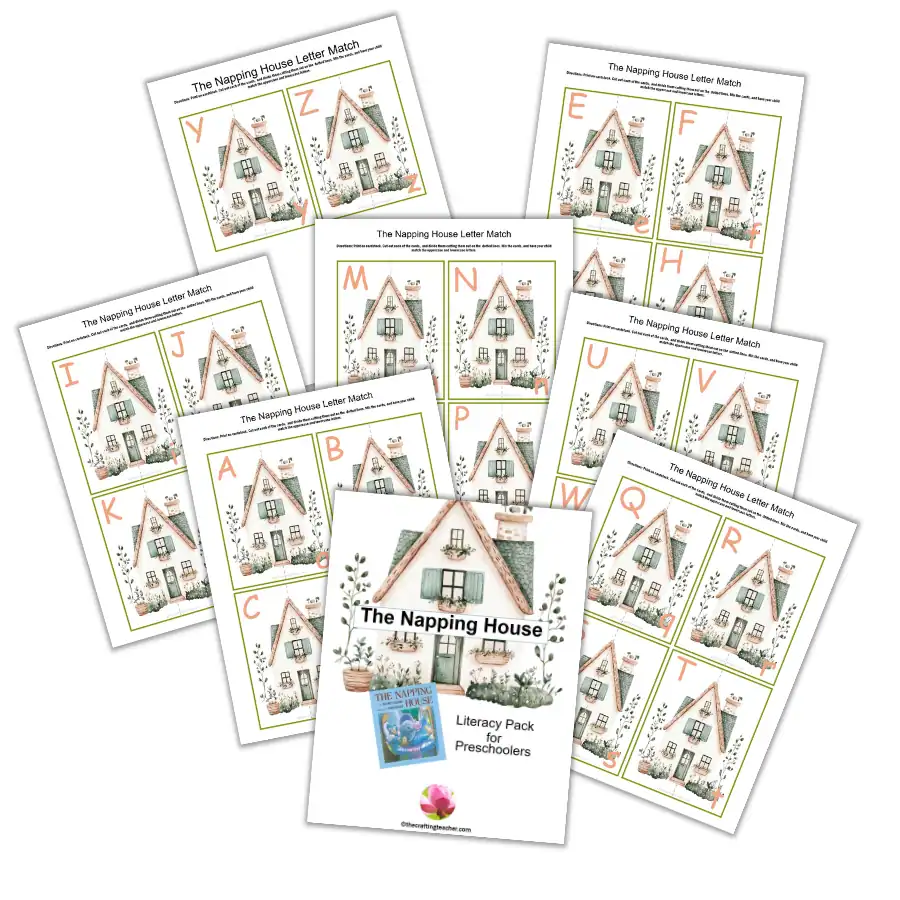
To prepare for this activity, print the pages on white cardstock, cut them out, divide the houses in half by cutting along the dotted lines, and laminate them for durability. You can have the children work alone or in pairs to match the houses’ uppercase and lowercase letters. Use all or part of the letters according to your children’s developmental stage.
The Napping House Pre-Writing
Pre-writing activities help preschoolers develop essential skills that support holding and using a pencil, drawing, copying, writing letters, words, and numbers, and coloring later on.
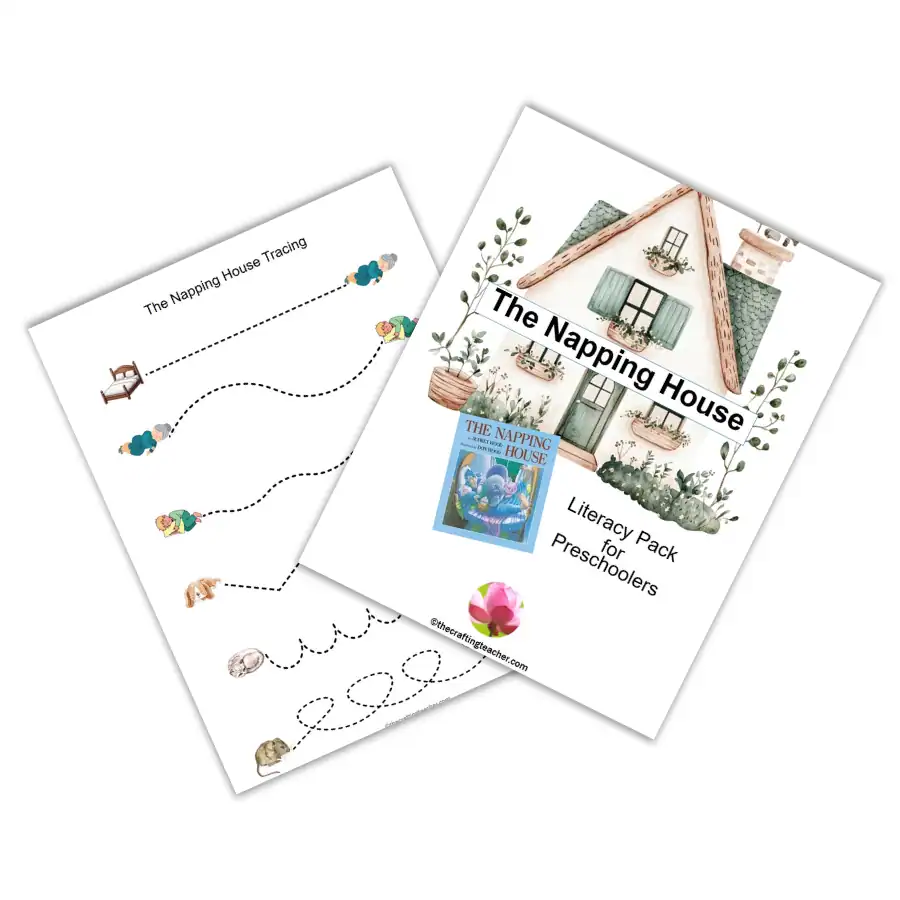
Among the important benefits pre-writing activities bring to preschoolers, we can mention:
- Fine Motor Development: These activities strengthen the children’s small-hand and finger muscles needed to grip a pencil correctly and develop pencil control.
- Shapes and Lines Foundation: Pre-writing activities teach children to produce vertical and horizontal lines, circles, crosses, and other shapes, which form the foundation for learning to write letters, words, phrases, and numbers.
- Hand-Eye Coordination: These activities help children train their eyes to guide their hand movements as they trace lines, improving their ability to trace letters, shapes, and numbers later on.
The Napping House Words Matching
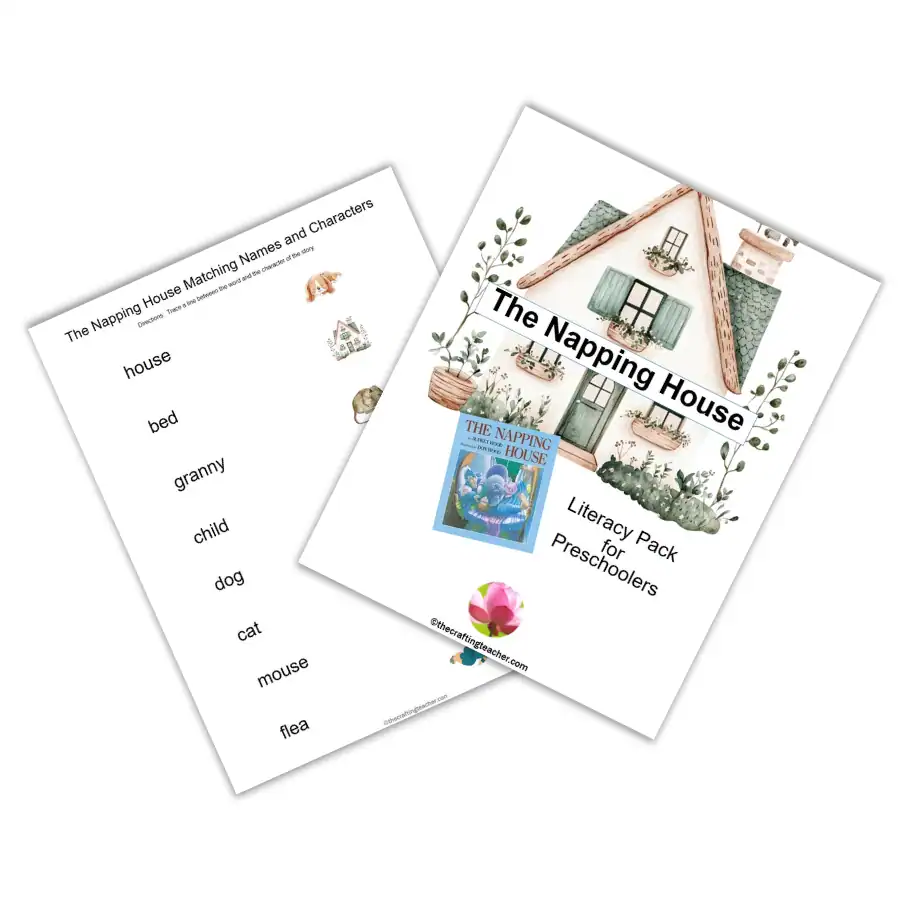
Recognizing and matching character names to their pictures will not only help preschoolers boost their cognitive and literacy skills, such as language, visual discrimination, and problem-solving, but also their math skills, such as sorting and letter recognition, through a fun, hands-on activity.
If you want to use any of the previous activities once, print each page on white paper and have the children trace it with a pencil, crayon, or marker to complete the activity.
If you want to use them multiple times, print each page on white cardstock and laminate it, or place it in a dry-erase pocket to make it last longer. Children can then use a dry-erase marker to do them.
Write a Class Story to Make a Book
During circle time, invite your children to create a similar story, reminding them it must have a beginning, middle, and end. Use chart paper to take dictation.
You can encourage them by starting with some phrase such as “In the happy house….” or “In a little house in the forest…” and let the children continue, accepting their words without correcting them. Only intervene if they seem to get stuck.
Print the story and have the students illustrate it when it is finished. Then, put it together as a library book and make a copy for each author.
Sing Songs
Singing is an excellent literacy activity; we all know children love it. I found the lyrics for The Napping House song in old papers at the school, with no mention of the author. If you know the author, please let me know so I can give them credit.
Napping House Song (Sing to the tune of BINGO)
There was a house, a napping house, where everyone was sleeping.
Nap-nap-napping house, nap-nap-napping house, nap-nap-napping house,
Where everyone was sleeping.
And in that house, that napping house, there was a cozy bed.
Cozy-cozy-cozy bed, cozy-cozy-cozy bed, cozy-cozy-cozy bed,
Where everyone was sleeping.
And in that house, that napping house, there was a snoring granny.
Snoring-snoring-snoring granny, snoring-snoring-snoring granny, snoring-snoring-snoring granny,
Where everyone was sleeping.
And in that house, that napping house, there was a dreaming child.
Dreaming-dreaming-dreaming child, dreaming-dreaming-dreaming child, dreaming-dreaming-dreaming child,
Where everyone was sleeping.
And in that house, that napping house, there was a dozing dog.
Dozing-dozing-dozing dog, dozing-dozing-dozing dog, dozing-dozing-dozing dog,
Where everyone was sleeping
And in that house, that napping house, there was a snoozing cat.
Snoozing-snoozing-snoozing cat, snoozing-snoozing-snoozing cat, snoozing-snoozing-snoozing cat,
Where everyone was sleeping.
And in that house, that napping house, there was a slumbering mouse.
Slumbering-slumbering-slumbering mouse, slumbering-slumbering-slumbering mouse, slumbering-slumbering-slumbering mouse,
Where everyone was sleeping.
And in that house, that napping house, there was a wakeful flea.
Wakeful-wakeful-wakeful flea, wakeful-wakeful-wakeful flea, wakeful-wakeful-wakeful flea,
Where NO ONE is now sleeping
I also found The Napping House song played on YouTube. Here is the link for your convenience.
You can also play lullabies and sing similar songs, as well as fingerplays. Some ideas are:
- Ten in the Bed.
- If You’re Sleepy and You Know It.
- Lazy Mary, Will You Get Up?
- Five Little Monkeys Jumping on the Bed.
- Are You Sleeping, Brother John?
- Are You Sleeping?
Comparing The Napping House and Other Stories
Comparing other stories with similar plots to those in The Napping House helps children better understand story structure and develop important skills that will lay the foundation for their academic analysis. Some of these skills are:
- Vocabulary and Language Development: Comparing stories introduces children to new words and different sentence structures, helping them enhance their communication skills.
- Critical Thinking: Preschoolers learn to sort, classify, and evaluate information by determining how two or more stories are similar or different.
- Reading Comprehension, Sequence, and Attention to Detail: When children compare different narratives, they strengthen their ability to notice and remember details, settings, and the sequence of events.
- Problem-solving, Imagination, and Creative Thinking: Using stories to create and discuss possible endings and scenarios encourages children to develop their imagination, creativity, and problem-solving skills.
- Emotional Intelligence and Empathy: Discussing the feelings and emotions different characters might be experiencing, which may explain their behavior and reactions to various challenges and situations, helps preschoolers develop their ability to analyze their own emotions and feel connected to the characters.
Below are some suggestions of stories you can use for this purpose. You can find these books at your local library, used bookstore, or on Amazon. To add them to your collection, you can use my affiliate links embedded in the titles for immediate access.
- Berlioz the Bear by Jan Brett. This book uses glorious illustrations to invite the eye to linger over exquisite details and humorous nuances that enhance the story.
- Joseph Had a Little Overcoat by Simms Taback. As children turn the pages of this book, they can use the die-cut holes to guess what Joseph will be making next from his amazing overcoat, while they laugh at the bold, cheerful artwork and learn that you can always make something, even out of nothing.
- This Is The House That Jack Built by Simms Taback. In this story, the author brings his distinctive humor and creativity to the beloved story of Jack and the house that he built.
- If I Build a House, by Chris Van Dusen, is a joyful, imaginative story with vibrant, retro illustrations and delightfully rhyming text that children will enjoy.
- The Turnip by Pierre Morgan tells the story of a turnip that grows so enormous that the whole family, including the dog, cat, and mouse, is needed to pull it up.
Extended Activities:
If you want additional activities and ideas related to cats and the letter Cc covering multiple domains, my 169-page C is for Cat Unit Pack is the perfect solution. This pack is perfect for engaging your children in hands-on learning that incorporates literacy, math, science, fine motor skills, and more, making it an excellent addition to any preschool or homeschool curriculum. You can check it out HERE.
If you want additional activities and ideas related to mice and the letter Mm covering multiple domains, my 141-page M is for Mouse Unit Pack will do the trick. You can check it out HERE.
Pin It For Later
If you are in a rush and don’t have time to read the post and download the printable, but want to save it for later, pin this to your Literacy board on Pinterest.
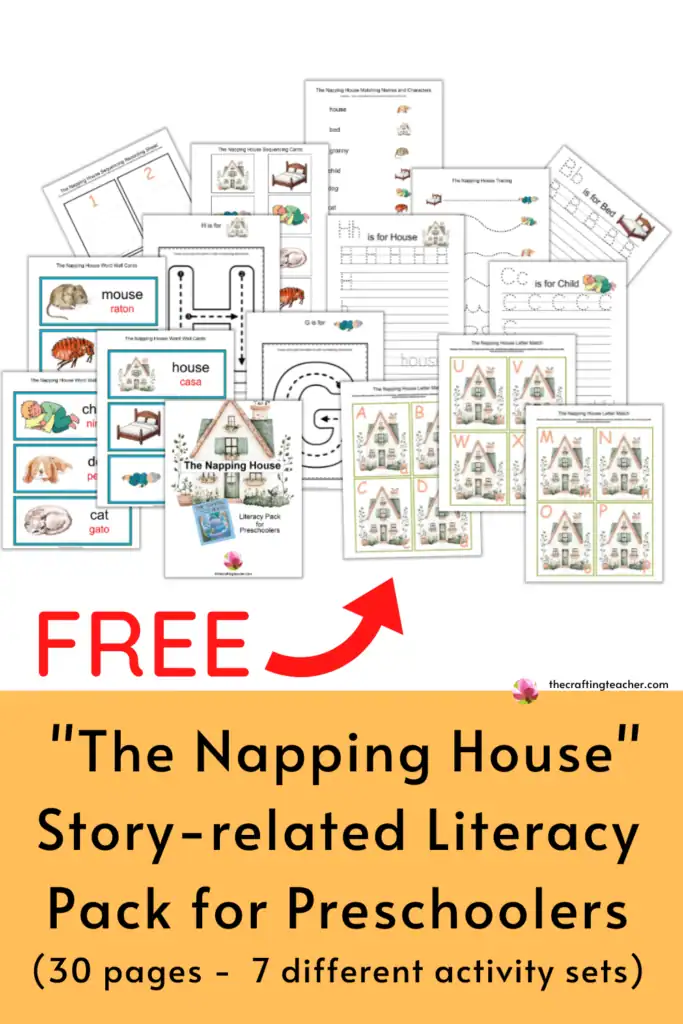
You can use these ideas on their own, but I invite you to combine them with the activities I included in the Math Pack and Science Pack. I created for this fun story, The Napping House, to take advantage of the opportunities this book offers.
Don’t forget to download your FREE The Napping House Literacy Pack. Click the link below and enter your email to download immediately.
Be happy, safe, and creative. I wish you well.
Love,

P.S. Let me know if these activities work for you. If you want to see an article or a printable on how to make something specific, please let me know, and I will do my best to create it for you.
Other Posts You Might Like: