
Fall Letters Tracing and Matching for Preschoolers
Affiliate Disclosure: “This post contains affiliate links, which means I receive a small commission, at no extra cost to you, if you make a purchase using those links.”
These FREE Fall Letters Tracing and Matching activities will help your preschoolers work on their pre-writing skills and build up a strong foundation for their emerging writing development.
Tracing and matching might seem like unimportant activities and perhaps even silly. In reality, they are very beneficial because they help children build the foundation to learn to read and write words later.
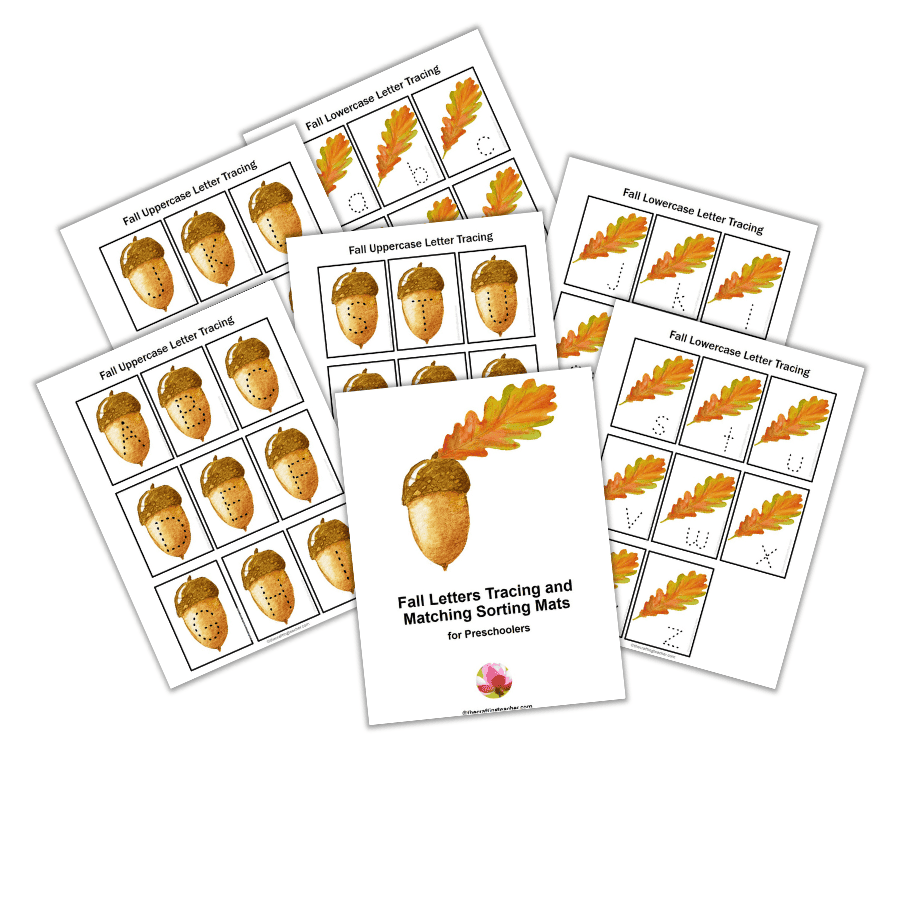
This Fall Letters Tracing and Matching activities pack includes six pages with all the letters of the alphabet. The uppercase versions are inside acorns, and the lowercase versions are inside fall leaves.
Benefits of Tracing and Matching Activities
Young children love to explore their creativity and put their ideas on paper. That is why they love to “scribble” since they can hold a crayon. This practice helps children develop essential skills such as:
- Pre-writing Skills: Tracing teaches young learners how to write letters by involving more refined movements, developing their ability to grip and manipulate writing tools, enhancing hand-eye coordination, and promoting directionality and dominant-hand development.
- Concentration and Focus: These skills are put into practice when your preschoolers use their eyes, hands, and fingers to trace and match the uppercase and lowercase letters. They must focus on what they are doing and on how to move the writing tool (pencil, crayon, or markers) along the lines correctly to form the different letters, and ensure that they match the correct pair of letters. This exercise also helps them work on their memory and attention.
- Fine Motor Skills: Tracing and matching are also excellent ways to practice fine motor control. These simple activities can also build up strength and coordination in their hand and finger muscles, which will help them refine control of the writing tools and their movements.
- Visual-Spatial Skills: These skills involve the child’s ability to perceive the location of objects around them. When they trace, they become aware that they have a piece of paper in front of them, a writing tool in their hand, and that they must connect the lines within certain limits.
- Drawing Skills: Tracing will help children learn how to make the different hand movements necessary to form straight and curved lines, which, in turn, enable them to create letters, numbers, and shapes. This practice will help them develop the skills needed to trace the same lines independently and combine them to make pictures and drawings.
Getting Your Fall Letters Tracing and Matching Activity Ready
This FREE Fall Letters Tracing and Matching printable can be used in different areas and ways, such as:
- Small group activity.
- Writing center option.
- Reading area option.
- Take-home game and Quiet area option.
It comes with six pages that include all the letters of the alphabet in both uppercase and lowercase.
This is a low-prep printable that will only require a handful of materials to get it ready, which are:
- Free Fall Letters Tracing and Matching printable (find at the end of this post).
- Printer.
- White cardstock.
- Scissors.
- Laminator or dry-erase pockets.
- Small basket or Ziploc bag.
To prepare for the activity, fill out the form below to download and print out the free printable. Then decide how you want to use it. If you’re going to conduct a one-time tracing activity, you must print the pages on white paper. If you plan to use it multiple times, print each page on white cardstock. Then, laminate the pages or place them in a dry-erase pocket, and have children use a dry-erase marker to trace the letters.


Depending on each child’s developmental stage, you can ask them to identify each letter and/or its sound before they trace it. If your kids are just starting to learn letter names, let them begin with just a few letters at a time. Then you can add two or three more every time they play.
Other Ideas
- You can have the children match the letter with magnetic, wooden, or foam letters to provide an alternative option for them to complete.
- They can write the letters on separate paper using pencils, markers, or crayons.
- They can find words that start with all or some of the letters, and match them with the appropriate letter.
Fall-related Storybooks
You know that I believe there is no such thing as too much reading. The more you read to your children, the better. It is essential to keep them engaged with books by periodically updating your library to reflect the theme and season.
These are some good suggestions for Fall. You can find all of these books at your local library, at a used books store, and on Amazon. You can use the links in each title to access them via my Amazon links, helping you grow your library for years to come.
- The Leaf Thief by Alice Heming uses vibrant art and captivating characters to capture the magic of autumn on each page as readers tag along with Squirrel’s forest adventure.
- Crunchy Leaves, Cozy Sweaters by Essie Bell is an enjoyable book written in rhyme. It showcases various activities that everyone can enjoy every day throughout the fall.
- What is Fall? by Random House introduces children to the wonders of fall with illustrations, holes to peek through, an autumnal color palette, and simple, rhyming text.
- There Was an Old Lady Who Swallowed Some Leaves by Lucille Colandro tells the story of an old lady who swallows some leaves, clothes, a pumpkin, and a rope to welcome the Fall season with humorous illustrations and a spin on a classic rhyme.
- Pete the Cat Falling for Autumn by James Dean discusses how Pete comes to realize there’s so much to enjoy and be thankful for about autumn when he discovers corn mazes, hayrides, and apple picking.
- A Very Big Fall by Emmy Kastner is a humorous and heartwarming story about three adorable autumn leaves, surprised by their changing colors and the promise of the fall to come, making it perfect for any child who struggles with change.
- The Very Hungry Caterpillar’s First Fall by Eric Carle will teach children about seasonal sensory experiences, such as observing the leaves as they change color, listening to the whooshing wind, and feeling the warmth of a warm, cozy sweater, among other things.
- We’re Going on a Leaf Hunt by Steve Metzger utilizes accessible rhyming text and engaging sound effects to tell the story of three friends embarking on a big adventure as they hike over a mountain and through a forest to collect leaves of all kinds and colors.
- Fletcher and the Falling Leaves by Julia Rawlinson will encourage children to share feelings of wonder and empathy as they listen to the story of Fletcher the fox, who is concerned about nature and wants to understand the changing seasons.
Pin It For Later
If you are in a rush and don’t have time to read the post and download the printable, but want to save it for later, pin this to your literacy or Fall board on Pinterest for later.

I hope these Fall Letter Tracing and Matching activities help your kiddos learn, and make your lesson planning a little easier. Don’t forget to get your FREE printable! Click the button below to download and start using it.
Be happy, safe, and creative. I wish you well.
Love,

P.S. Please let me know if this activity works for you. If you would like to see an article or a printable about how to make something specific, please let me know, and I will do my best to create it for you. My goal is to help you in any way I can, and I take great pleasure in posting something that you might find helpful.