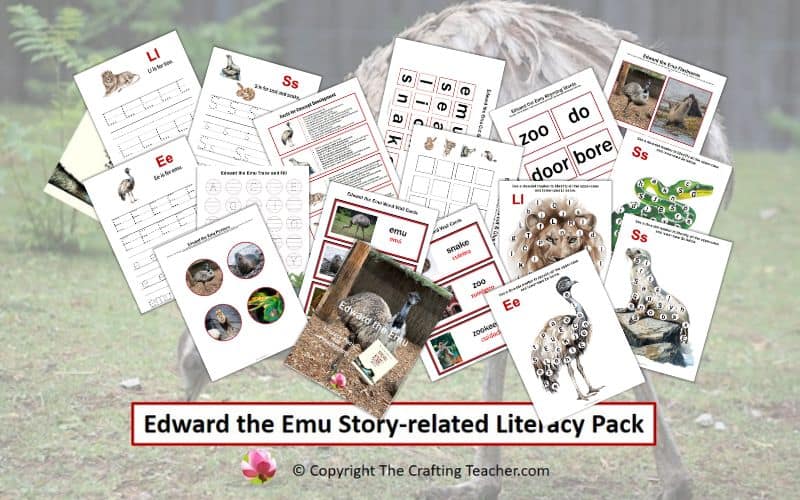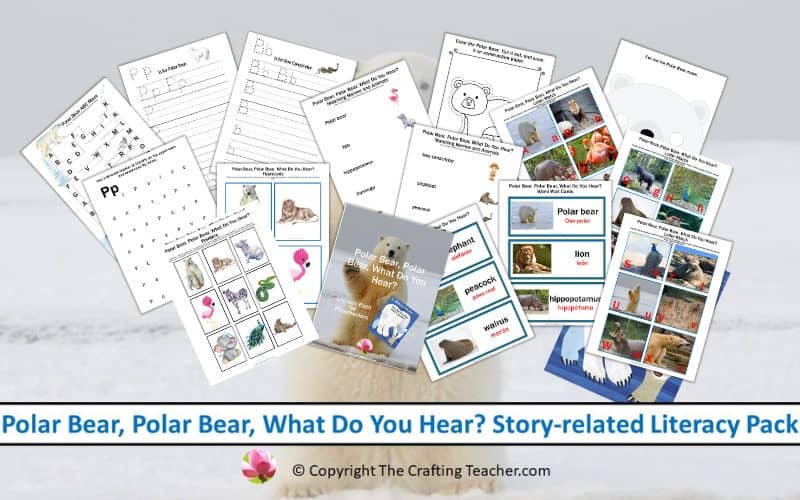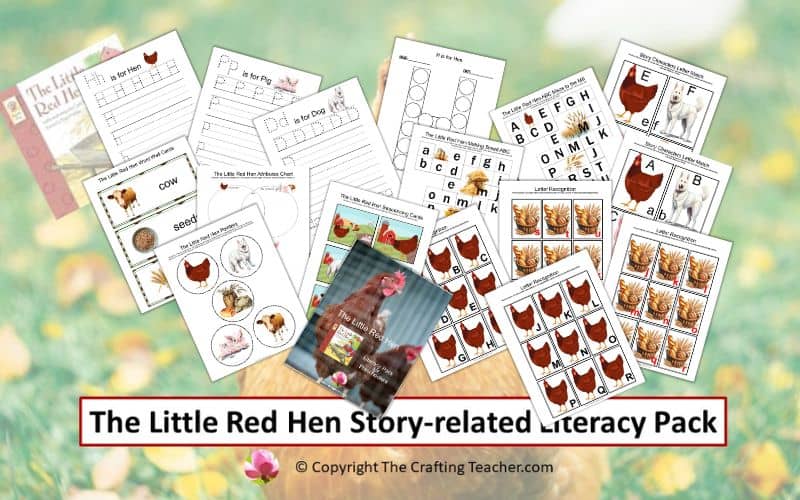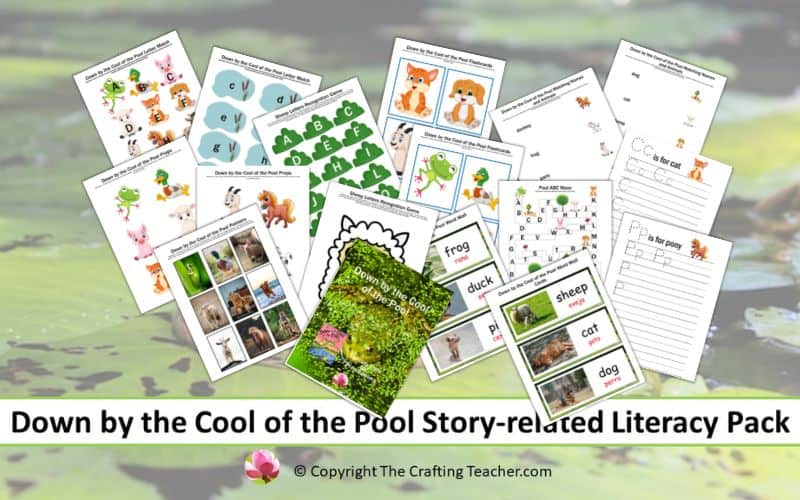

The Leaf Thief Story-related Literacy Pack for Preschoolers
Affiliate Disclosure: “This post contains affiliate links, which means I receive a small commission, at no extra cost to you, if you make a purchase using those links”.
The Leaf Thief by Alice Hemming is one of my favorite fall stories. It tells the story of a squirrel who becomes very distressed when it notices a leaf is missing from its tree and believes a “leaf thief” is responsible. He consults his friend Bird and accuses the other animals in the forest of being the thief. At the end, he finally understands that the missing leaves are actually a natural part of the autumn season, but starts all over again in the morning when the grass is gone.
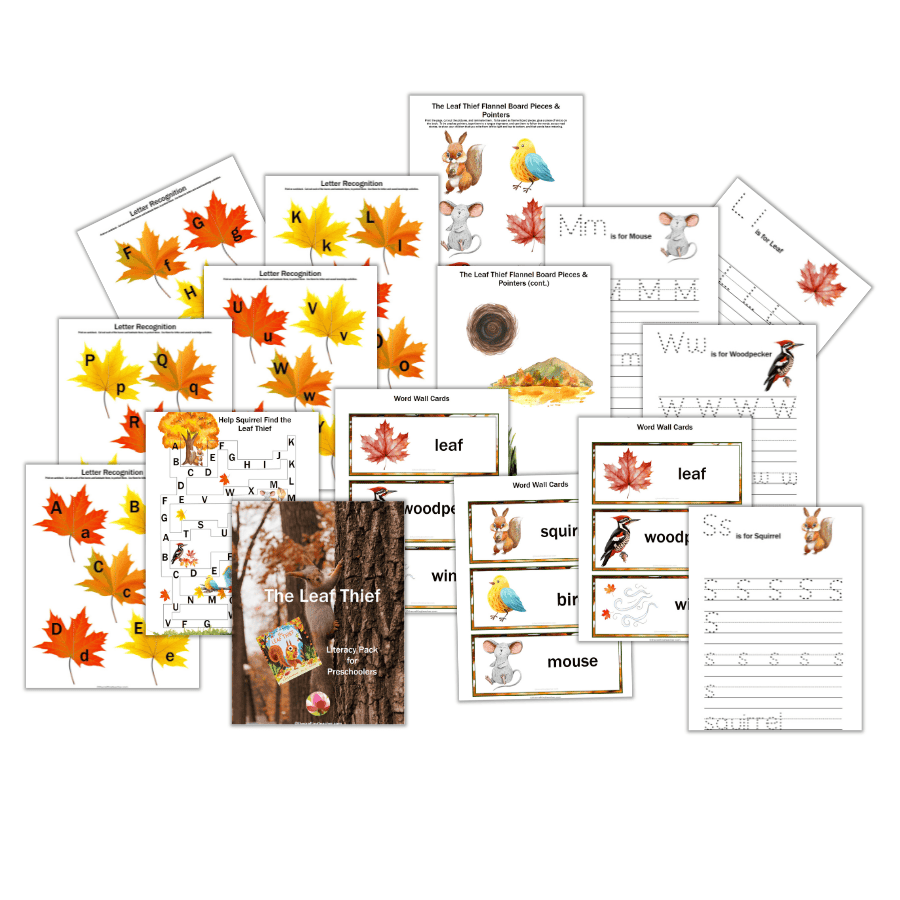
The Leaf Thief FREE 24-page Literacy Pack includes six different activity sets and can be downloaded at the end of this post.
The Leaf Thief Literacy Pack
- Language and Vocabulary: By reading, retelling, and discussing the story, children learn new words, sentence structures, and how to use language to communicate ideas.
- Phonological Awareness: By introducing new words and their beginning sounds, children begin to identify individual sounds in words and which sounds combine to make different words.
- Pre-writing and Fine Motor: Children learn the names and sounds of letters, how to write them, and begin making marks to represent ideas; these activities help strengthen the small muscles in their fingers and hands to develop fine motor skills.
- Pre-reading: Listening to stories helps preschoolers develop attention, listening skills, and an understanding that written and spoken words have meaning, while also fostering their interest in books.
- Social-emotional: Literacy activities engage children in conversations and help them develop respect, take turns, express their thoughts and feelings, and build understanding and empathy.
The Leaf Thief Literacy Pack includes six different activities to accompany the story. If you want to use the activities one time, print the pages on white paper. If you are going to use them multiple times, print them on white cardstock and laminate them for durability.
The activities offered in this pack are:
Reading and Retelling the Story

Glue one set of tongue depressors to be used as pointers to mark the words as you read. Glue a piece of Velcro to the back of the other set to use as flannel board pieces to retell the story.
Reading the Story
Reading stories to children from birth helps them develop their brains, learn vocabulary, and use language to express their ideas, while also enhancing their listening skills and social-emotional growth.
This activity also strengthens the bond between caregivers and children, stimulates their imagination and creativity, and helps them learn many concepts, preparing them for future academic success.
Gather the children in a circle on the floor. Place a green sheet in the middle of the circle, and tell them that it represents the grass. Use the pointers to show the children that you read from left to right and top to bottom, and that words have meaning.
Before reading, review the parts of the book: cover, title, author, illustrator, spine, and back.
Show them the cover and ask them what type of animals they think they are. Tell them the name of the animals. Talk about what type of animals those are.
During reading, ask who, what, where, when, and why questions, such as:
- Who are the main characters of the story?
- Where is the story taking place?
- During what season does the story take place?
- Who do you think the leaf thief is?
Also, ask open-ended questions, such as questions about the student’s life experiences. Open-ended questions can have multiple answers.
After reading the questions about the story, such as:
- Do you think this story is real or make-believe? Why? Why not?
- Do you believe animals’ nests have furniture inside?
- Do you think a mouse can build a boat?
- Why do you think leaves change colors?
Retelling the Story
It is essential to retell stories to preschoolers and invite them to do it as well to help them organize and communicate their thoughts, develop problem-solving abilities by understanding in what order the events of the story occur, build vocabulary, and enhance their social-emotional skills by developing empathy, understanding, and imagination, setting up the foundation for their future reading success.
Provide the flannel board pieces and a flannel board as props, and encourage the children to retell the story. You can also place other sets of the props in the Listening, Library, and Writing centers to invite the children to retell the story on their own.
Help Squirrel Find The Leaf Thief
This activity will help preschoolers build letter recognition, develop phonemic awareness, enhance fine motor, problem-solving, and concentration skills, and boost self-esteem.

Invite the children to help the squirrel find the leaf thief by marking the letters in alphabetical order using a regular, dot-to-dot, or dry-erase marker. They can also say the letter name and sound as they go for a more complete activity.
Leaf Letter Recognition
This activity will also help preschoolers build letter recognition, develop phonemic awareness, enhance fine motor, problem-solving, and concentration skills, and boost self-esteem.

Present the letter recognition cards and have your children match the uppercase letters with the leaf halves and the lowercase letters with the leaf halves. Invite them to say the name and sound of the letter they are matching.
The Leaf Thief Word Wall Cards
Word Walls or vocabulary cards help preschoolers develop pre-reading and pre-writing skills such as learning new vocabulary, discussing attributes, beginning sounds, onset and rime, spelling, tracing, and writing.

Encourage your children to use each Word Wall word in a short sentence. You can also use them to review the name and/or sound of the beginning letter of each word. I included the words squirrel, bird, mouse, woodpecker, leaf, nest, autumn, grass, and wind.
Tracing Letters
Tracing letters and words helps preschoolers develop essential pre-writing and pre-reading skills such as fine motor skills, hand-eye coordination, phonological awareness, and spatial awareness, which are vital for developing literacy. These activities also support cognitive growth by making literacy fun and engaging and fostering a love of learning.

The Leaf Thief Literacy Pack includes nine tracing letter sheets: Ss for squirrel; Bb for bird; Ll for leaf; Ww for woodpecker and wind; Mm for mouse; Nn for nest; Gg for grass; and Aa for Autumn.
Extension Activities:
- During circle time, invite your children to create a story, reminding them that it must have a beginning, middle, and end. Use chart paper to take dictation. When it’s finished, type the story, and invite children who didn’t participate in writing it to illustrate it. Make copies for each author and illustrator, and assemble the books.
- Teach or review the beginning sound of each word and the name of the letter each word starts with.
- Invite children to find other words that start with the same letters.
- Spell the words.
Books about Fall and Leaves
You can always read and add more related books to your library at other centers to give children a wide range of learning experiences and variety. I’m sure the previous activities will spark their curiosity, and these books could be an excellent source of knowledge.
You can find these books at your local library, used bookstore, and on Amazon. If you’d want to add them to your collection, you can use the affiliate links embedded in the titles for immediate access.
- Crunchy Leaves, Cozy Sweaters by Essie Bell is an enjoyable rhyming book. It shows various activities everyone can enjoy every day throughout the fall.
- What is Fall? by Random House introduces children to the wonders of fall with illustrations, holes to peek through, an autumnal color palette, and simple, rhyming text.
- There Was an Old Lady Who Swallowed Some Leaves by Lucille Colandro tells the story of an old lady who swallows some leaves, clothes, a pumpkin, and a rope to welcome the Fall season, with funny illustrations and a spin on a classic rhyme!
- Pete the Cat Falling for Autumn by James Dean shows how Pete realizes there’s so much to enjoy and be thankful for about autumn when he discovers corn mazes, hayrides, and apple picking.
- A Very Big Fall by Emmy Kastner is a funny, heartwarming story about three adorable autumn leaves, surprised by their changing colors and the promise of fall, perfect for any child who struggles with change.
- The Very Hungry Caterpillar’s First Fall by Eric Carle teaches children about seasonal sensory experiences, such as watching leaves change color, listening to the whooshing wind, feeling the warmth of a cozy sweater, and more.
- We’re Going on a Leaf Hunt by Steve Metzger uses accessible rhyming text and fun sound effects to tell the story of three friends on a big adventure, hiking over a mountain and through a forest to collect leaves of all kinds and colors.
- Fletcher and the Falling Leaves by Julia Rawlinson encourages children to share feelings of wonder and empathy as they listen to the story of Fletcher the fox, who cares about nature and wants to understand the changing seasons.
Pin It For Later
If you are in a rush and don’t have time to read the post and download the printable but want to save it for later, pin this to your Literacy board on Pinterest.
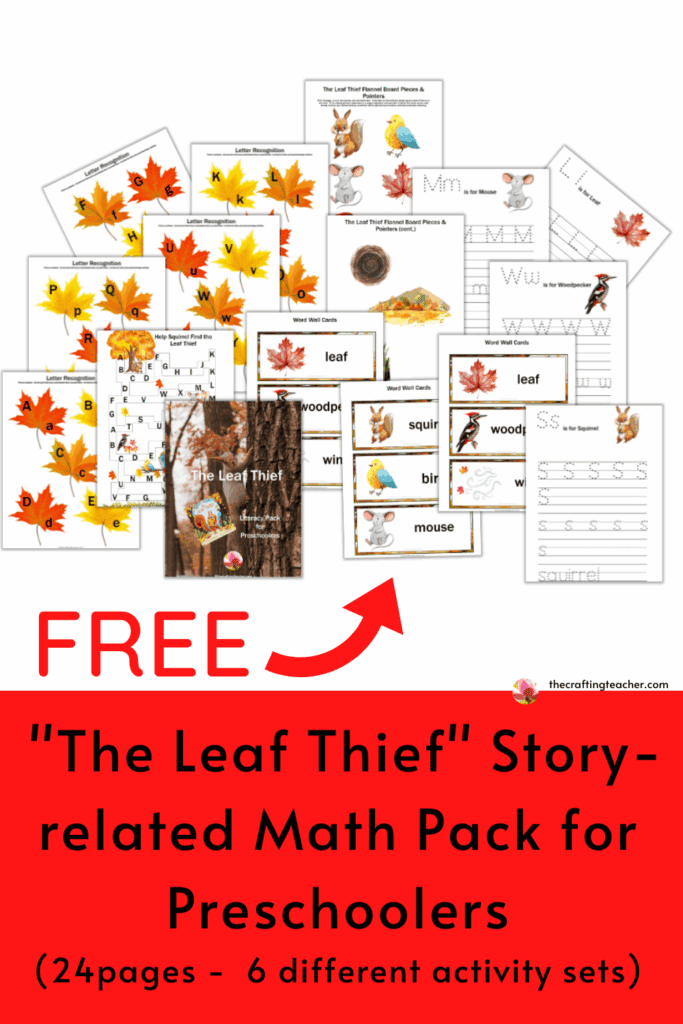
Don’t forget to download your FREE The Leaf Thief Literacy Pack. Click the link below and enter your email for an immediate download.
Be happy, safe, and creative. I wish you well.
Love,

P.S. Please let me know if these activities work for you. My goal is to help you however I can.
Other Posts You Might Like: